I haven't written a blog post on here in how long?! I got busy, and I decided that I was bored with critiquing all these studies, because really they're all the same crap. There's something wrong with all of them. They're either underpowered, or funded by special interest, or the researchers are unethical sacks of shit. You get the idea.
But I got with the 21st century and got a smart phone late last year. I made the mistake (only in that it takes up too much of my time) of following some very genius people on twitter like Woo, and it came to my attention that the ridiculous cult of personality that is people like Richard Nikoley and Carbsane and others have come into a veritable classical age. Why are these idiots even still around? Why have they not scurried off into the nether regions of the Interwebs? What's more, why do they care what I eat? Why do they care what you eat? No, I'm serious. You have to ask yourself why these people care so damn much whether you ate bacon for breakfast or potatoes. You can't tell me it's because they're altruistic or something. They're all really rude people with no manners and I find it hard to believe they are doing what they do out of the goodness of their hearts. So, why don't you do what makes you feel good, keeps your blood-work healthy, and keeps the weight off? If eating potatoes and bananas does that for ya, well, more power to you.
This is tangential though to what spurned this blog post. You see, in the West, formal religion has been on the decline for decades. A lot of people may identify as one religion or another, but many don't go to church or even socialize with others who share their beliefs. And that is why we have the rise of the 'gurus', people like Nikoley, and Carbsane, and the thirty-bananas-a-day guy (is he even still alive?). You're all looking for something that has meaning. Something to be a part of. You don't want to do the old school thing where you join a church. So you jump on, and sometimes fall off, bandwagons of cult personalities. This doesn't help you at all. All it helps are the ad revenues of people who really don't give a fig about your health, but were very happy that you brought traffic to their site and maybe even bought whatever they were hawking.
The 'gurus' have spawned something worse though than wasted time, wasted money, and perhaps inflicting ill health on people. They have spawned what I call the Food Inquisition. Excuse me, but when did it become okay to comment about what I eat? When did it become okay to comment on what is in my grocery basket? You see, when you think that the diet you are following is the One True Diet and all others are anathema, then the next logical step is we must squash the unbelievers! Burn the heretics! We can't allow them to eat bacon, don't they know it's going to kill them? We must get the government to intervene, make them tax everything that is bad for people, to protect them from themselves. Just like in the Medieval period, the Inquisition only functioned with the cooperation of the civil power.
Yes, it's that absurd. You see, evolutionarily speaking, we are really no different physiologically than our medieval ancestors, and I do think that some of you have taken a leaf out of their books. You need to stop it. Just stop it. Next time you feel compelled to comment about what someone is eating. Don't. If they want your opinion, they'll ask you. And chances are, they don't want your opinion.

Showing posts with label low carb. Show all posts
Showing posts with label low carb. Show all posts
Friday, May 6, 2016

Friday, January 20, 2012
You might think...
... that after a while, the chorus of inaccurate information would be drowned in the sea of evidence. MSNBC's Health Today posted an article four days ago (I've been busy) on Paula Deen's diabetes. They basically say the same old tired non-sense about how it has nothing to do with what you eat, that if you only maintain your weight and exercise more you won't get diabetes, unless of course you are predisposed to it because of genetics.
What’s important when it comes to diabetes prevention is not what you eat, but rather, how much, said Linda Siminerio, director of the Diabetes Institute at the University of Pittsburgh Medical Center.
“To my knowledge no particular food has been linked to an increase in the risk of diabetes,” Siminerio said. “It’s being overweight and inactive.”
Linda Siminerio ought to be ashamed of herself. How does one become director of a Diabetes Institute without having a grasp on biochemistry? What in the hell does she think makes people gain weight? What food could be cut out to make them lose weight effortlessly? I'll give you three guesses. Carbohydrates(!) make you gain weight (if you are insulin resistant). End of discussion.
Excessive carbohydrate intake (along with damage to your mitochondria, maybe from eating trans-fats or all the fake processed crap or something else unknown or all of the above) exacerbate insulin resistance, which in time leads to diabetes. See! I understand that and I'm a freakin' artist. I'm probably more qualified than she is to talk about what diabetics and those at risk of diabetes ought to eat. Why? Because I have a brain, some common sense, and can look at the data and draw a conclusion. Ms. Siminerio on the other hand is beholden to the "establishment". She can't say anything that hasn't already been dictated or she'd probably lose her cushy position as director of some Institute on Something.
Oh, but you say, "Some people eat carbohydrates and they don't get fat or get diabetes." And I say, that's fantastic for them. The bottom line is, if your metabolism is "broken" you can't eat carbohydrates. I know, it's very sad. I like brioche and donuts as much as the next person. But like recovering alcoholics liking their alcohol, I know that if I eat them, I will gain all the weight back.
Here's the deal. Doctors and these "experts" are just humans. Half of them probably aren't even as smart as the average person. In fact, I've come to the conclusion that none of them have even half the common sense of your average American. That's a sad state of affairs. I've seen day laborers with more sense than Ms. Siminerio and her "expert" friends. 
I'm rambling now, and I have a ton of other things to do than rage about the stupidity of people. How many more people have to DIE before these asshats stop spreading lies and misinformation? >_<
I'll leave you with something heartening, on the way home today, I saw a sign at a local Tex Mex place that said "Low Carb Plate $7.95" :)
Thursday, January 12, 2012
Low Carb Brownie Recipe
I made the chocolate covered peanuts recipe from the other day again today. It's a real winner, everyone in the house likes it, which means I keep running out. Anyway, after I made it, as I was licking the pan before washing it, I had an epiphany. I thought the chocolate part would make a good base for brownies. And boy was I right! Everyone loved these brownies:
Melt butter on very low heat. Add cocoa and stir until smooth. Remove from heat.
In mixing bowl, beat eggs until light. Add sugar and stir well.
Then add the above together (after the cocoa has cooled off a little).
Add vanilla and stir.
Add dry ingredients and mix thoroughly.
Bake on 350 degrees in a well greased 8x8x2 pan for thirty to thirty-five minutes.
Brownies (Low Carb, cake type)
1 stick butter (8 T.)
2 T. cocoa
2 eggs
3/4 c. splenda
1/4 c. erythritol (buy it here)
1 tsp vanilla
3/4 c. almond flour (buy it here or grind your own)
1/2 tsp baking powder
1/2 tsp salt
Melt butter on very low heat. Add cocoa and stir until smooth. Remove from heat.
In mixing bowl, beat eggs until light. Add sugar and stir well.
Then add the above together (after the cocoa has cooled off a little).
Add vanilla and stir.
Add dry ingredients and mix thoroughly.
Bake on 350 degrees in a well greased 8x8x2 pan for thirty to thirty-five minutes.
Friday, January 6, 2012
Recipe: Chocolate Peanut Butter Bark
I have come up with the perfect treat if you're eating low-carb. It tastes just like chocolate covered peanuts but in the form of something like toffee bark, in that it is poured into a pan.
I'm calling it:
Chocolate Peanut Butter Bark
Melt the butter on low heat in a sauce pan. Add cocoa and stir until smooth. Add the the peanut butter and stir again until smooth. Turn the heat off.
Add sweeteners and vanilla, and again, stir, but it won't be smooth. At this point, you'll want to add enough cream to make it smooth again. You may need to turn the heat back on at this point. If the mixture winds up a little thin, it's okay because it will harden in the fridge.
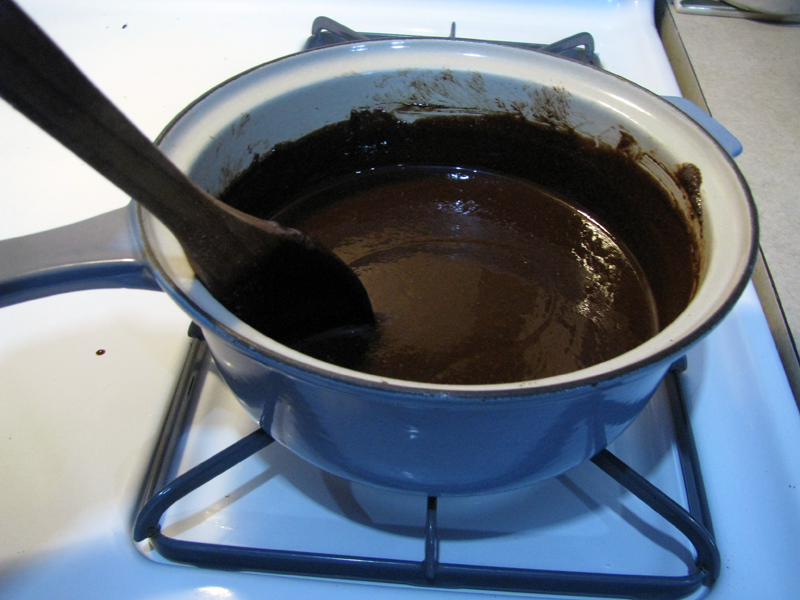
Add peanuts and stir until they are thoroughly covered. For the last batch I made I tried peanuts from a local place that still had the skin on them, and they came out just fine.
Pour the mixture into a quarter sheet pan that is covered with parchment paper. Spread the mixture over the pan.
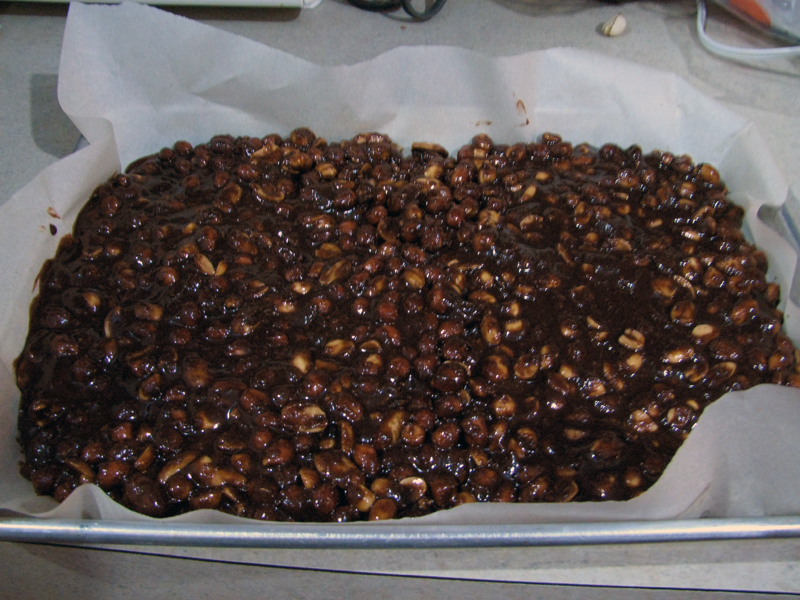
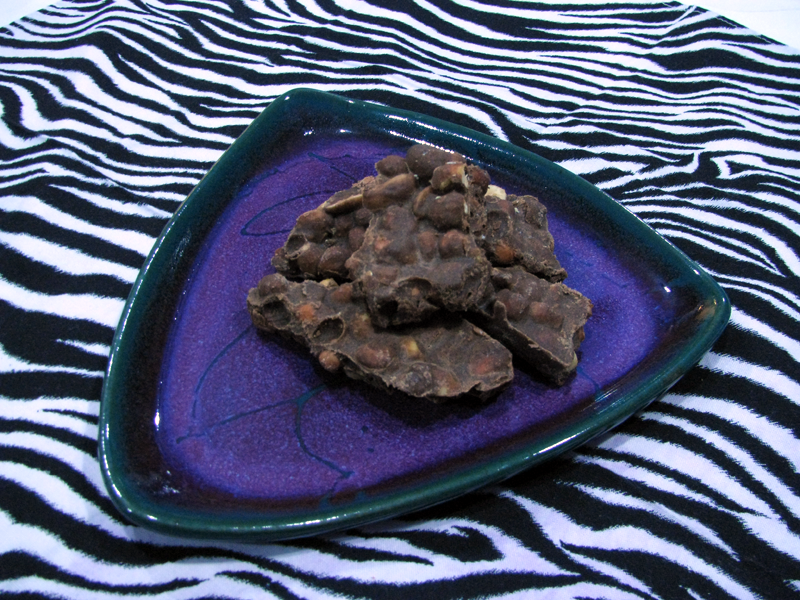
Refrigerate for a few hours until hardened. Once hardened you can break into chunks and put them in a container and freeze them. It's very good frozen! Actually it's just damned good :)
I'm calling it:
Chocolate Peanut Butter Bark
1 stick + 2 T. of butter (total of 10 T.)
6 T. cocoa
4 T. peanut butter
1 1/2 c. splenda
1/2 c. erythritol (buy it here)
2 packets stevia
1/2 tsp vanilla extract
heavy cream as needed (appx. 3-4 T.)
2-3 c. peanuts (depending on how much cream you add)
Melt the butter on low heat in a sauce pan. Add cocoa and stir until smooth. Add the the peanut butter and stir again until smooth. Turn the heat off.
Add sweeteners and vanilla, and again, stir, but it won't be smooth. At this point, you'll want to add enough cream to make it smooth again. You may need to turn the heat back on at this point. If the mixture winds up a little thin, it's okay because it will harden in the fridge.
Don't stop stirring while the heat is on
Add peanuts and stir until they are thoroughly covered. For the last batch I made I tried peanuts from a local place that still had the skin on them, and they came out just fine.
Pour the mixture into a quarter sheet pan that is covered with parchment paper. Spread the mixture over the pan.
Parchment paper is the best thing since sliced meat :P
Refrigerate for a few hours until hardened. Once hardened you can break into chunks and put them in a container and freeze them. It's very good frozen! Actually it's just damned good :)
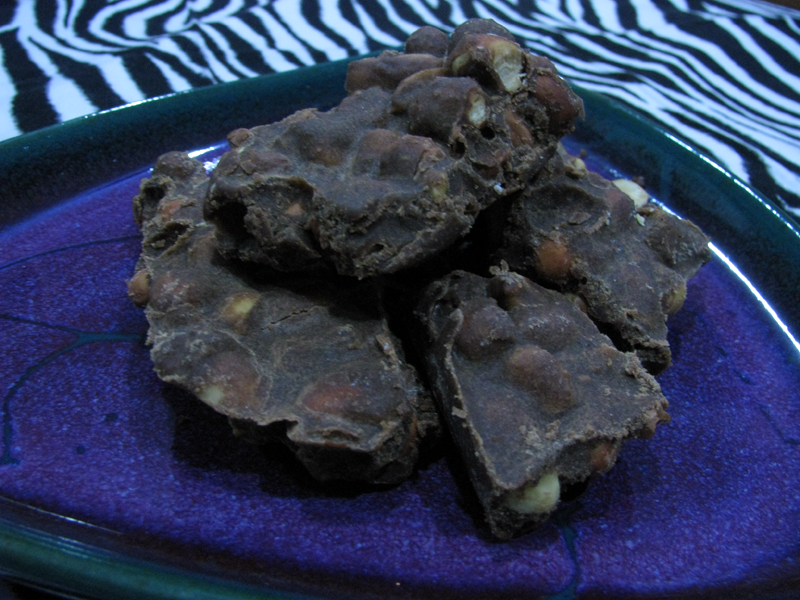
The final product, great for everyday snacks or a party
The entire recipe has the following nutritional content (according to the Nutrition Data website):
5645 calories (all that butter yum!)
505 g fat
139 g saturated fat
213 g carbs
64 g fiber
184 g protein
That's 149 grams of net carbs in the entire recipe. You can eat maybe three pieces before you've really had quite enough. There's probably about 5 grams of carbs per chunk, depending on the size of the chunk. And a whole lot of yummy fat to mediate those carbs.
The entire recipe has the following nutritional content (according to the Nutrition Data website):
5645 calories (all that butter yum!)
505 g fat
139 g saturated fat
213 g carbs
64 g fiber
184 g protein
That's 149 grams of net carbs in the entire recipe. You can eat maybe three pieces before you've really had quite enough. There's probably about 5 grams of carbs per chunk, depending on the size of the chunk. And a whole lot of yummy fat to mediate those carbs.
Wednesday, August 17, 2011
Texas Diabetes Council is Murdering Diabetics
The Texas Diabetes Council is trying to murder diabetics. I downloaded their food guide on a lark, and it basically mirrors the crappy food pyramid that the government advocates. They tell diabetics to eat six or MORE servings of bread per day. Hello? Bread is the same as sugar. But oh, sugar is okay for diabetics according to their food guide, but fat isn't.
Excuse me, but what the hell is wrong with these people? Why? I feel some days like I'm living in Orwell's 1984. Freedom is slavery, war is peace, sugar is good for diabetics.
They advocate a no to low fat diet. Since one can only eat so much protein, that means they advocate a high carbohydrate/sugar diet for diabetics. I'm sorry, Texas Diabetes Council, 1960 called. It wants it's diabetic diet back.
If you'd like to call them and ask why they're killing diabetics, their phone number is 1.888.963.7111 Ext 7490, or you can write them at PO Box 149347 MC 1965, Austin TX 78714-9347.
Or you can go in person:
THEY'RE KILLING PEOPLE WITH THEIR BAD, INACCURATE AND FRAUDULENT ADVICE, FUNDED BY OUR TAX DOLLARS. These "authorities" publish a message that is contrary to all of the scientific evidence, a message that makes people sicker so they have to rely on drugs, which ultimately makes them so sick they tax our healthcare system, which we ALL pay for. This nonsense, it makes me absolutely livid. How many more people have to DIE because of their bad advice?
Excuse me, but what the hell is wrong with these people? Why? I feel some days like I'm living in Orwell's 1984. Freedom is slavery, war is peace, sugar is good for diabetics.
They advocate a no to low fat diet. Since one can only eat so much protein, that means they advocate a high carbohydrate/sugar diet for diabetics. I'm sorry, Texas Diabetes Council, 1960 called. It wants it's diabetic diet back.
If you'd like to call them and ask why they're killing diabetics, their phone number is 1.888.963.7111 Ext 7490, or you can write them at PO Box 149347 MC 1965, Austin TX 78714-9347.
Or you can go in person:
Next Quarterly Texas Diabetes Council Meeting: October 27, 2011, 1:00 p.m., Texas Department of State Health Services, 1100 West 49th Street, Austin, TX 78756
THEY'RE KILLING PEOPLE WITH THEIR BAD, INACCURATE AND FRAUDULENT ADVICE, FUNDED BY OUR TAX DOLLARS. These "authorities" publish a message that is contrary to all of the scientific evidence, a message that makes people sicker so they have to rely on drugs, which ultimately makes them so sick they tax our healthcare system, which we ALL pay for. This nonsense, it makes me absolutely livid. How many more people have to DIE because of their bad advice?
Wednesday, March 23, 2011
Lard Mayonnaise
I had read somewhere online that you could make mayonnaise from lard. And indeed, you can. But, just because you can do something, doesn't mean you should. The thing is, it didn't taste too bad right when we made it, when it was warm. I thought it was a bit strong but okay. But then we refrigerated it, and used some of it later. It was disgusting, for lack of a better word. I'm not sure why, but I suspect it may be because when there's a lot of fat in a food, it's usually better heated up.
So, if you're thinking about trying it, I wouldn't.
So, if you're thinking about trying it, I wouldn't.
Tuesday, March 22, 2011
The Difference a Few Years Makes
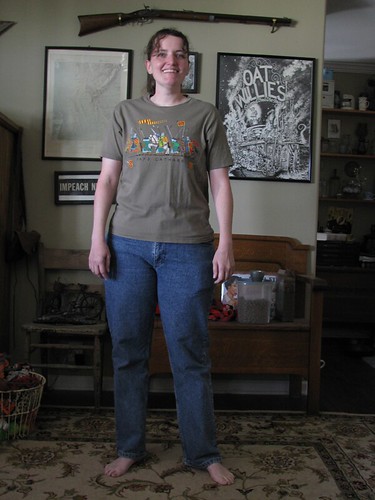
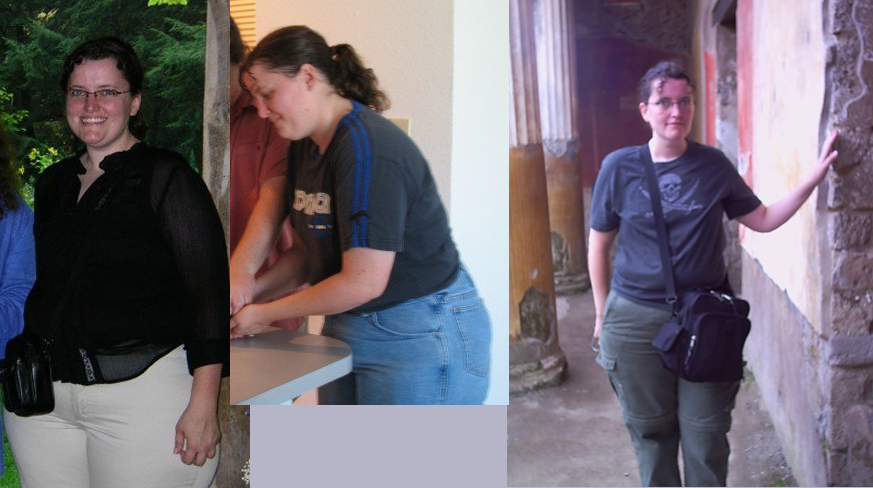
I got to looking at some pictures of myself from a few years ago, and I have to tell you, I see a huge difference. In fact, my own mother nearly didn't recognize me when I posted a picture on facebook a couple of months ago. That says something I think. I haven't seen my mom in four years because I live so far from her, and I've lost a lot of weight since then.

The picture on the left of me was taken at my brother-in-law's wedding in July 2006. I could barely squeeze into a size 42 in men's. I had gained weight like mad at school, and struggled to keep from gaining any more, much less lose any. The picture in the middle is me in October 2006. The picture on the right was taken at Pompei in May 2009. You can see at that point I had lost some weight but it was a struggle to keep it off. I gained back somewhere in the neighborhood of ten to fifteen pounds right after my trip.
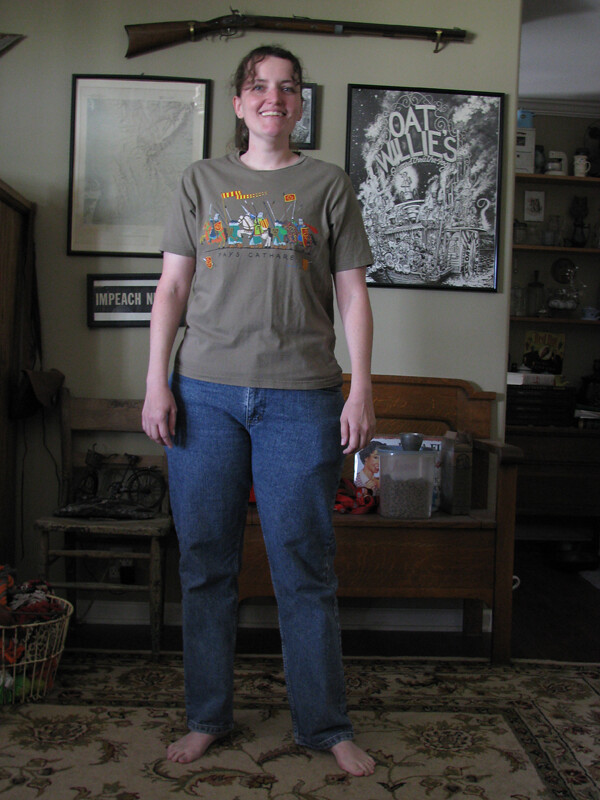
This is me today. I wear a 34 in men's.
And I don't have any pictures of me from when I was really heavy. That was before there were digital cameras. I think my mom may have some. I really tried to avoid ever having my picture taken then.
Hubby has lost a lot of weight too, but he forbids me to post any pictures of him LOL We've both lost all this weight, and haven't been hungry to do it. We've also been rather lazy and haven't even worked out. I do need to get motivated into a walking routine again. I think it would help me lose the rest of the weight I need to at a quicker pace, and maybe tone up the backside some ;)
Anyway, as they say, the proof is in the pudding, or in this case, in the pictures.
The picture on the left of me was taken at my brother-in-law's wedding in July 2006. I could barely squeeze into a size 42 in men's. I had gained weight like mad at school, and struggled to keep from gaining any more, much less lose any. The picture in the middle is me in October 2006. The picture on the right was taken at Pompei in May 2009. You can see at that point I had lost some weight but it was a struggle to keep it off. I gained back somewhere in the neighborhood of ten to fifteen pounds right after my trip.
This is me today. I wear a 34 in men's.
And I don't have any pictures of me from when I was really heavy. That was before there were digital cameras. I think my mom may have some. I really tried to avoid ever having my picture taken then.
Hubby has lost a lot of weight too, but he forbids me to post any pictures of him LOL We've both lost all this weight, and haven't been hungry to do it. We've also been rather lazy and haven't even worked out. I do need to get motivated into a walking routine again. I think it would help me lose the rest of the weight I need to at a quicker pace, and maybe tone up the backside some ;)
Anyway, as they say, the proof is in the pudding, or in this case, in the pictures.
Thursday, March 17, 2011
Low Carb should not be High Protein
Over at Primal Wisdom I read this post today. I have my own comments on the news article, which can be found here. I really wanted to read the original journal article, but it's new and the library doesn't have a subscription to the journal. Going off the abstract, it sounds first of all like a bullshit study.
Why? Well let's start with this. The assumption that a low carbohydrate diet is high in protein. It isn't. Or shouldn't be anyway. Unless you're a body builder. A low carbohydrate diet should be high in fat, not protein. The amount of protein they fed these 17 obese men is more than I consume on a typical day, some days by double. My protein intake is generally 70g to 130g. They fed these men 137-139g of protein.
My other main problem with this study, and why I think it's really irrelevant without even having to read it, is it's short duration and it's use of 17 men as subjects. Under powered and sexist to boot LOL
I think it's an obfuscation, what they're doing. They're attacking animal protein by attacking the low carbohydrate diet. In the case of the above study, I assume that they fed the people in the low carbohydrate group primarily animal protein. How else would you keep your carbohydrate count so low?
This whole attack on animal protein brings me back to something I was reading last night. They blame the protein in dairy for cancer. How did they come to that conclusion? By feeding people skim milk. The study I was looking at also lumped "all dairy" together and implied that "all dairy" had protein.
All dairy? Really. What about butter? Heavy cream? They have no protein. They have very little lactose, if any. You tell me how that's possible. I say it isn't. I say someone has an agenda and it's against animal products. Gee, I wonder who would have an agenda against animal products. I'll let you draw your own conclusions on that one.
Of course their insulin levels are higher in the skim milk group, the meat didn't have sugar (lactose) in it, and second of all, skim milk is not milk as you drink it from the cow. I mean, how stupid does one have to be? I went back and looked at the study that they're talking about, and talk about some confounding variables. The children were allowed to choose the diet they ate. Yes, you read that correctly. The children ate whatever they wanted, and simply were required to drink 1.5 liters of skim milk (12 of the boys) or eat 250g of low fat meat (the other 12). Consuming the milk apparently raised their IGF levels. But did it? Was it the milk? The protein in the milk? The lactose in the milk raising their insulin levels? The lack of fat in the milk so there was nothing to mediate their insulin levels? Some other dietary factor since there was no set diet? I mean, it could have been anything. I won't even get into the fact that it's under-powered and was only one week in duration.
Is drinking a large quantity of skim milk good for you? Hell no. I say you should never drink skim milk. If you want to consume milk, make sure it's whole, and better yet is straight from a dairy cow, not processed commercially.
In other words, is it really the protein alone, or is it more likely that it's the lactose? And when they say "milk" do they mean skim, whole, or what? Because each kind should in theory have a completely different effect on your insulin levels.
One place to look for good information on what ketogenic diets do is in the one place that they're standard and acceptable. And that is in the treatment of epileptic seizures. About half of people, children included, will have a positive response to a ketogenic diet in helping control their seizures. This study found that IGF-1 was greatly reduced in a ketogenic diet, to the point where it stunted the growth of the children.3 A ketogenic diet is extremely low carb, basically near zero carb and low protein too (it's a high fat diet), and these children undertook it because being short is preferable to having seizures.
In fact, a lot of the literature is rife with making low carb synonymous with high protein. Like this study where they fed mice more protein than fat (46% v. 35% respectively). That's a lot of protein. Not to mention it throws in a confounding variable, so that when they declare that low carb diets do not slow tumor growth, one has to wonder how they know this. If they had fed them a higher fat diet, they might have noticed some benefit, since we know that protein affects insulin production, and insulin levels are probably a driving force behind a lot of nasty things. In fact, in this study IGF-1 was higher in the low carb group than in the high carb group, and I'm sure that is due to the protein, since insulin drives IGF.
So the point of all this? When eating a low carb diet, it should be primarily animal fat (none of that synthetic vegetable crap), your protein should probably be 15-20% depending on your activity level, and your carb count should be as high as you can tolerate and still lose/maintain weight. And don't listen to stupid journalists, and be wary of researchers, because I don't think most of them know what they're talking about.
References:
1. Milk - The promoter of chronic Western diseases. Medical Hypotheses 2009; 72(6): 631-639
2. Role of insulin, insulin-like growth factor-1, hyperglycaemic food and milk consumption in the pathogenesis of acne vulgaris. Experimental Dermatology 2009; 18: 833–841.
3.Growth dependence on insulin-like growth factor-I during the ketogenic diet. Epilepsia 2009; 50(2): 297-303.
Why? Well let's start with this. The assumption that a low carbohydrate diet is high in protein. It isn't. Or shouldn't be anyway. Unless you're a body builder. A low carbohydrate diet should be high in fat, not protein. The amount of protein they fed these 17 obese men is more than I consume on a typical day, some days by double. My protein intake is generally 70g to 130g. They fed these men 137-139g of protein.
My other main problem with this study, and why I think it's really irrelevant without even having to read it, is it's short duration and it's use of 17 men as subjects. Under powered and sexist to boot LOL
I think it's an obfuscation, what they're doing. They're attacking animal protein by attacking the low carbohydrate diet. In the case of the above study, I assume that they fed the people in the low carbohydrate group primarily animal protein. How else would you keep your carbohydrate count so low?
This whole attack on animal protein brings me back to something I was reading last night. They blame the protein in dairy for cancer. How did they come to that conclusion? By feeding people skim milk. The study I was looking at also lumped "all dairy" together and implied that "all dairy" had protein.
"Except for cheese with an insulin score of 45, milk and all dairy products including yoghurt, ice cream, cottage cheese, and fermented milk products have potent insulinotropic properties."1 [emphasis mine]
All dairy? Really. What about butter? Heavy cream? They have no protein. They have very little lactose, if any. You tell me how that's possible. I say it isn't. I say someone has an agenda and it's against animal products. Gee, I wonder who would have an agenda against animal products. I'll let you draw your own conclusions on that one.
"In a one-week intervention study of 24 pre-pubertal eight-year-old boys the effect of daily intake of 53 g of either lean meat or skim milk (1.5 l per day) was studied with regard to insulin and IGF-1 responses. In the skim milk group insulin significantly increased by 105% (from 22 to 45 pmol/l) and IGF-1 significantly increased by 19% (from 209 to 249 ng/ml) [12]. There was no significant increase in either insulin or IGF-1 in the meat group."1 [emphasis mine]
Of course their insulin levels are higher in the skim milk group, the meat didn't have sugar (lactose) in it, and second of all, skim milk is not milk as you drink it from the cow. I mean, how stupid does one have to be? I went back and looked at the study that they're talking about, and talk about some confounding variables. The children were allowed to choose the diet they ate. Yes, you read that correctly. The children ate whatever they wanted, and simply were required to drink 1.5 liters of skim milk (12 of the boys) or eat 250g of low fat meat (the other 12). Consuming the milk apparently raised their IGF levels. But did it? Was it the milk? The protein in the milk? The lactose in the milk raising their insulin levels? The lack of fat in the milk so there was nothing to mediate their insulin levels? Some other dietary factor since there was no set diet? I mean, it could have been anything. I won't even get into the fact that it's under-powered and was only one week in duration.
Is drinking a large quantity of skim milk good for you? Hell no. I say you should never drink skim milk. If you want to consume milk, make sure it's whole, and better yet is straight from a dairy cow, not processed commercially.
"Milk consumption results in a significant increase in insulin and IGF-1 serum levels comparable with high glycaemic food. Insulin induces hepatic IGF-1 secretion, and both hormones amplify the stimulatory effect of GH on sebocytes and augment mitogenic downstream signalling pathways of insulin receptors, IGF-1 receptor and fibroblast growth factor receptor-2b."2
In other words, is it really the protein alone, or is it more likely that it's the lactose? And when they say "milk" do they mean skim, whole, or what? Because each kind should in theory have a completely different effect on your insulin levels.
One place to look for good information on what ketogenic diets do is in the one place that they're standard and acceptable. And that is in the treatment of epileptic seizures. About half of people, children included, will have a positive response to a ketogenic diet in helping control their seizures. This study found that IGF-1 was greatly reduced in a ketogenic diet, to the point where it stunted the growth of the children.3 A ketogenic diet is extremely low carb, basically near zero carb and low protein too (it's a high fat diet), and these children undertook it because being short is preferable to having seizures.
In fact, a lot of the literature is rife with making low carb synonymous with high protein. Like this study where they fed mice more protein than fat (46% v. 35% respectively). That's a lot of protein. Not to mention it throws in a confounding variable, so that when they declare that low carb diets do not slow tumor growth, one has to wonder how they know this. If they had fed them a higher fat diet, they might have noticed some benefit, since we know that protein affects insulin production, and insulin levels are probably a driving force behind a lot of nasty things. In fact, in this study IGF-1 was higher in the low carb group than in the high carb group, and I'm sure that is due to the protein, since insulin drives IGF.
So the point of all this? When eating a low carb diet, it should be primarily animal fat (none of that synthetic vegetable crap), your protein should probably be 15-20% depending on your activity level, and your carb count should be as high as you can tolerate and still lose/maintain weight. And don't listen to stupid journalists, and be wary of researchers, because I don't think most of them know what they're talking about.
References:
1. Milk - The promoter of chronic Western diseases. Medical Hypotheses 2009; 72(6): 631-639
2. Role of insulin, insulin-like growth factor-1, hyperglycaemic food and milk consumption in the pathogenesis of acne vulgaris. Experimental Dermatology 2009; 18: 833–841.
3.Growth dependence on insulin-like growth factor-I during the ketogenic diet. Epilepsia 2009; 50(2): 297-303.
Wednesday, March 16, 2011
Sometimes commercial is better?(!)
The mum-in-law found this recipe over at Linda's Low Carb a little while ago. It's for a quick peanut butter pudding. On that day, I had been wanting something with peanut butter, but didn't know what. We tried making it, and the first bowl didn't mix up at all. The second one did. We were using raw cream. I finally figured out that you couldn't put one bit more cream in than what the recipe called for. The bowl that didn't mix up, I had spilled a bit extra in. It also took five minutes of whisking to make. Needless to say, I didn't want to make any for anyone else.
This week we went to get more raw cream, and the dairy didn't have any. So sad, I know. We're hoping to get a special order in for next time. Anyway, we're not purists, so we went over to the store and bought some commercial cream. I like my cream, a lot LOL. So today when I made that recipe from Linda's Low Carb, you're not going to believe this, but it whipped up in thirty seconds, and was way thicker than the recipe made from the raw cream. I'm thinking it probably has something to do with the carrageenan that's in the commercial cream. The hubby was happy too because I offered to make him some! If you use raw cream and need to whip it for a recipe that requires it be very creamy, you might want to get some commercial cream instead. It was very interesting that for making recipes, the commercial cream might be better.
This week we went to get more raw cream, and the dairy didn't have any. So sad, I know. We're hoping to get a special order in for next time. Anyway, we're not purists, so we went over to the store and bought some commercial cream. I like my cream, a lot LOL. So today when I made that recipe from Linda's Low Carb, you're not going to believe this, but it whipped up in thirty seconds, and was way thicker than the recipe made from the raw cream. I'm thinking it probably has something to do with the carrageenan that's in the commercial cream. The hubby was happy too because I offered to make him some! If you use raw cream and need to whip it for a recipe that requires it be very creamy, you might want to get some commercial cream instead. It was very interesting that for making recipes, the commercial cream might be better.
Exercise away the plateau?
I have to admit it, I'm lazy as hell. I've never been all that keen on exercising, or when I was a kid, playing. Back then, I liked to stay inside and read instead.
One summer when I was in college, I did a summer program where I was acamp counselor glorified baby sitter for high school students. We were expected to stay in the dorm pretty much around the clock with the kids. The gym however, was an acceptable place to be if we weren't in the dorm. So I started going to the gym to get the hell away from the dorm and the kids. I exercised everyday almost for about two or three hours. I had never been to the gym so much in my life. Why did I do this? I'm sure you've heard of the 'freshman 15' where the new college student gains fifteen pounds from eating the crap that Sodexo (used to be called Sodexho), or some similar food service, serves. I had gained something like 90 pounds in the two years that I had been at school. I never thought I particularly stuffed my face. I simply ate until I wasn't hungry. Skinny people do that all the time and don't gain weight. Anyway, I was approaching 250 pounds, and this after I had been down to 163 pounds (after eating Atkins no less!), from a high of 270 pounds when I was in high school. Let's just say, I wasn't having any of it.
This is before I understood how low carb works, so in addition to going to the gym I cut back my food intake. I was hungry all summer, but I lost twenty-five pounds (which left me at about 225 pounds) and in the end found it easier to do the elliptical machine for nearly an hour. I also lifted weights too. The last time I went to the gym, which was just before school started for the fall, this skinny bitch approached me and told me that I ought not to lift weights until I had lost more weight. Really? People seem quite capable of poking into your personal business. I shut her up by telling her my doctor had told me to. Well, I didn't have a doctor, but most doctors would tell you that resistance training is beneficial, especially if you're overweight.
I stopped going to the gym because during my senior year, I barely had time to sleep, much less exercise. I did maintain my weight though, and I credit that to living in an apartment-style dorm and not eating at the cafeteria very often. I think Sodexo makes it a point to injectsugar, er, I mean High Fructose Corn Syrup, into all of their food. Typical fare was a burger with fries, or mystery meat with potatoes and some other vegetable. Don't get me wrong, if I had understood how low carb worked, I could have probably eaten there on it. I just didn't know at the time. Ignorance is not bliss.
When I graduated I stayed about 225 pounds for a while. Then I decided that I really wanted to lose some weight since I was going to Europe, so I started restricting calories and going to the gym again. I typically walked on the treadmill for an hour with it set to being inclined. I did lose another twenty pounds. After my trip, all the weight came right back the second I started eating until I was content. That's a great thing about low-carb. You can eat until you're not hungry, and you don't gain weight. The same could never be said when I wasn't doing low-carb.
Anyway, I was back at 220 pounds when I started this low carb journey back in May of last year. I'm currently at about 180 lbs, which I haven't weighed since before I went to college.
So what's the point of my story? About exercise. When I used to walk a lot, especially before my trip to Europe in 2009, I would be so sore. All the time. My legs used to feel like they were on fire the next day, especially if I skived off of walking for a few weeks and then started doing it again. (Maybe the pain is what made me not ever have the inclination to be a gym rat.) The first day after walking a few miles was always hell. And it often didn't get much better. I would think, 'I have been walking five miles every other day, shouldn't it get easier?'
Well, I've been stuck at 180 pounds for about a month now, and it's kinda annoying. I am 5'9" tall, and I think I probably ought to weigh 160 or maybe a little less. My BMI is currently 26.6, which is slightly overweight. I might ought to weigh 150, I'm not sure. I'd have to see when I get to 160. Anyway, I decided that I could do one of three things to break this plateau. I could try exercising, which I haven't done, because as I said at the beginning of this, I'm lazy as hell, not to mention I'm not masochistic. I don't like pain. The second thing I could do is cut out the diet coke and splenda sweetened kool-aid I drink, since artificial sweeteners could be a problem because they do raise insulin levels (I hate plain water, and I have cut back on the diet coke, you don't even want to know how much I used to drink). Or I could cut out the bit of dairy I eat (mostly cream or half and half) since I have read of other people who said dairy caused them to plateau. I decided I wanted to try exercising first. Walking is probably good for us, and I want to go backpacking in Europe again someday, so if I keep up being able to walk long distances, that would be a good thing.
I walked two miles yesterday. This after not walking, much less exercising, in months. I'm not sore today. I suspect it's the low carb diet, which reduces inflammation. (Inflammation causes pain, particularly in the joints). It's pretty amazing actually. I'm hoping this breaks the plateau. I'll let you know.
One summer when I was in college, I did a summer program where I was a
This is before I understood how low carb works, so in addition to going to the gym I cut back my food intake. I was hungry all summer, but I lost twenty-five pounds (which left me at about 225 pounds) and in the end found it easier to do the elliptical machine for nearly an hour. I also lifted weights too. The last time I went to the gym, which was just before school started for the fall, this skinny bitch approached me and told me that I ought not to lift weights until I had lost more weight. Really? People seem quite capable of poking into your personal business. I shut her up by telling her my doctor had told me to. Well, I didn't have a doctor, but most doctors would tell you that resistance training is beneficial, especially if you're overweight.
I stopped going to the gym because during my senior year, I barely had time to sleep, much less exercise. I did maintain my weight though, and I credit that to living in an apartment-style dorm and not eating at the cafeteria very often. I think Sodexo makes it a point to inject
When I graduated I stayed about 225 pounds for a while. Then I decided that I really wanted to lose some weight since I was going to Europe, so I started restricting calories and going to the gym again. I typically walked on the treadmill for an hour with it set to being inclined. I did lose another twenty pounds. After my trip, all the weight came right back the second I started eating until I was content. That's a great thing about low-carb. You can eat until you're not hungry, and you don't gain weight. The same could never be said when I wasn't doing low-carb.
Anyway, I was back at 220 pounds when I started this low carb journey back in May of last year. I'm currently at about 180 lbs, which I haven't weighed since before I went to college.
So what's the point of my story? About exercise. When I used to walk a lot, especially before my trip to Europe in 2009, I would be so sore. All the time. My legs used to feel like they were on fire the next day, especially if I skived off of walking for a few weeks and then started doing it again. (Maybe the pain is what made me not ever have the inclination to be a gym rat.) The first day after walking a few miles was always hell. And it often didn't get much better. I would think, 'I have been walking five miles every other day, shouldn't it get easier?'
Well, I've been stuck at 180 pounds for about a month now, and it's kinda annoying. I am 5'9" tall, and I think I probably ought to weigh 160 or maybe a little less. My BMI is currently 26.6, which is slightly overweight. I might ought to weigh 150, I'm not sure. I'd have to see when I get to 160. Anyway, I decided that I could do one of three things to break this plateau. I could try exercising, which I haven't done, because as I said at the beginning of this, I'm lazy as hell, not to mention I'm not masochistic. I don't like pain. The second thing I could do is cut out the diet coke and splenda sweetened kool-aid I drink, since artificial sweeteners could be a problem because they do raise insulin levels (I hate plain water, and I have cut back on the diet coke, you don't even want to know how much I used to drink). Or I could cut out the bit of dairy I eat (mostly cream or half and half) since I have read of other people who said dairy caused them to plateau. I decided I wanted to try exercising first. Walking is probably good for us, and I want to go backpacking in Europe again someday, so if I keep up being able to walk long distances, that would be a good thing.
I walked two miles yesterday. This after not walking, much less exercising, in months. I'm not sore today. I suspect it's the low carb diet, which reduces inflammation. (Inflammation causes pain, particularly in the joints). It's pretty amazing actually. I'm hoping this breaks the plateau. I'll let you know.
Tuesday, March 15, 2011
Lindt changes ingredients in it's chocolate
It pisses me off that Lindt has changed their 85% dark chocolate. They have doubled the carb count and the sugar. I had been buying it because four squares only had eight grams of carbs and three grams of sugar. Now it has fifteen grams of carbs and five grams of sugar. I suppose it's not a whole lot of difference, especially if you only eat one square here and there as I do, but I don't understand WHY they had to change it. It was good the way it was. I like bitter chocolate.
A lot of people are mad that they changed their 70% chocolate to have soy lecithin in it. I suppose they've done this to make it more like American chocolate. To which I think, why would people buy European chocolate to have it be more like American chocolate? If you want American chocolate, there's already Hershey's.
I probably won't be buying any more of it. I'll find something else. Probably something made in Europe and not here.
A lot of people are mad that they changed their 70% chocolate to have soy lecithin in it. I suppose they've done this to make it more like American chocolate. To which I think, why would people buy European chocolate to have it be more like American chocolate? If you want American chocolate, there's already Hershey's.
I probably won't be buying any more of it. I'll find something else. Probably something made in Europe and not here.
Monday, March 14, 2011
Low Carb Diet Side Effects: How to deal with them
Salt and fat are very important on a low carb diet.
If you've being doing low carb for a while, you may have heard of people saying that they had a "bad reaction", or suffered "side effects" on the diet. One of the most obnoxious side effects constantly stated is that you'll get bad breath. The press likes this one, as if bad breath was the worst thing that you could have happen to you. Personally, I never had a problem with this, nor did any of my family members who went low carb. Maybe we were just lucky? Anyway, the side effects people encounter are probably from them either not getting enough fat, from not getting enough salt, or from going on and off the diet regularly (see my post about how your body makes enzymes and hormones based on what you've eaten recently). Or maybe a combination of all of that. So, what to do about these unpleasant "side effects"?
First and foremost, throw your fear of fat out the window. You don't want a lot of protein. You want fat, mostly saturated animal fat. It's best to avoid synthetic, man-made vegetable fat. Eating a low-carb, low-fat, high protein diet will make you sick. They call it "rabbit starvation" because rabbits are such lean meat, you'll die if that's all you have to eat.
Some things that can happen while on a low carb diet are tachycardia (racing heart). What can cause this? Low blood pressure. Eating a low carb diet lowers your blood pressure, and if you have low blood pressure already, you know that you sometimes get a fast heart beat. The mum-in-law has low blood pressure, and she sometimes gets a racing heart. She says that it's because your heart needs to get that blood pumped around your body somehow, even if it has to beat faster to do it. It's usually nothing to worry about, although I would suggest seeing a doctor just to be sure.** Something that may help this, is to increase your salt intake. Salt intake does raise your blood pressure slightly (between 1 and 6 mg/Hg) and it may be enough to avoid the side effect of low blood pressure. In fact, increasing your salt intake on the low carb diet, especially in the beginning, can prevent you from losing too much salt from losing too much water. You retain water when you eat carbohydrates (chemically speaking, water is required for their metabolism, and they're made of water, hence the 'hydrate' part). That leads to the point that if you eat a high carbohydrate meal once or twice a week, you will gain water weight, sometimes crazily so. This is not because you've eaten too much per se, it's because you're retaining water. It can take a week or two of eating low carb again to lose the water weight.
Another cause of low blood pressure may be if you're on medication for your high blood pressure, and you go on a low carb diet, well, you may need to have your doctor adjust your blood pressure medicine down to compensate.
I personally (and I know this is anecdotal) do so much better on a low carb diet when it comes to my heart. I have a hard time getting enough potassium when I eat the standard American diet, and I once wound up in the emergency room with sinus arrhythmia, my heart was stopping momentarily, literally skipping beats. Needless to say, it scared the hell out of me. The doctors told me that my potassium was low. I don't get sinus arrhythmia on the low carb diet. Probably because red meat is a great source of potassium. I also noticed that my heart doesn't beat as "hard" as it used to when I would lay down to go to sleep. I used to be able to feel it beating loudly, and it doesn't make so much noise any more. My pulse is normal, it just seems like it's working more efficiently or something. And again, this is all anecdotal, so take it with a grain of salt (pun intended).
**Please note, that if you are having problems, especially to do with your heart, see a doctor. Have blood tests, get hooked up to an EKG and make sure you don't have an underlying medical condition.
If you've being doing low carb for a while, you may have heard of people saying that they had a "bad reaction", or suffered "side effects" on the diet. One of the most obnoxious side effects constantly stated is that you'll get bad breath. The press likes this one, as if bad breath was the worst thing that you could have happen to you. Personally, I never had a problem with this, nor did any of my family members who went low carb. Maybe we were just lucky? Anyway, the side effects people encounter are probably from them either not getting enough fat, from not getting enough salt, or from going on and off the diet regularly (see my post about how your body makes enzymes and hormones based on what you've eaten recently). Or maybe a combination of all of that. So, what to do about these unpleasant "side effects"?
First and foremost, throw your fear of fat out the window. You don't want a lot of protein. You want fat, mostly saturated animal fat. It's best to avoid synthetic, man-made vegetable fat. Eating a low-carb, low-fat, high protein diet will make you sick. They call it "rabbit starvation" because rabbits are such lean meat, you'll die if that's all you have to eat.
Some things that can happen while on a low carb diet are tachycardia (racing heart). What can cause this? Low blood pressure. Eating a low carb diet lowers your blood pressure, and if you have low blood pressure already, you know that you sometimes get a fast heart beat. The mum-in-law has low blood pressure, and she sometimes gets a racing heart. She says that it's because your heart needs to get that blood pumped around your body somehow, even if it has to beat faster to do it. It's usually nothing to worry about, although I would suggest seeing a doctor just to be sure.** Something that may help this, is to increase your salt intake. Salt intake does raise your blood pressure slightly (between 1 and 6 mg/Hg) and it may be enough to avoid the side effect of low blood pressure. In fact, increasing your salt intake on the low carb diet, especially in the beginning, can prevent you from losing too much salt from losing too much water. You retain water when you eat carbohydrates (chemically speaking, water is required for their metabolism, and they're made of water, hence the 'hydrate' part). That leads to the point that if you eat a high carbohydrate meal once or twice a week, you will gain water weight, sometimes crazily so. This is not because you've eaten too much per se, it's because you're retaining water. It can take a week or two of eating low carb again to lose the water weight.
Another cause of low blood pressure may be if you're on medication for your high blood pressure, and you go on a low carb diet, well, you may need to have your doctor adjust your blood pressure medicine down to compensate.
I personally (and I know this is anecdotal) do so much better on a low carb diet when it comes to my heart. I have a hard time getting enough potassium when I eat the standard American diet, and I once wound up in the emergency room with sinus arrhythmia, my heart was stopping momentarily, literally skipping beats. Needless to say, it scared the hell out of me. The doctors told me that my potassium was low. I don't get sinus arrhythmia on the low carb diet. Probably because red meat is a great source of potassium. I also noticed that my heart doesn't beat as "hard" as it used to when I would lay down to go to sleep. I used to be able to feel it beating loudly, and it doesn't make so much noise any more. My pulse is normal, it just seems like it's working more efficiently or something. And again, this is all anecdotal, so take it with a grain of salt (pun intended).
**Please note, that if you are having problems, especially to do with your heart, see a doctor. Have blood tests, get hooked up to an EKG and make sure you don't have an underlying medical condition.
Saturday, March 12, 2011
The Usual Fare: How your body adapts to what you're eating
After reading some of the comments on the news articles I read for what I wrote last night, about how McDonald's made the commenters sick, I got to thinking about it and the mum-in-law pointed out that most of them probably are vegetarian and perhaps ate it in a pinch, and then did get sick because their bodies did not have enough of the enzyme to digest the meat. It had nothing to do with the fact that it was McDonald's. If they'd eaten at Austin Land and Cattle, they'd have had the same response, and I don't think a $42 steak should make you sick. Unless your body just isn't used to eating meat.
Your body responds to what you usually eat by making enzymes (like protease) and hormones (like insulin) to deal with your daily food intake. This goes for all food components, fat, carbohydrates and protein. I personally don't eat very many carbs, usually. I still need to lose about twenty pounds, so I'm going to keep on the very low carb band wagon until I lose all the weight. Now, yesterday, if you read my post about what we ate for lunch, you'll know that we all felt like crap afterwards. This is because your insulin production is based on what you ate for the last meal and maybe overall on what you ate in the last day or two. If you do very low carb and want to eat sugar again, just like with a vegetarian who hasn't eaten meat in a while, you have to go gradually off of it. If you are vegetarian and decide that you're going to eat meat again, and you eat a double Whopper, you're probably going to be sick. And it isn't because of the food itself. The same happens if you're a low carber. Say for instance, you go to France on holiday and you eat half a dozen pain au chocolat, you're going to be sick. I suggest ramping up for that LOL
According to Lippincott's Illustrated biochemistry text, the things that stimulate insulin synthesis (production) are glucose, amino acids, and gastrointestinal hormones, and it says that "the synthesis and release of insulin are decreased when there is a scarcity of dietary fuels [i.e. carbohydrates]..." p.310
In other words, if you don't eat carbohydrates, your body isn't making very much insulin. Why would it? That would be inefficient. Luckily the body is highly adaptable, and in the case of former vegetarians will go back to making the enzymes for digesting meat in a couple of days. Same for the low carb folks. Fall off the wagon, and your body will start making insulin again. If we weren't so adaptable, you wouldn't be sitting here reading this because your ancestors wouldn't have lived.
~~~~~~~~~~~~~~~~~~~~~~~~~~~~~~~~~~~~~~~
And a little tangential thing I read today while I was researching the above, for your amusement. It's about the stupidest thing I've ever read actually. From a study,
Now you tell me how a diet is simultaneously healthy and yet long-term adherence causes deficiencies. And not only that, in the results of this paper, they even say that plant protein is not as digestible as animal protein. The prior is codswallop if I ever read it and the latter should really have some vegans and vegetarians raising an eyebrow about what they've been fed (hint: lies). Someone has an agenda, and it ain't in the interest of your health. If I eat meat only, as Stefansson (and the Inuit) did, no supplements are required. Chew on that.
Your body responds to what you usually eat by making enzymes (like protease) and hormones (like insulin) to deal with your daily food intake. This goes for all food components, fat, carbohydrates and protein. I personally don't eat very many carbs, usually. I still need to lose about twenty pounds, so I'm going to keep on the very low carb band wagon until I lose all the weight. Now, yesterday, if you read my post about what we ate for lunch, you'll know that we all felt like crap afterwards. This is because your insulin production is based on what you ate for the last meal and maybe overall on what you ate in the last day or two. If you do very low carb and want to eat sugar again, just like with a vegetarian who hasn't eaten meat in a while, you have to go gradually off of it. If you are vegetarian and decide that you're going to eat meat again, and you eat a double Whopper, you're probably going to be sick. And it isn't because of the food itself. The same happens if you're a low carber. Say for instance, you go to France on holiday and you eat half a dozen pain au chocolat, you're going to be sick. I suggest ramping up for that LOL
According to Lippincott's Illustrated biochemistry text, the things that stimulate insulin synthesis (production) are glucose, amino acids, and gastrointestinal hormones, and it says that "the synthesis and release of insulin are decreased when there is a scarcity of dietary fuels [i.e. carbohydrates]..." p.310
In other words, if you don't eat carbohydrates, your body isn't making very much insulin. Why would it? That would be inefficient. Luckily the body is highly adaptable, and in the case of former vegetarians will go back to making the enzymes for digesting meat in a couple of days. Same for the low carb folks. Fall off the wagon, and your body will start making insulin again. If we weren't so adaptable, you wouldn't be sitting here reading this because your ancestors wouldn't have lived.
~~~~~~~~~~~~~~~~~~~~~~~~~~~~~~~~~~~~~~~
And a little tangential thing I read today while I was researching the above, for your amusement. It's about the stupidest thing I've ever read actually. From a study,
Protein dietary reference intakes may be inadequate for vegetarians if low amounts of animal protein are consumed:
"The health benefits of vegetarian diets are well-recognized; however, long-term adherence to these diets may be associated with nutrient inadequacies, particularly vitamins B12 and D, calcium, irno, zinc and protein...
Results and Discussion...
Furthermore, two food groups (nuts/seeds and fruits/vegetables) contributed to nearly 20% of dietary protein, sources not recognized by the DRI report. These are important distinctions because protein from cereals and vegetables (particularly if these foods are less refined) has poor digestibility. Traditional vegetarian diets (e.g., Indian and Guatemalan vegetarian diets) with low amounts of animal proteins and large proportions of cereal and vegetable protein have protein digestibility scores averaging 70% (range 54–77%) compared with plant-based diets with a large proportion of animal protein (mean 88%, range 78–93%)..."
Now you tell me how a diet is simultaneously healthy and yet long-term adherence causes deficiencies. And not only that, in the results of this paper, they even say that plant protein is not as digestible as animal protein. The prior is codswallop if I ever read it and the latter should really have some vegans and vegetarians raising an eyebrow about what they've been fed (hint: lies). Someone has an agenda, and it ain't in the interest of your health. If I eat meat only, as Stefansson (and the Inuit) did, no supplements are required. Chew on that.
Friday, March 11, 2011
The Cholesterol Lie: They'll never let it go
If you've read anything by Uffe Ravnskov, you'll know that cholesterol does not cause heart disease. So, when I read this article this evening, I thought, they'll never let it go will they?
So, basically they do mention that diabetes is a risk factor for heart disease. What causes diabetes? Elevated blood sugar over a prolonged period of time that causes insulin resistance. What causes elevated blood sugar? Eating carbohydrates. Bleeding simple, and yet they're like Don Quixote, tilting at windmills. Forget testing for cholesterol. It's irrelevant! Test for blood glucose levels instead. That would give a better idea of whether someone is healthy or not.
If you are overweight, then you probably have elevated blood sugar and/or are insulin resistant. In fact, I'm not sure that it's possible to be overweight and NOT be insulin resistant. Hence why being obese is associated with cardiovascular disease, because every time your blood sugar is elevated, you are damaging your internal organs. Yes, you read that right. Every time you drink a Coca-Cola, every time you eat a piece of chocolate cake, you are DAMAGING YOUR INTERNAL ORGANS. In fact, even if you are not overweight and even if your insulin works well and it brings your blood sugar down quickly, it is probably never quick enough to completely avoid the damage that is done. Add this up over days and years, and you have cardiovascular disease. Not to mention all the other disease of civilization, like cancer. If you damage your cells repeatedly, they repair or regenerate themselves. If your cells are required to do this frequently, the cells regenerate quickly, leading to high cell turnover, leading eventually to a cell that doesn't regenerate in the right way, which leads to cancer.
The good thing is, your cells will repair themselves if given a chance. The bad news? You can never go back to eating the way you did if you want to remain healthy. You have to ask yourself what is more important. The slice of chocolate cake or your health? Death is inevitable. Health is your choice.
Fat Alone, Not Where It Sits, May Be Key to Heart Problems
"That challenges the widely adopted notion that not all obesity is alike, with so-called apple-shaped people, who carry fat mainly in their midsections, facing a bigger risk for heart problems than those whose excess fat is carried on the hips or elsewhere.
Not so, say the researchers behind the new study. When it comes to obesity and heart disease, no excess fat is good fat, regardless of where it ends up, their analysis has found.
"Society has accepted the idea that if you carry more weight around the middle, your risk of heart disease is higher," said Dr. Emanuele Di Angelantonio, the study's co-author and a lecturer in medical screening at the University of Cambridge in England. "But actually this study shows that it doesn't matter where your fat is located. If you're overweight you're at risk, full stop."...
They also found that tracking a person's blood pressure and cholesterol levels, as well as monitoring their history of diabetes, appeared to be best way to assess heart disease risk. When such indicators were readily available, they noted, adding in BMI and waist measurement information did not improve risk diagnosis..."
So, basically they do mention that diabetes is a risk factor for heart disease. What causes diabetes? Elevated blood sugar over a prolonged period of time that causes insulin resistance. What causes elevated blood sugar? Eating carbohydrates. Bleeding simple, and yet they're like Don Quixote, tilting at windmills. Forget testing for cholesterol. It's irrelevant! Test for blood glucose levels instead. That would give a better idea of whether someone is healthy or not.
If you are overweight, then you probably have elevated blood sugar and/or are insulin resistant. In fact, I'm not sure that it's possible to be overweight and NOT be insulin resistant. Hence why being obese is associated with cardiovascular disease, because every time your blood sugar is elevated, you are damaging your internal organs. Yes, you read that right. Every time you drink a Coca-Cola, every time you eat a piece of chocolate cake, you are DAMAGING YOUR INTERNAL ORGANS. In fact, even if you are not overweight and even if your insulin works well and it brings your blood sugar down quickly, it is probably never quick enough to completely avoid the damage that is done. Add this up over days and years, and you have cardiovascular disease. Not to mention all the other disease of civilization, like cancer. If you damage your cells repeatedly, they repair or regenerate themselves. If your cells are required to do this frequently, the cells regenerate quickly, leading to high cell turnover, leading eventually to a cell that doesn't regenerate in the right way, which leads to cancer.
The good thing is, your cells will repair themselves if given a chance. The bad news? You can never go back to eating the way you did if you want to remain healthy. You have to ask yourself what is more important. The slice of chocolate cake or your health? Death is inevitable. Health is your choice.
Tuesday, March 8, 2011
Eat Meat to Cut Stroke, Heart Disease Risk
Well, that wasn't the headline, but it should have been. An article I read today said that foods rich in potassium may cut the risk of heart disease and stroke. For those of you who don't know, potassium is what carries the electrical signals from your brain to your heart. I know this because low potassium, and because of that, sinus arrhythmia, run in my family.
When I ate the standard American diet, I used to get irregular heartbeat all the time. It's very upsetting, and once I wound up in the emergency room because I thought something was seriously wrong with my heart. They had me hooked up to an EKG and took blood and informed me that my potassium was low. The doctor told me to eat a banana.
Well, that's BS really. Bananas don't have much potassium in them. Potatoes have more, but they're not good for you either.
You know what has a lot of potassium in it? Meat. An 8oz steak has 850mg of potassium or about 25% of your recommended daily intake. Since eating low carb and trying to keep my food paleo friendly, I haven't had any problems with my potassium level, no sinus arrhythmia. Another thing that might help besides an increased intake in potassium, is that without elevated glucose and therefore elevated insulin levels my body may use the potassium more efficiently. I read somewhere that insulin interferes with the uptake of Vitamin C, and that raised glucose levels do as well (though which it is, is difficult to untangle since increased glucose leads to increased insulin). It stands to reason that glucose/insulin may interfere with other biological function too.
Of course, the press can't tell you to eat more meat, because that flies in the face of what they're advocating, which is a vegetarian (or better yet vegan) diet devoid of essential fatty and amino acids. Why are they advocating it? One could speculate, but what difference would it make?
When I ate the standard American diet, I used to get irregular heartbeat all the time. It's very upsetting, and once I wound up in the emergency room because I thought something was seriously wrong with my heart. They had me hooked up to an EKG and took blood and informed me that my potassium was low. The doctor told me to eat a banana.
Well, that's BS really. Bananas don't have much potassium in them. Potatoes have more, but they're not good for you either.
You know what has a lot of potassium in it? Meat. An 8oz steak has 850mg of potassium or about 25% of your recommended daily intake. Since eating low carb and trying to keep my food paleo friendly, I haven't had any problems with my potassium level, no sinus arrhythmia. Another thing that might help besides an increased intake in potassium, is that without elevated glucose and therefore elevated insulin levels my body may use the potassium more efficiently. I read somewhere that insulin interferes with the uptake of Vitamin C, and that raised glucose levels do as well (though which it is, is difficult to untangle since increased glucose leads to increased insulin). It stands to reason that glucose/insulin may interfere with other biological function too.
Of course, the press can't tell you to eat more meat, because that flies in the face of what they're advocating, which is a vegetarian (or better yet vegan) diet devoid of essential fatty and amino acids. Why are they advocating it? One could speculate, but what difference would it make?
Wednesday, February 16, 2011
Oh noes! Trans fats might make you depressed...
o_O
Articles are popping up today about how trans fats cause depression. Now, I'm not saying artificial trans fats are good, quite the opposite. It seems they cause damage on a cellular level as well. But you know what else isn't good? The quality of research that has been put into some of these articles. Like this one:
Where do these people get off? I'd really like to know. I'd like to know how you can have a survey of people and act like it's a clinical trial. I'd like to know how you can have confounding variables out the wazzoo and act like you've controlled for a single variable. I'd also like to know why these people don't understand that CORRELATION IS NOT CAUSATION. It's so simple, and yet soooooo beyond the grasp of your basic nutrition "expert" or "journalist".
I don't need to point out that industrial cakes, biscuits and fast food are very high in carbohydrates. But did they decide that carbohydrates cause depression? No. Of course not.
But the thing that is really wrong with this article, and why I decided to write about it, is that it equates naturally occurring trans fats with the industrially manufactured ones. There are trans fats in nature, but they are not the same in chemical structure as the commercially developed ones. The most common one, Conjugated Linoleic Acid does indeed occur in dairy, eggs and meat. (Of course, those are all bad for you! Run away!) What's ironic, is CLA is known to be an anti-carcinogen. Yeah, how does that grab ya? Certain forms of CLA also reduce inflammation and thereby prevent cardiovascular disease. What was that about not eating eggs, whole milk and meat?
And even Time jumped on the band wagon, and failed to do any research on the difference between artificial and naturally occurring trans fatty acids:
Articles are popping up today about how trans fats cause depression. Now, I'm not saying artificial trans fats are good, quite the opposite. It seems they cause damage on a cellular level as well. But you know what else isn't good? The quality of research that has been put into some of these articles. Like this one:
"Of all these, the participants with a high level of consumption of trans-fats, artificially present in industrial cakes and biscuits and in fast food, and naturally in certain full-fat milk products, "showed an increase in risk of depression of up to 48% compared to those participants who did not consume these,"..."
Where do these people get off? I'd really like to know. I'd like to know how you can have a survey of people and act like it's a clinical trial. I'd like to know how you can have confounding variables out the wazzoo and act like you've controlled for a single variable. I'd also like to know why these people don't understand that CORRELATION IS NOT CAUSATION. It's so simple, and yet soooooo beyond the grasp of your basic nutrition "expert" or "journalist".
I don't need to point out that industrial cakes, biscuits and fast food are very high in carbohydrates. But did they decide that carbohydrates cause depression? No. Of course not.
But the thing that is really wrong with this article, and why I decided to write about it, is that it equates naturally occurring trans fats with the industrially manufactured ones. There are trans fats in nature, but they are not the same in chemical structure as the commercially developed ones. The most common one, Conjugated Linoleic Acid does indeed occur in dairy, eggs and meat. (Of course, those are all bad for you! Run away!) What's ironic, is CLA is known to be an anti-carcinogen. Yeah, how does that grab ya? Certain forms of CLA also reduce inflammation and thereby prevent cardiovascular disease. What was that about not eating eggs, whole milk and meat?
And even Time jumped on the band wagon, and failed to do any research on the difference between artificial and naturally occurring trans fatty acids:
"The results of the study may be especially bad news for Americans. While the average Spaniard gets about 0.4% of his or her calories from trans fats — mostly from natural or whole-food sources like milk, butter, meat and cheese — Americans log an average of 2.5% of total calories from trans fats. Americans not only eat more overall, but also eat worse-quality food, getting many trans fats from sources like processed snack foods and fried or fast food."What do these "journalists" get paid to do? Copy and paste? It took me five minutes to find out about CLAs, and to realize they're not the same as artificial trans fats. But more than that, I realize that this "study" is flawed, and not even worth considering as evidence of anything, except that out of 12k people, a few got depressed.
Low Carb Hearty Chicken Soup Recipe
The mum-in-law made this for dinner tonight and it was delish! It's pretty easy to make too, and something you can walk away from while it's simmering. It's a good dish to make if you're busy.
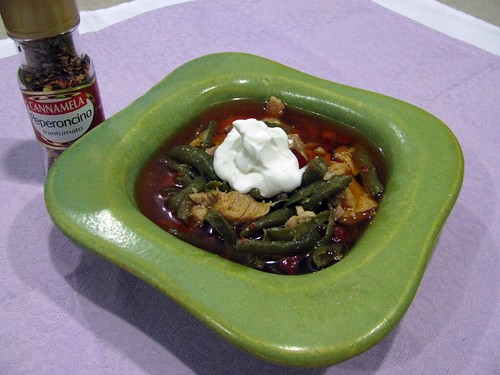
Notes on making: We used canned red bell peppers because that was what we had on hand. Feel free to use fresh if you have it. We also used frozen green beans, as we have some frozen from our garden from last year. Also, you could chop the chicken up before cooking it if desired.
Low Carb Hearty Chicken Soup
10 slices of thick bacon, chopped
1 large onion, chopped
2 c. water
3 c. chicken broth
4 lbs boneless skinless chicken thighs
4 cloves garlic
1 T. salt
1 tsp pepper
15oz can of diced red bell pepper (or equivalent fresh)
2 1/2 c. green beans, frozen or fresh from garden
sour cream for topping (optional)
In a large pot sautée bacon and onion until bacon is crisp and onion is tender.
Pour in water, 2 cups of the chicken broth, add chicken, garlic, salt and pepper. Cook until chicken is done. Remove chicken and cut up into 1" cubes.
Add chicken back into pot, and add the red bell peppers and another cup of chicken broth. Cook approximately 30 minutes.
Add the green beans and cook until the green beans are tender.
Serve hot, top with sour cream if desired. Makes about 10-12 servings.
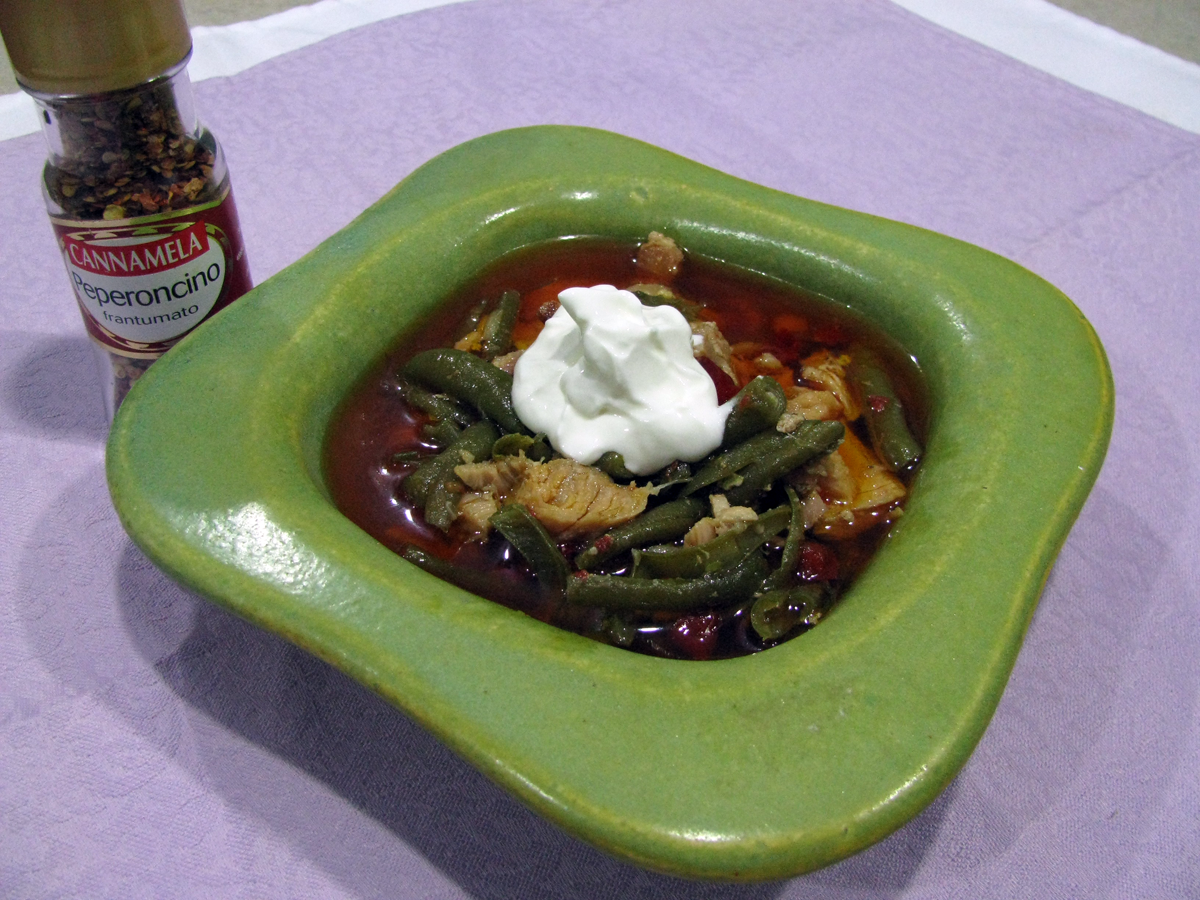
Notes on making: We used canned red bell peppers because that was what we had on hand. Feel free to use fresh if you have it. We also used frozen green beans, as we have some frozen from our garden from last year. Also, you could chop the chicken up before cooking it if desired.
Tuesday, February 15, 2011
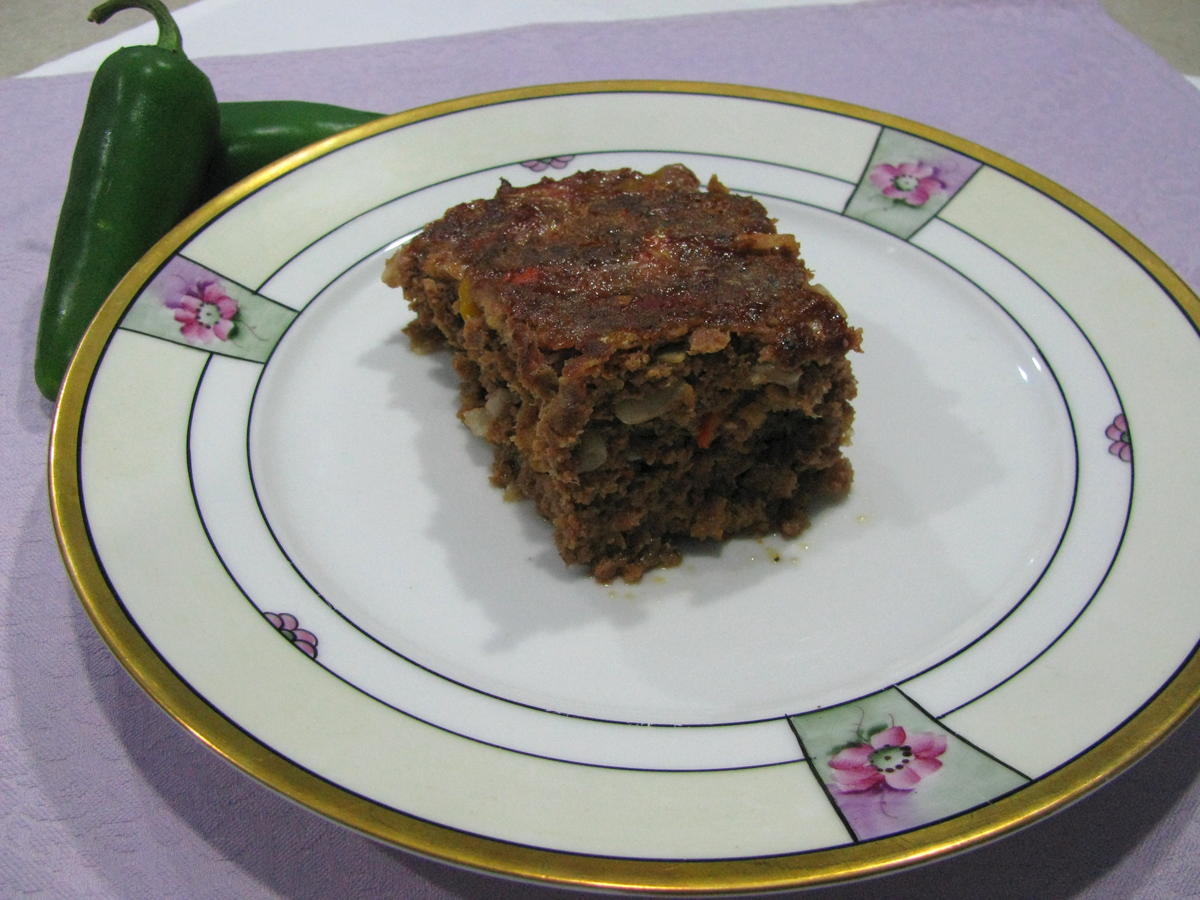
Low-Carb Venison Meatloaf : Updated
UPDATED: New Pictures 2/15/2011
We had this the other night for dinner:
Mix all this in a large bowl until all ingredients are well mixed. Put into a casserole pan. Bake at 350 degrees for about an hour. Everyone here thought it was very tasty!
New Pics!
We made this again tonight (the 15th) and I took pictures so I could update this post. I think we put in more peppers than the recipe calls for, so take note.

Venison and ground pork rinds

Fresh Yard Eggs, and yes that is a green egg! I think the lady has some Araucana chickens.

Colorful peppers

Peppers are chopped
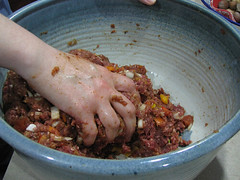
Mixing it up
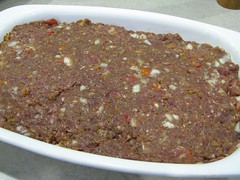
In the pan, ready for the oven
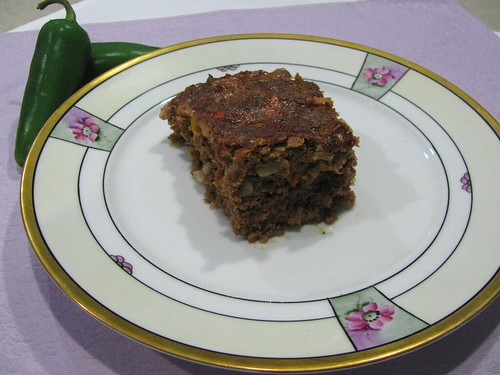
And the final piece, enjoy!
We had this the other night for dinner:
Low-Carb Venison Meatloaf
2 lbs. ground venison
2 T. pure lard (not hydrogenated crap)
2 eggs
2 c. pulverized pork rinds (put them in a zippy bag and use a rolling pin on them)
2 tsp salt
1 c. chopped onions
1/2 c. chopped green peppers (or sweet peppers)
15 oz. tomato sauce (or spaghetti sauce, make sure it doesn't have any added crap)
Mix all this in a large bowl until all ingredients are well mixed. Put into a casserole pan. Bake at 350 degrees for about an hour. Everyone here thought it was very tasty!
New Pics!
We made this again tonight (the 15th) and I took pictures so I could update this post. I think we put in more peppers than the recipe calls for, so take note.
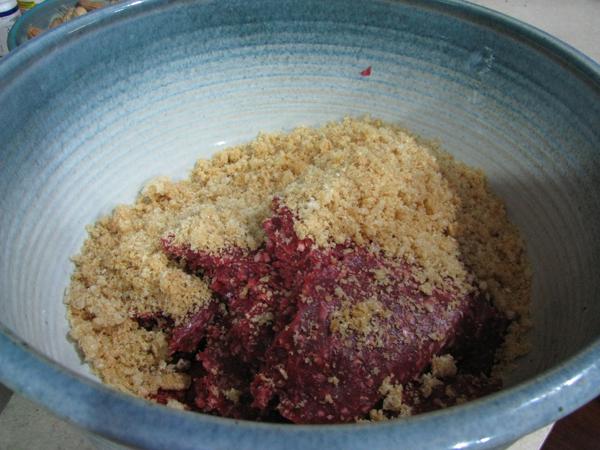
Venison and ground pork rinds

Fresh Yard Eggs, and yes that is a green egg! I think the lady has some Araucana chickens.

Colorful peppers
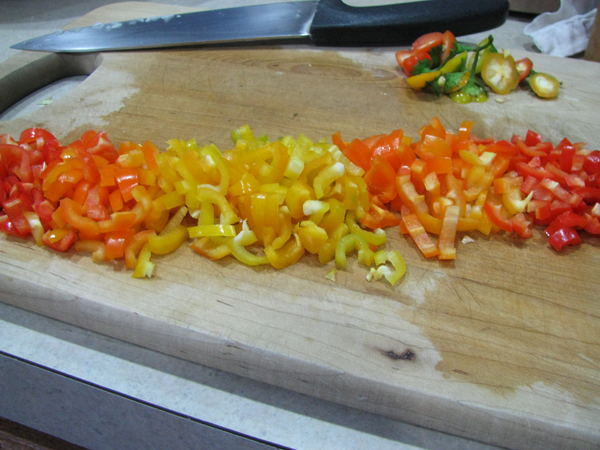
Peppers are chopped
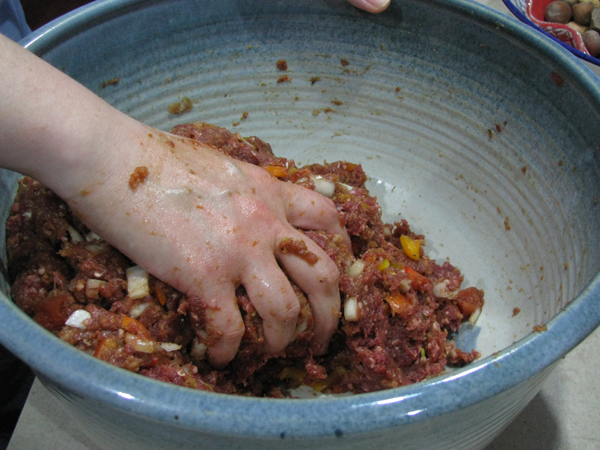
Mixing it up
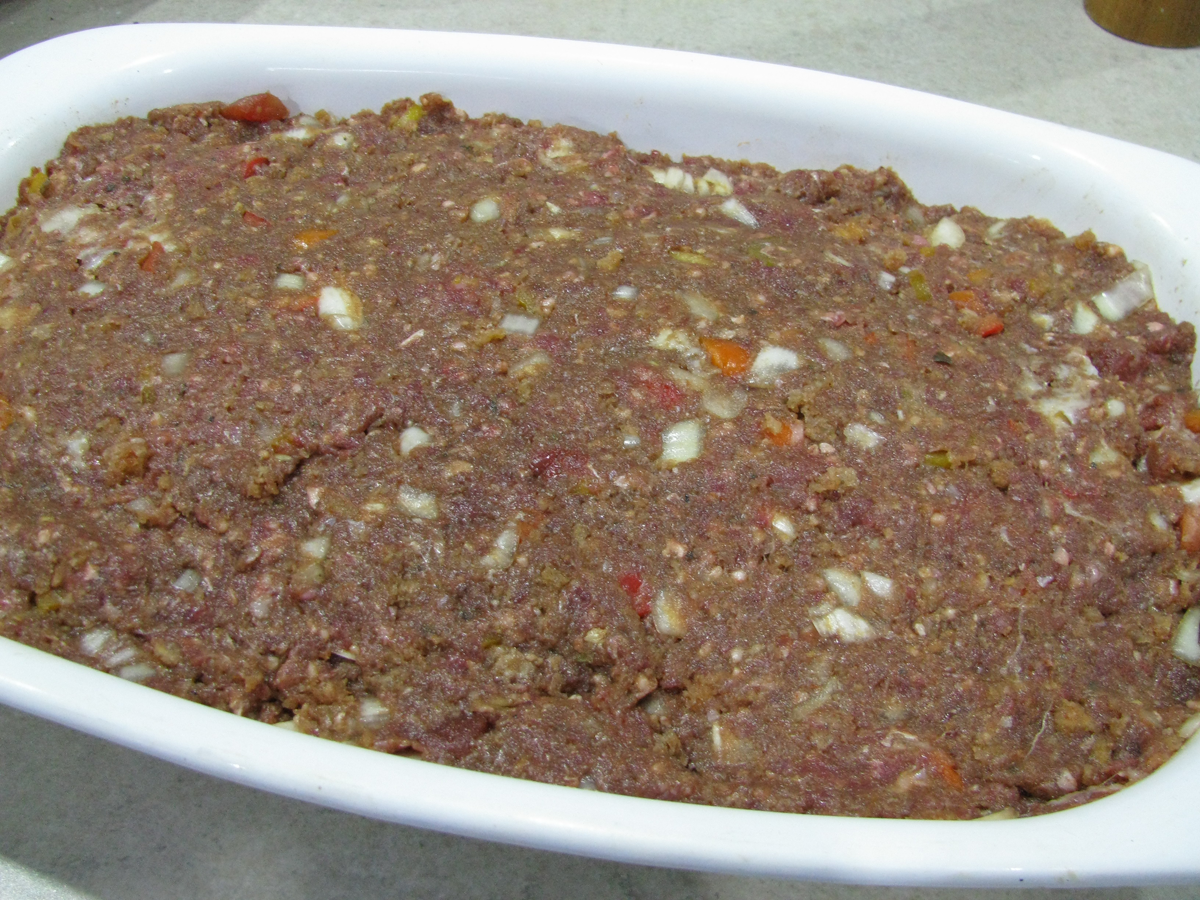
In the pan, ready for the oven
And the final piece, enjoy!
Saturday, February 12, 2011
We reap what we sow...
And in this case, a lot of wheat and corn are sown, even by our frozen northern neighbors. Canadians are not immune to the bad dietary advice given here in the States. Indeed, it seems that the poor advice has spread pretty much the world over.
A few days ago, the Leader-Post, a Saskatchewan newspaper, published an online article about how "fresh artisan bread... and warm oatmeal raisin cookie[s]" can be part of a weight loss diet. I feel myself gaining weight just thinking about that. They deride the low carb diet, saying:
Weight is gained back after going off a low-carb diet, because low carb isn't a temporary diet. You gained weight from eating carbohydrates in the first place, so of course when you go back to eating them, you gain the weight back. That's why Atkins has a maintenance phase, and the carbohydrate intake subsequently is based on how many carbs you can eat and still keep the weight off.
The article goes on to say:
I'd like to know what "key weight-loss strategy" they're thinking of. I suppose they think that if we all just nibble on iceberg lettuce, that surely we'll somehow magically get thin. They go on to give bad advice, first by saying that there's nothing decent to eat on-the-go (by decent, they mean full of fiber), and then saying if you do find it, it will be expensive. I hardly qualify a banana as being "healthy." Most people's insulin levels would spike, and they'd be hungry again in an hour. As for on-the-go food, I was thinking what a great thing the low carb diet is, as you can always get a huge bacon and cheese burger with lettuce, tomato, and mayonnaise and then toss the bun. You have a good bit of fat and protein that will keep you satiated for hours.
So why am I writing about this nonsense article, when there are so many other nonsense articles out there? Because two days later the same paper published two articles about how so many people in Saskatchewan are diabetic.
A few days ago, the Leader-Post, a Saskatchewan newspaper, published an online article about how "fresh artisan bread... and warm oatmeal raisin cookie[s]" can be part of a weight loss diet. I feel myself gaining weight just thinking about that. They deride the low carb diet, saying:
"Just eight years ago, the lowcarb wave rolled through North America. Admitting to eating bread or even starchy vegetables was like confessing to a crime. Carbs were cut out and weight was lost -initially. When the dust settled, weight was gained back. Low-carb stores closed for good."First of all, I've never heard of anyone having a problem admitting to eating carbohydrates. It's more like the opposite, where you tell people you don't eat carbs and they look at you like you've got three heads. Secondly, low carb stores? Hmm, never had any of those here. Saskatchewan must be a strange place to live. Maybe the cold has something to do with it, but I digress.
Weight is gained back after going off a low-carb diet, because low carb isn't a temporary diet. You gained weight from eating carbohydrates in the first place, so of course when you go back to eating them, you gain the weight back. That's why Atkins has a maintenance phase, and the carbohydrate intake subsequently is based on how many carbs you can eat and still keep the weight off.
The article goes on to say:
"All vegetables, fruit and grain products are carbohydrates. Since a key weight-loss strategy is to make half the plate vegetables in most meals, eliminating carbs is illogical...
Unfortunately, the wrong carbs are everywhere. Forget to bring food for a busy day and it can mean game over. Many muffins, cookies and even sandwiches available on the go lack fibre. And if vegetables and fruit weren't packed, you might be without them until returning home. If you stumble upon them, will you pay a toonie for a banana at the coffee shop?"
I'd like to know what "key weight-loss strategy" they're thinking of. I suppose they think that if we all just nibble on iceberg lettuce, that surely we'll somehow magically get thin. They go on to give bad advice, first by saying that there's nothing decent to eat on-the-go (by decent, they mean full of fiber), and then saying if you do find it, it will be expensive. I hardly qualify a banana as being "healthy." Most people's insulin levels would spike, and they'd be hungry again in an hour. As for on-the-go food, I was thinking what a great thing the low carb diet is, as you can always get a huge bacon and cheese burger with lettuce, tomato, and mayonnaise and then toss the bun. You have a good bit of fat and protein that will keep you satiated for hours.
So why am I writing about this nonsense article, when there are so many other nonsense articles out there? Because two days later the same paper published two articles about how so many people in Saskatchewan are diabetic.
"Saskatchewan has the highest combined prevalence of diabetes and prediabetes on the Prairies and a quarter of our population will be living with either condition by the end of this decade...Well, no wonder so many people have diabetes when the advice they're given is rubbish. As the proverb goes, you reap what you sow. In this case, bad advice has sown an epidemic of diabetes and obesity. And what happens? The diabetic gets blamed for their medical condition, a condition brought on by bad advice, which leads to other diseases that eventually cause death in a very long, drawn out, painful way. We can't possibly lay the blame where it belongs, which is at the feet of people who are supposed to be educated in medicine and diet, people who should know better, and yet ignore the evidence that what they're telling people, is making people sick and killing them.
It might be a tiresome old message to some ears, but diet and exercise is a good prescription to follow -both for those who have diabetes and those who want to avoid it."
Thursday, February 10, 2011
Parrot: "I'm a doctor!"
Are writers incapable of researching stuff before parroting what they're told? Are editors? I hope some are, but it seems like the majority aren't.
For example, this article from US News states that eating too much sodium leads to high blood pressure. Except it doesn't. A dietary reduction in salt can lead to a whopping 1.1 to 5 mmHg at *most*, if you believe meta-analysis. I'm completely underwhelmed. Most high blood pressure is genetic and diet has very little to do with it. If your blood pressure is high you need medication. That's about the only thing you'll hear me say that you need medicine for.
Why don't these doctors do some research instead of relying on Big Brother, er, I mean the government to tell them what to tell their patients? I guess they're too busy to read anything. Or to think for themselves. I find all kinds of interesting information simply searching Science Direct or even google. If they'd recommend to their patients to eat low-carb or paleo, most of their patients' health problems would improve and/or resolve themselves. In fact, I'd bet money on it. I'd even bet a million dollars. I could definitely use a million bucks.
Maybe they're scared? Taubes said in Why we get fat that no doctor was ever sued for recommending a low fat diet. I guess the acceptable killing of patients via the low fat nonsense is preferable to a lawsuit.
For example, this article from US News states that eating too much sodium leads to high blood pressure. Except it doesn't. A dietary reduction in salt can lead to a whopping 1.1 to 5 mmHg at *most*, if you believe meta-analysis. I'm completely underwhelmed. Most high blood pressure is genetic and diet has very little to do with it. If your blood pressure is high you need medication. That's about the only thing you'll hear me say that you need medicine for.
From the article:
"As a family doctor, I've observed that more and more of my practice is devoted to preventing and treating nutrition-related disorders such as high blood pressure, obesity, and diabetes. So I had hoped that the new dietary guidelines would provide me with concrete strategies for helping change my patients' eating habits for the better."
Why don't these doctors do some research instead of relying on Big Brother, er, I mean the government to tell them what to tell their patients? I guess they're too busy to read anything. Or to think for themselves. I find all kinds of interesting information simply searching Science Direct or even google. If they'd recommend to their patients to eat low-carb or paleo, most of their patients' health problems would improve and/or resolve themselves. In fact, I'd bet money on it. I'd even bet a million dollars. I could definitely use a million bucks.
Maybe they're scared? Taubes said in Why we get fat that no doctor was ever sued for recommending a low fat diet. I guess the acceptable killing of patients via the low fat nonsense is preferable to a lawsuit.
Subscribe to:
Posts (Atom)