I haven't written a blog post on here in how long?! I got busy, and I decided that I was bored with critiquing all these studies, because really they're all the same crap. There's something wrong with all of them. They're either underpowered, or funded by special interest, or the researchers are unethical sacks of shit. You get the idea.
But I got with the 21st century and got a smart phone late last year. I made the mistake (only in that it takes up too much of my time) of following some very genius people on twitter like Woo, and it came to my attention that the ridiculous cult of personality that is people like Richard Nikoley and Carbsane and others have come into a veritable classical age. Why are these idiots even still around? Why have they not scurried off into the nether regions of the Interwebs? What's more, why do they care what I eat? Why do they care what you eat? No, I'm serious. You have to ask yourself why these people care so damn much whether you ate bacon for breakfast or potatoes. You can't tell me it's because they're altruistic or something. They're all really rude people with no manners and I find it hard to believe they are doing what they do out of the goodness of their hearts. So, why don't you do what makes you feel good, keeps your blood-work healthy, and keeps the weight off? If eating potatoes and bananas does that for ya, well, more power to you.
This is tangential though to what spurned this blog post. You see, in the West, formal religion has been on the decline for decades. A lot of people may identify as one religion or another, but many don't go to church or even socialize with others who share their beliefs. And that is why we have the rise of the 'gurus', people like Nikoley, and Carbsane, and the thirty-bananas-a-day guy (is he even still alive?). You're all looking for something that has meaning. Something to be a part of. You don't want to do the old school thing where you join a church. So you jump on, and sometimes fall off, bandwagons of cult personalities. This doesn't help you at all. All it helps are the ad revenues of people who really don't give a fig about your health, but were very happy that you brought traffic to their site and maybe even bought whatever they were hawking.
The 'gurus' have spawned something worse though than wasted time, wasted money, and perhaps inflicting ill health on people. They have spawned what I call the Food Inquisition. Excuse me, but when did it become okay to comment about what I eat? When did it become okay to comment on what is in my grocery basket? You see, when you think that the diet you are following is the One True Diet and all others are anathema, then the next logical step is we must squash the unbelievers! Burn the heretics! We can't allow them to eat bacon, don't they know it's going to kill them? We must get the government to intervene, make them tax everything that is bad for people, to protect them from themselves. Just like in the Medieval period, the Inquisition only functioned with the cooperation of the civil power.
Yes, it's that absurd. You see, evolutionarily speaking, we are really no different physiologically than our medieval ancestors, and I do think that some of you have taken a leaf out of their books. You need to stop it. Just stop it. Next time you feel compelled to comment about what someone is eating. Don't. If they want your opinion, they'll ask you. And chances are, they don't want your opinion.

Showing posts with label diet. Show all posts
Showing posts with label diet. Show all posts
Friday, May 6, 2016

Wednesday, August 15, 2012
Low carb, Hypothyroidism, and How to Lie with Statistics
I'm just an artist. An artist that read Darrell Huff's "How to Lie with Statistics". It's an old book, published sixty years ago now. Apparently people have been using statistics to lie about things for a while now.
I had heard something about low-carb diets causing hypothyroidism (repeat after me, correlation is not causation). As it stands, it seems to me that there is no way to know definitively whether they do or not, because the subject has never been studied. Oh, but you say, what about all those studies that are cited by so many bloggers. One of the first posts I found when I delved into this notion, was by blogger Anthony Colpo, and I read his post on the matter. Not withstanding the rudeness (which is not just on his side of the argument but rather all about the blogosphere as it were [did y'alls mothers not teach basic manners?]), I did think he might-could-be on to something. Until of course I looked at the studies he cited.
I never understood exactly why an underpowered study was, well, underpowered until I read Huff's book. You see, if you don't have enough of a sample size, what you have is chance. Yes that's right, pure unadulterated chance. The same sort of chance that you have flipping a coin. The explanation that Huff gives is crystal clear, and I urge you to buy his book and read it. If you flip a penny ten times (let's say to represent the outcome of ten patients in a study), you might get that it comes up heads eight out of the ten times. But you might get that it comes out heads two of the ten times. You would have to flip thousands of times (or maybe study 100k participants because humans have more than two variables) to come out with any sort of reasonable data to study.
There could be something to this and there might not be. If there is a higher incidence of thyroid problems among people who eat low-carb (and I don't even know that that is true, but IF it is) how do you know that the problems weren't triggered by the diet they ate before they ate low-carb, the crappy Standard American Diet? Or that since most people who do low-carb want to lose weight, maybe the obesity triggered their thyroid to go out of whack. Or maybe it was a virus they were exposed to. It could be absolutely any of the above, or none at all. A week long study is not enough for your endocrine system to adjust to the changes of going from a Standard diet to a low-carb diet. Six males or three random participants tells you nothing other than chance. It seems like most of the medical studies I read are run by Vegas gambling addicts. Let's throw the dice and see what we come up with! This is not science. This is nonsense.
I had heard something about low-carb diets causing hypothyroidism (repeat after me, correlation is not causation). As it stands, it seems to me that there is no way to know definitively whether they do or not, because the subject has never been studied. Oh, but you say, what about all those studies that are cited by so many bloggers. One of the first posts I found when I delved into this notion, was by blogger Anthony Colpo, and I read his post on the matter. Not withstanding the rudeness (which is not just on his side of the argument but rather all about the blogosphere as it were [did y'alls mothers not teach basic manners?]), I did think he might-could-be on to something. Until of course I looked at the studies he cited.
I never understood exactly why an underpowered study was, well, underpowered until I read Huff's book. You see, if you don't have enough of a sample size, what you have is chance. Yes that's right, pure unadulterated chance. The same sort of chance that you have flipping a coin. The explanation that Huff gives is crystal clear, and I urge you to buy his book and read it. If you flip a penny ten times (let's say to represent the outcome of ten patients in a study), you might get that it comes up heads eight out of the ten times. But you might get that it comes out heads two of the ten times. You would have to flip thousands of times (or maybe study 100k participants because humans have more than two variables) to come out with any sort of reasonable data to study.
"The importance of using a small group is this: With a large group any difference produced by chance is likely to be a small one and unworthy of big type...How results that are not indicative of anything can be produced by pure chance--given a small enough number of cases--is something you can test yourself at small cost. Just start tossing a penny... Only when there is a substantial number of trials [or participants] involved is the law of averages a useful description or prediction."--Darrell Huff, How to Lie with Statistics p.39-40The two studies Colpo cites in his article, Dietary-induced Alterations in Thyroid Hormone Metabolism during Overnutrition and Isocaloric carbohydrate deprivation induces protein catabolism despite a low T3-syndrome in healthy men are woefully underpowered. The first one used three, yes THREE participants to conclude that no carbohydrates induces low T3 over a week. Yes, a week. The second study had a total of six participants over the course of eleven days (the abstract doesn't say if that's 11 days for each diet, or 11 days total, but whether it is one or the other it adds up to bull-hockey). I suppose that's twice as good as the first study. Bull-hockey times two equals twice as much bull-hockey for your grant money.
There could be something to this and there might not be. If there is a higher incidence of thyroid problems among people who eat low-carb (and I don't even know that that is true, but IF it is) how do you know that the problems weren't triggered by the diet they ate before they ate low-carb, the crappy Standard American Diet? Or that since most people who do low-carb want to lose weight, maybe the obesity triggered their thyroid to go out of whack. Or maybe it was a virus they were exposed to. It could be absolutely any of the above, or none at all. A week long study is not enough for your endocrine system to adjust to the changes of going from a Standard diet to a low-carb diet. Six males or three random participants tells you nothing other than chance. It seems like most of the medical studies I read are run by Vegas gambling addicts. Let's throw the dice and see what we come up with! This is not science. This is nonsense.
Thursday, January 12, 2012
Low Carb Brownie Recipe
I made the chocolate covered peanuts recipe from the other day again today. It's a real winner, everyone in the house likes it, which means I keep running out. Anyway, after I made it, as I was licking the pan before washing it, I had an epiphany. I thought the chocolate part would make a good base for brownies. And boy was I right! Everyone loved these brownies:
Melt butter on very low heat. Add cocoa and stir until smooth. Remove from heat.
In mixing bowl, beat eggs until light. Add sugar and stir well.
Then add the above together (after the cocoa has cooled off a little).
Add vanilla and stir.
Add dry ingredients and mix thoroughly.
Bake on 350 degrees in a well greased 8x8x2 pan for thirty to thirty-five minutes.
Brownies (Low Carb, cake type)
1 stick butter (8 T.)
2 T. cocoa
2 eggs
3/4 c. splenda
1/4 c. erythritol (buy it here)
1 tsp vanilla
3/4 c. almond flour (buy it here or grind your own)
1/2 tsp baking powder
1/2 tsp salt
Melt butter on very low heat. Add cocoa and stir until smooth. Remove from heat.
In mixing bowl, beat eggs until light. Add sugar and stir well.
Then add the above together (after the cocoa has cooled off a little).
Add vanilla and stir.
Add dry ingredients and mix thoroughly.
Bake on 350 degrees in a well greased 8x8x2 pan for thirty to thirty-five minutes.
Wednesday, January 4, 2012
Face-Palm Thursdays: Because two million years of evolution is obviously wrong
I should start a new trend where I publish things that make me face-palm on Thursdays. Actually, in this subject I could probably find enough things to make me face-palm every day of the week, possibly multiple times a day. US News has the skinny on what will make you skinny. Not really.
Face Palm: Best Diets for the New Year 2012
Top of the list? A diet, called the DASH diet, developed by the National Heart, Lung, and Blood Institute (NHLBI). You guessed it, eat your recommended number of carbs plus all those "healthy" whole grains, and just don't eat salt and saturated fat and you'll lose weight, especially if you cut back on calories! How does that work anyway? And they say that "rigorous studies" showed that this diet can lower blood pressure. Funnily enough, they don't quote exactly which "rigorous studies" they're referring to.
I'm not going to list all of the craptacular diets they put at the top of the list, (and believe me, I know all about craptacular diets having been obese for most of my life and trying repeatedly to lose the weight and being unable to), but they put Atkins towards the bottom. While their "rigorous studies" obviously prove that cutting back salt and eating whole grains defeats heart disease (really! I'm super cereal! pun totally intended) they dis Atkins because all the studies were too short and the data was not statistically significant. You can read that again, but I assure you, you didn't misread it.
Now, the Vegan Diet did better than Atkins and the Paleo diet despite the fact that it "may not provide enough of some nutrients." No kidding. But it ranks higher than ones that are better for you? Well, I believe that's called cognitive dissonance.
And what did they put at the bottom of the list? The Paleo Diet. Because 2 million years of evolution is obviously wrong. To whatever quack job wrote the article on US News, go live with the Inuit for a year like Stefansson did and get back to me on the lack of dairy and grains. Here's what they say about the nutritional breakdown of the Paleo Diet:
Repeat after me, THERE ARE NO ESSENTIAL CARBOHYDRATES.
Face Palm: Best Diets for the New Year 2012
Top of the list? A diet, called the DASH diet, developed by the National Heart, Lung, and Blood Institute (NHLBI). You guessed it, eat your recommended number of carbs plus all those "healthy" whole grains, and just don't eat salt and saturated fat and you'll lose weight, especially if you cut back on calories! How does that work anyway? And they say that "rigorous studies" showed that this diet can lower blood pressure. Funnily enough, they don't quote exactly which "rigorous studies" they're referring to.
I'm not going to list all of the craptacular diets they put at the top of the list, (and believe me, I know all about craptacular diets having been obese for most of my life and trying repeatedly to lose the weight and being unable to), but they put Atkins towards the bottom. While their "rigorous studies" obviously prove that cutting back salt and eating whole grains defeats heart disease (really! I'm super cereal! pun totally intended) they dis Atkins because all the studies were too short and the data was not statistically significant. You can read that again, but I assure you, you didn't misread it.
Now, the Vegan Diet did better than Atkins and the Paleo diet despite the fact that it "may not provide enough of some nutrients." No kidding. But it ranks higher than ones that are better for you? Well, I believe that's called cognitive dissonance.
And what did they put at the bottom of the list? The Paleo Diet. Because 2 million years of evolution is obviously wrong. To whatever quack job wrote the article on US News, go live with the Inuit for a year like Stefansson did and get back to me on the lack of dairy and grains. Here's what they say about the nutritional breakdown of the Paleo Diet:
Fat. At about 39 percent of daily calories from fat, a sample Paleo menu exceeds the government’s 35 percent cap by a bit.
Protein. The government recommends 10 to 35 percent of daily calories come from protein; the Paleo diet clocks in around 38 percent.
Carbohydrates. At 23 percent of daily calories from carbs, it’s far below the government’s 45 to 65 percent recommendation.
Repeat after me, THERE ARE NO ESSENTIAL CARBOHYDRATES.
Wednesday, May 18, 2011
Vegan Bacon
At Hunter-Gatherer.
Who would eat such crap? That's what I'm asking. Look, I've said it before and I'll say it again, if you want to wreck your health being vegan, well fine. Go for it, but why would you eat something that is manufactured by some corporation and that doesn't even resemble food?
Veganism is one of THE stupidest things that exist, and the people who follow it like a religion are even stupider. I understand if you do it for "ethical" reasons (which I think is misguided but whatever), but it certainly ought not be for "health" reasons since it's one of the most unhealthful diets you can eat, right after the Standard American Diet. I blame the lack of saturated fat. Saturated fat is really important for developing and maintaining cognitive function. So is cholesterol, but I digress.
The thing that really burns my biscuits though, is that vegans act like theirs is the natural diet man is supposed to be eating. This couldn't be further from the truth. Do you think that paleolithic man had greens, bananas and other stuff that only grows for part of the year in most places, shipped to them from a tropical location? They ate meat and lots of it. Some archaeologists think that paleolithic people were partially responsible for the mass extinction of mega-fauna at the end of the paleolithic.
If one wanted to be "ethical" about the way we treat this planet, they would eat local. They'd eat what was in their back yard. Of course, that would require having a back yard. I despise living in a city. I've done it, and I really don't like it. The only place I despise living more is in the suburbs. The neighbors are always a bunch of wackos.
If you eat vegan bacon, I'd suggest finding some real food to eat instead. The ingredient list on this vegan bacon reads like any other crap-in-a-box you might find in the frozen food section. Hint: soybean oil is very bad for you
Who would eat such crap? That's what I'm asking. Look, I've said it before and I'll say it again, if you want to wreck your health being vegan, well fine. Go for it, but why would you eat something that is manufactured by some corporation and that doesn't even resemble food?
Veganism is one of THE stupidest things that exist, and the people who follow it like a religion are even stupider. I understand if you do it for "ethical" reasons (which I think is misguided but whatever), but it certainly ought not be for "health" reasons since it's one of the most unhealthful diets you can eat, right after the Standard American Diet. I blame the lack of saturated fat. Saturated fat is really important for developing and maintaining cognitive function. So is cholesterol, but I digress.
The thing that really burns my biscuits though, is that vegans act like theirs is the natural diet man is supposed to be eating. This couldn't be further from the truth. Do you think that paleolithic man had greens, bananas and other stuff that only grows for part of the year in most places, shipped to them from a tropical location? They ate meat and lots of it. Some archaeologists think that paleolithic people were partially responsible for the mass extinction of mega-fauna at the end of the paleolithic.
If one wanted to be "ethical" about the way we treat this planet, they would eat local. They'd eat what was in their back yard. Of course, that would require having a back yard. I despise living in a city. I've done it, and I really don't like it. The only place I despise living more is in the suburbs. The neighbors are always a bunch of wackos.
If you eat vegan bacon, I'd suggest finding some real food to eat instead. The ingredient list on this vegan bacon reads like any other crap-in-a-box you might find in the frozen food section. Hint: soybean oil is very bad for you
Saturday, April 16, 2011
Squirrel Lunch
I harvested my first squirrel yesterday and we fried it up today for lunch. I had never had squirrel before, but my dad and my in-laws grew up eating it. I have to say I liked it and I'll probably try to harvest another one soon. The little bastards tore up our deer feeder last year and that means we have too many running around.
Some cities also have too many running around and they won't even let the residents do anything about it. A elderly neighbor of my uncle in Austin contracted typhus, which was probably transmitted by fleas living on the squirrels that have overrun the town since it's illegal to kill them. A female squirrel can have six offspring a year, so without predators, that quickly gets out of control. You can nearly kill little old ladies but you can't have squirrel for breakfast. Makes me glad I live out in the country.
Anyway, all this squirrel hunting made me think about how things used to be and why the amount of meat they say our ancestors ate is probably a huge under-estimation. Our grandparents and their parents, unless they lived in some place like New York City, did not rely on grocery stores for food. They also did not rely on huge commercial farms that grow genetically modified crops that can withstand bad weather. Go out in the woods and tell me how much you can gather. It ain't much. You're way better off trying to hunt something than to find edible plants, at least where I live. Our ancestors may have relied on other farmers or other hunters, but most of their food was not grown far away. Most people who lived out in the country hunted whatever they could get their hands on and it was never counted by USDA morons. Nowadays you'd probably go to jail if you tried selling meat to the neighbors, but I digress.
I thoroughly suggest for all you paleo types out there to go hunt your own food if it's possible. There's nothing like being out in the woods on a lovely spring morning. I know some people live where it's not possible, and all I can say is, I feel terribly sorry for you ;)
Some cities also have too many running around and they won't even let the residents do anything about it. A elderly neighbor of my uncle in Austin contracted typhus, which was probably transmitted by fleas living on the squirrels that have overrun the town since it's illegal to kill them. A female squirrel can have six offspring a year, so without predators, that quickly gets out of control. You can nearly kill little old ladies but you can't have squirrel for breakfast. Makes me glad I live out in the country.
Anyway, all this squirrel hunting made me think about how things used to be and why the amount of meat they say our ancestors ate is probably a huge under-estimation. Our grandparents and their parents, unless they lived in some place like New York City, did not rely on grocery stores for food. They also did not rely on huge commercial farms that grow genetically modified crops that can withstand bad weather. Go out in the woods and tell me how much you can gather. It ain't much. You're way better off trying to hunt something than to find edible plants, at least where I live. Our ancestors may have relied on other farmers or other hunters, but most of their food was not grown far away. Most people who lived out in the country hunted whatever they could get their hands on and it was never counted by USDA morons. Nowadays you'd probably go to jail if you tried selling meat to the neighbors, but I digress.
I thoroughly suggest for all you paleo types out there to go hunt your own food if it's possible. There's nothing like being out in the woods on a lovely spring morning. I know some people live where it's not possible, and all I can say is, I feel terribly sorry for you ;)
“Any woman who does not thoroughly enjoy tramping across the country on a clear, frosty morning with a good gun and a pair of dogs does not know how to enjoy life.” ~Annie Oakley
Tuesday, March 29, 2011
The problem IS veganism
Props to Free the Animal:
Only in the "civilized" world would people be so stupid as to prescribe to a diet that would kill their child.
And only in the "civilized" world would people make excuses and say that it's not the diet that killed the baby since there are plenty of healthy vegan babies. That's a bunch of codwallop. The diet did kill the child, and the parents believed said codswallop. In both English and French press, there are people saying it's not the diet that killed the baby, but something else that was responsible, like the parents' ignorance, etc. I won't say it wasn't their ignorance that killed it, indeed it was. Ignorance that a diet that leaves you deficient could possibly be good for their infant daughter.
Let's explain this in terms that even a child should understand. Vitamin B12 deficiency can kill you. Vitamin B12 is found only in animal products. Therefore, many vegans are B12 deficient. As an adult, you have a store of B12 that might take years to deplete. If you metabolize B12 well, you might never become deficient. If you don't metabolize it well, you might become very sick.
A child has no choice. A child also does not have the vitamin stores that an adult has. I'm not going to beat around the bush and pander to your PC sensibilities. You are an absolute idiot to be vegan while pregnant or nursing.Ask any pediatrician. I blame a lack of saturated fat, which so happens to be essential for brain development. I think it makes them have a hard time thinking. If you're an adult and you want to be vegan, more power to you. Go for it. It's a free world. If you get sick and die, that was your choice. But don't damage your child's health by having them be as well. And the stupid thing is, you don't have to eat meat to get vitamin B12, you could be vegetarian. So long as you consume cream and eggs, you'd be fine.
Why must another child die for a lie? The lie is that veganism is healthy. It isn't.
Only in the "civilized" world would people be so stupid as to prescribe to a diet that would kill their child.
And only in the "civilized" world would people make excuses and say that it's not the diet that killed the baby since there are plenty of healthy vegan babies. That's a bunch of codwallop. The diet did kill the child, and the parents believed said codswallop. In both English and French press, there are people saying it's not the diet that killed the baby, but something else that was responsible, like the parents' ignorance, etc. I won't say it wasn't their ignorance that killed it, indeed it was. Ignorance that a diet that leaves you deficient could possibly be good for their infant daughter.
Let's explain this in terms that even a child should understand. Vitamin B12 deficiency can kill you. Vitamin B12 is found only in animal products. Therefore, many vegans are B12 deficient. As an adult, you have a store of B12 that might take years to deplete. If you metabolize B12 well, you might never become deficient. If you don't metabolize it well, you might become very sick.
A child has no choice. A child also does not have the vitamin stores that an adult has. I'm not going to beat around the bush and pander to your PC sensibilities. You are an absolute idiot to be vegan while pregnant or nursing.Ask any pediatrician. I blame a lack of saturated fat, which so happens to be essential for brain development. I think it makes them have a hard time thinking. If you're an adult and you want to be vegan, more power to you. Go for it. It's a free world. If you get sick and die, that was your choice. But don't damage your child's health by having them be as well. And the stupid thing is, you don't have to eat meat to get vitamin B12, you could be vegetarian. So long as you consume cream and eggs, you'd be fine.
Why must another child die for a lie? The lie is that veganism is healthy. It isn't.
Wednesday, March 23, 2011
Lard Mayonnaise
I had read somewhere online that you could make mayonnaise from lard. And indeed, you can. But, just because you can do something, doesn't mean you should. The thing is, it didn't taste too bad right when we made it, when it was warm. I thought it was a bit strong but okay. But then we refrigerated it, and used some of it later. It was disgusting, for lack of a better word. I'm not sure why, but I suspect it may be because when there's a lot of fat in a food, it's usually better heated up.
So, if you're thinking about trying it, I wouldn't.
So, if you're thinking about trying it, I wouldn't.
Tuesday, March 22, 2011
The Difference a Few Years Makes
I got to looking at some pictures of myself from a few years ago, and I have to tell you, I see a huge difference. In fact, my own mother nearly didn't recognize me when I posted a picture on facebook a couple of months ago. That says something I think. I haven't seen my mom in four years because I live so far from her, and I've lost a lot of weight since then.

The picture on the left of me was taken at my brother-in-law's wedding in July 2006. I could barely squeeze into a size 42 in men's. I had gained weight like mad at school, and struggled to keep from gaining any more, much less lose any. The picture in the middle is me in October 2006. The picture on the right was taken at Pompei in May 2009. You can see at that point I had lost some weight but it was a struggle to keep it off. I gained back somewhere in the neighborhood of ten to fifteen pounds right after my trip.
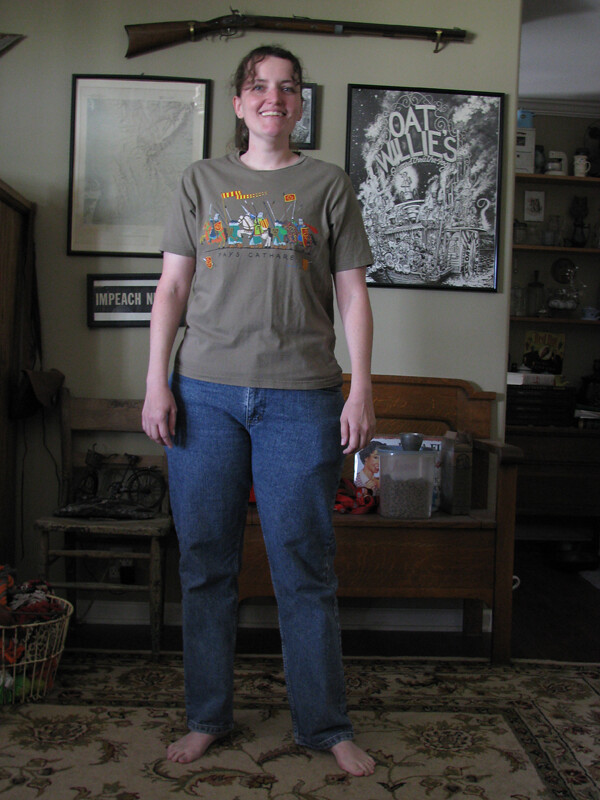
This is me today. I wear a 34 in men's.

And I don't have any pictures of me from when I was really heavy. That was before there were digital cameras. I think my mom may have some. I really tried to avoid ever having my picture taken then.
Hubby has lost a lot of weight too, but he forbids me to post any pictures of him LOL We've both lost all this weight, and haven't been hungry to do it. We've also been rather lazy and haven't even worked out. I do need to get motivated into a walking routine again. I think it would help me lose the rest of the weight I need to at a quicker pace, and maybe tone up the backside some ;)
Anyway, as they say, the proof is in the pudding, or in this case, in the pictures.
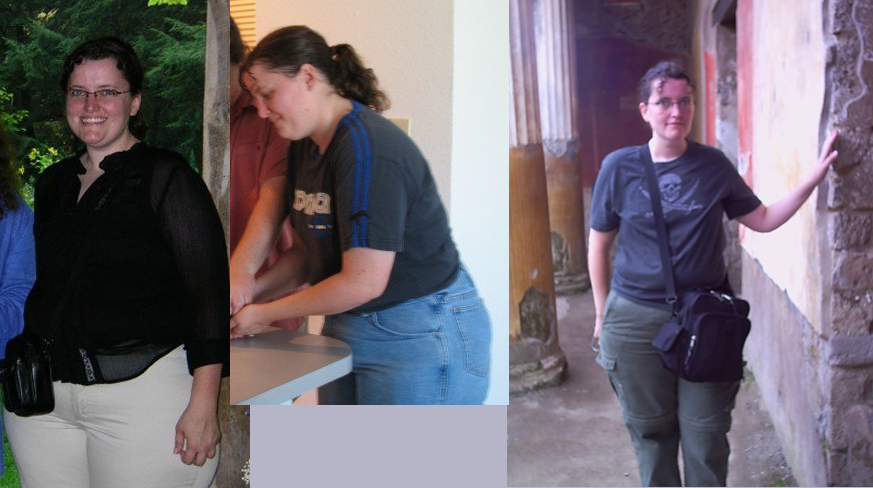
The picture on the left of me was taken at my brother-in-law's wedding in July 2006. I could barely squeeze into a size 42 in men's. I had gained weight like mad at school, and struggled to keep from gaining any more, much less lose any. The picture in the middle is me in October 2006. The picture on the right was taken at Pompei in May 2009. You can see at that point I had lost some weight but it was a struggle to keep it off. I gained back somewhere in the neighborhood of ten to fifteen pounds right after my trip.
This is me today. I wear a 34 in men's.
And I don't have any pictures of me from when I was really heavy. That was before there were digital cameras. I think my mom may have some. I really tried to avoid ever having my picture taken then.
Hubby has lost a lot of weight too, but he forbids me to post any pictures of him LOL We've both lost all this weight, and haven't been hungry to do it. We've also been rather lazy and haven't even worked out. I do need to get motivated into a walking routine again. I think it would help me lose the rest of the weight I need to at a quicker pace, and maybe tone up the backside some ;)
Anyway, as they say, the proof is in the pudding, or in this case, in the pictures.
Thursday, March 17, 2011
Low Carb should not be High Protein
Over at Primal Wisdom I read this post today. I have my own comments on the news article, which can be found here. I really wanted to read the original journal article, but it's new and the library doesn't have a subscription to the journal. Going off the abstract, it sounds first of all like a bullshit study.
Why? Well let's start with this. The assumption that a low carbohydrate diet is high in protein. It isn't. Or shouldn't be anyway. Unless you're a body builder. A low carbohydrate diet should be high in fat, not protein. The amount of protein they fed these 17 obese men is more than I consume on a typical day, some days by double. My protein intake is generally 70g to 130g. They fed these men 137-139g of protein.
My other main problem with this study, and why I think it's really irrelevant without even having to read it, is it's short duration and it's use of 17 men as subjects. Under powered and sexist to boot LOL
I think it's an obfuscation, what they're doing. They're attacking animal protein by attacking the low carbohydrate diet. In the case of the above study, I assume that they fed the people in the low carbohydrate group primarily animal protein. How else would you keep your carbohydrate count so low?
This whole attack on animal protein brings me back to something I was reading last night. They blame the protein in dairy for cancer. How did they come to that conclusion? By feeding people skim milk. The study I was looking at also lumped "all dairy" together and implied that "all dairy" had protein.
All dairy? Really. What about butter? Heavy cream? They have no protein. They have very little lactose, if any. You tell me how that's possible. I say it isn't. I say someone has an agenda and it's against animal products. Gee, I wonder who would have an agenda against animal products. I'll let you draw your own conclusions on that one.
Of course their insulin levels are higher in the skim milk group, the meat didn't have sugar (lactose) in it, and second of all, skim milk is not milk as you drink it from the cow. I mean, how stupid does one have to be? I went back and looked at the study that they're talking about, and talk about some confounding variables. The children were allowed to choose the diet they ate. Yes, you read that correctly. The children ate whatever they wanted, and simply were required to drink 1.5 liters of skim milk (12 of the boys) or eat 250g of low fat meat (the other 12). Consuming the milk apparently raised their IGF levels. But did it? Was it the milk? The protein in the milk? The lactose in the milk raising their insulin levels? The lack of fat in the milk so there was nothing to mediate their insulin levels? Some other dietary factor since there was no set diet? I mean, it could have been anything. I won't even get into the fact that it's under-powered and was only one week in duration.
Is drinking a large quantity of skim milk good for you? Hell no. I say you should never drink skim milk. If you want to consume milk, make sure it's whole, and better yet is straight from a dairy cow, not processed commercially.
In other words, is it really the protein alone, or is it more likely that it's the lactose? And when they say "milk" do they mean skim, whole, or what? Because each kind should in theory have a completely different effect on your insulin levels.
One place to look for good information on what ketogenic diets do is in the one place that they're standard and acceptable. And that is in the treatment of epileptic seizures. About half of people, children included, will have a positive response to a ketogenic diet in helping control their seizures. This study found that IGF-1 was greatly reduced in a ketogenic diet, to the point where it stunted the growth of the children.3 A ketogenic diet is extremely low carb, basically near zero carb and low protein too (it's a high fat diet), and these children undertook it because being short is preferable to having seizures.
In fact, a lot of the literature is rife with making low carb synonymous with high protein. Like this study where they fed mice more protein than fat (46% v. 35% respectively). That's a lot of protein. Not to mention it throws in a confounding variable, so that when they declare that low carb diets do not slow tumor growth, one has to wonder how they know this. If they had fed them a higher fat diet, they might have noticed some benefit, since we know that protein affects insulin production, and insulin levels are probably a driving force behind a lot of nasty things. In fact, in this study IGF-1 was higher in the low carb group than in the high carb group, and I'm sure that is due to the protein, since insulin drives IGF.
So the point of all this? When eating a low carb diet, it should be primarily animal fat (none of that synthetic vegetable crap), your protein should probably be 15-20% depending on your activity level, and your carb count should be as high as you can tolerate and still lose/maintain weight. And don't listen to stupid journalists, and be wary of researchers, because I don't think most of them know what they're talking about.
References:
1. Milk - The promoter of chronic Western diseases. Medical Hypotheses 2009; 72(6): 631-639
2. Role of insulin, insulin-like growth factor-1, hyperglycaemic food and milk consumption in the pathogenesis of acne vulgaris. Experimental Dermatology 2009; 18: 833–841.
3.Growth dependence on insulin-like growth factor-I during the ketogenic diet. Epilepsia 2009; 50(2): 297-303.
Why? Well let's start with this. The assumption that a low carbohydrate diet is high in protein. It isn't. Or shouldn't be anyway. Unless you're a body builder. A low carbohydrate diet should be high in fat, not protein. The amount of protein they fed these 17 obese men is more than I consume on a typical day, some days by double. My protein intake is generally 70g to 130g. They fed these men 137-139g of protein.
My other main problem with this study, and why I think it's really irrelevant without even having to read it, is it's short duration and it's use of 17 men as subjects. Under powered and sexist to boot LOL
I think it's an obfuscation, what they're doing. They're attacking animal protein by attacking the low carbohydrate diet. In the case of the above study, I assume that they fed the people in the low carbohydrate group primarily animal protein. How else would you keep your carbohydrate count so low?
This whole attack on animal protein brings me back to something I was reading last night. They blame the protein in dairy for cancer. How did they come to that conclusion? By feeding people skim milk. The study I was looking at also lumped "all dairy" together and implied that "all dairy" had protein.
"Except for cheese with an insulin score of 45, milk and all dairy products including yoghurt, ice cream, cottage cheese, and fermented milk products have potent insulinotropic properties."1 [emphasis mine]
All dairy? Really. What about butter? Heavy cream? They have no protein. They have very little lactose, if any. You tell me how that's possible. I say it isn't. I say someone has an agenda and it's against animal products. Gee, I wonder who would have an agenda against animal products. I'll let you draw your own conclusions on that one.
"In a one-week intervention study of 24 pre-pubertal eight-year-old boys the effect of daily intake of 53 g of either lean meat or skim milk (1.5 l per day) was studied with regard to insulin and IGF-1 responses. In the skim milk group insulin significantly increased by 105% (from 22 to 45 pmol/l) and IGF-1 significantly increased by 19% (from 209 to 249 ng/ml) [12]. There was no significant increase in either insulin or IGF-1 in the meat group."1 [emphasis mine]
Of course their insulin levels are higher in the skim milk group, the meat didn't have sugar (lactose) in it, and second of all, skim milk is not milk as you drink it from the cow. I mean, how stupid does one have to be? I went back and looked at the study that they're talking about, and talk about some confounding variables. The children were allowed to choose the diet they ate. Yes, you read that correctly. The children ate whatever they wanted, and simply were required to drink 1.5 liters of skim milk (12 of the boys) or eat 250g of low fat meat (the other 12). Consuming the milk apparently raised their IGF levels. But did it? Was it the milk? The protein in the milk? The lactose in the milk raising their insulin levels? The lack of fat in the milk so there was nothing to mediate their insulin levels? Some other dietary factor since there was no set diet? I mean, it could have been anything. I won't even get into the fact that it's under-powered and was only one week in duration.
Is drinking a large quantity of skim milk good for you? Hell no. I say you should never drink skim milk. If you want to consume milk, make sure it's whole, and better yet is straight from a dairy cow, not processed commercially.
"Milk consumption results in a significant increase in insulin and IGF-1 serum levels comparable with high glycaemic food. Insulin induces hepatic IGF-1 secretion, and both hormones amplify the stimulatory effect of GH on sebocytes and augment mitogenic downstream signalling pathways of insulin receptors, IGF-1 receptor and fibroblast growth factor receptor-2b."2
In other words, is it really the protein alone, or is it more likely that it's the lactose? And when they say "milk" do they mean skim, whole, or what? Because each kind should in theory have a completely different effect on your insulin levels.
One place to look for good information on what ketogenic diets do is in the one place that they're standard and acceptable. And that is in the treatment of epileptic seizures. About half of people, children included, will have a positive response to a ketogenic diet in helping control their seizures. This study found that IGF-1 was greatly reduced in a ketogenic diet, to the point where it stunted the growth of the children.3 A ketogenic diet is extremely low carb, basically near zero carb and low protein too (it's a high fat diet), and these children undertook it because being short is preferable to having seizures.
In fact, a lot of the literature is rife with making low carb synonymous with high protein. Like this study where they fed mice more protein than fat (46% v. 35% respectively). That's a lot of protein. Not to mention it throws in a confounding variable, so that when they declare that low carb diets do not slow tumor growth, one has to wonder how they know this. If they had fed them a higher fat diet, they might have noticed some benefit, since we know that protein affects insulin production, and insulin levels are probably a driving force behind a lot of nasty things. In fact, in this study IGF-1 was higher in the low carb group than in the high carb group, and I'm sure that is due to the protein, since insulin drives IGF.
So the point of all this? When eating a low carb diet, it should be primarily animal fat (none of that synthetic vegetable crap), your protein should probably be 15-20% depending on your activity level, and your carb count should be as high as you can tolerate and still lose/maintain weight. And don't listen to stupid journalists, and be wary of researchers, because I don't think most of them know what they're talking about.
References:
1. Milk - The promoter of chronic Western diseases. Medical Hypotheses 2009; 72(6): 631-639
2. Role of insulin, insulin-like growth factor-1, hyperglycaemic food and milk consumption in the pathogenesis of acne vulgaris. Experimental Dermatology 2009; 18: 833–841.
3.Growth dependence on insulin-like growth factor-I during the ketogenic diet. Epilepsia 2009; 50(2): 297-303.
Monday, March 14, 2011
Low Carb Diet Side Effects: How to deal with them
Salt and fat are very important on a low carb diet.
If you've being doing low carb for a while, you may have heard of people saying that they had a "bad reaction", or suffered "side effects" on the diet. One of the most obnoxious side effects constantly stated is that you'll get bad breath. The press likes this one, as if bad breath was the worst thing that you could have happen to you. Personally, I never had a problem with this, nor did any of my family members who went low carb. Maybe we were just lucky? Anyway, the side effects people encounter are probably from them either not getting enough fat, from not getting enough salt, or from going on and off the diet regularly (see my post about how your body makes enzymes and hormones based on what you've eaten recently). Or maybe a combination of all of that. So, what to do about these unpleasant "side effects"?
First and foremost, throw your fear of fat out the window. You don't want a lot of protein. You want fat, mostly saturated animal fat. It's best to avoid synthetic, man-made vegetable fat. Eating a low-carb, low-fat, high protein diet will make you sick. They call it "rabbit starvation" because rabbits are such lean meat, you'll die if that's all you have to eat.
Some things that can happen while on a low carb diet are tachycardia (racing heart). What can cause this? Low blood pressure. Eating a low carb diet lowers your blood pressure, and if you have low blood pressure already, you know that you sometimes get a fast heart beat. The mum-in-law has low blood pressure, and she sometimes gets a racing heart. She says that it's because your heart needs to get that blood pumped around your body somehow, even if it has to beat faster to do it. It's usually nothing to worry about, although I would suggest seeing a doctor just to be sure.** Something that may help this, is to increase your salt intake. Salt intake does raise your blood pressure slightly (between 1 and 6 mg/Hg) and it may be enough to avoid the side effect of low blood pressure. In fact, increasing your salt intake on the low carb diet, especially in the beginning, can prevent you from losing too much salt from losing too much water. You retain water when you eat carbohydrates (chemically speaking, water is required for their metabolism, and they're made of water, hence the 'hydrate' part). That leads to the point that if you eat a high carbohydrate meal once or twice a week, you will gain water weight, sometimes crazily so. This is not because you've eaten too much per se, it's because you're retaining water. It can take a week or two of eating low carb again to lose the water weight.
Another cause of low blood pressure may be if you're on medication for your high blood pressure, and you go on a low carb diet, well, you may need to have your doctor adjust your blood pressure medicine down to compensate.
I personally (and I know this is anecdotal) do so much better on a low carb diet when it comes to my heart. I have a hard time getting enough potassium when I eat the standard American diet, and I once wound up in the emergency room with sinus arrhythmia, my heart was stopping momentarily, literally skipping beats. Needless to say, it scared the hell out of me. The doctors told me that my potassium was low. I don't get sinus arrhythmia on the low carb diet. Probably because red meat is a great source of potassium. I also noticed that my heart doesn't beat as "hard" as it used to when I would lay down to go to sleep. I used to be able to feel it beating loudly, and it doesn't make so much noise any more. My pulse is normal, it just seems like it's working more efficiently or something. And again, this is all anecdotal, so take it with a grain of salt (pun intended).
**Please note, that if you are having problems, especially to do with your heart, see a doctor. Have blood tests, get hooked up to an EKG and make sure you don't have an underlying medical condition.
If you've being doing low carb for a while, you may have heard of people saying that they had a "bad reaction", or suffered "side effects" on the diet. One of the most obnoxious side effects constantly stated is that you'll get bad breath. The press likes this one, as if bad breath was the worst thing that you could have happen to you. Personally, I never had a problem with this, nor did any of my family members who went low carb. Maybe we were just lucky? Anyway, the side effects people encounter are probably from them either not getting enough fat, from not getting enough salt, or from going on and off the diet regularly (see my post about how your body makes enzymes and hormones based on what you've eaten recently). Or maybe a combination of all of that. So, what to do about these unpleasant "side effects"?
First and foremost, throw your fear of fat out the window. You don't want a lot of protein. You want fat, mostly saturated animal fat. It's best to avoid synthetic, man-made vegetable fat. Eating a low-carb, low-fat, high protein diet will make you sick. They call it "rabbit starvation" because rabbits are such lean meat, you'll die if that's all you have to eat.
Some things that can happen while on a low carb diet are tachycardia (racing heart). What can cause this? Low blood pressure. Eating a low carb diet lowers your blood pressure, and if you have low blood pressure already, you know that you sometimes get a fast heart beat. The mum-in-law has low blood pressure, and she sometimes gets a racing heart. She says that it's because your heart needs to get that blood pumped around your body somehow, even if it has to beat faster to do it. It's usually nothing to worry about, although I would suggest seeing a doctor just to be sure.** Something that may help this, is to increase your salt intake. Salt intake does raise your blood pressure slightly (between 1 and 6 mg/Hg) and it may be enough to avoid the side effect of low blood pressure. In fact, increasing your salt intake on the low carb diet, especially in the beginning, can prevent you from losing too much salt from losing too much water. You retain water when you eat carbohydrates (chemically speaking, water is required for their metabolism, and they're made of water, hence the 'hydrate' part). That leads to the point that if you eat a high carbohydrate meal once or twice a week, you will gain water weight, sometimes crazily so. This is not because you've eaten too much per se, it's because you're retaining water. It can take a week or two of eating low carb again to lose the water weight.
Another cause of low blood pressure may be if you're on medication for your high blood pressure, and you go on a low carb diet, well, you may need to have your doctor adjust your blood pressure medicine down to compensate.
I personally (and I know this is anecdotal) do so much better on a low carb diet when it comes to my heart. I have a hard time getting enough potassium when I eat the standard American diet, and I once wound up in the emergency room with sinus arrhythmia, my heart was stopping momentarily, literally skipping beats. Needless to say, it scared the hell out of me. The doctors told me that my potassium was low. I don't get sinus arrhythmia on the low carb diet. Probably because red meat is a great source of potassium. I also noticed that my heart doesn't beat as "hard" as it used to when I would lay down to go to sleep. I used to be able to feel it beating loudly, and it doesn't make so much noise any more. My pulse is normal, it just seems like it's working more efficiently or something. And again, this is all anecdotal, so take it with a grain of salt (pun intended).
**Please note, that if you are having problems, especially to do with your heart, see a doctor. Have blood tests, get hooked up to an EKG and make sure you don't have an underlying medical condition.
Saturday, March 12, 2011
The Usual Fare: How your body adapts to what you're eating
After reading some of the comments on the news articles I read for what I wrote last night, about how McDonald's made the commenters sick, I got to thinking about it and the mum-in-law pointed out that most of them probably are vegetarian and perhaps ate it in a pinch, and then did get sick because their bodies did not have enough of the enzyme to digest the meat. It had nothing to do with the fact that it was McDonald's. If they'd eaten at Austin Land and Cattle, they'd have had the same response, and I don't think a $42 steak should make you sick. Unless your body just isn't used to eating meat.
Your body responds to what you usually eat by making enzymes (like protease) and hormones (like insulin) to deal with your daily food intake. This goes for all food components, fat, carbohydrates and protein. I personally don't eat very many carbs, usually. I still need to lose about twenty pounds, so I'm going to keep on the very low carb band wagon until I lose all the weight. Now, yesterday, if you read my post about what we ate for lunch, you'll know that we all felt like crap afterwards. This is because your insulin production is based on what you ate for the last meal and maybe overall on what you ate in the last day or two. If you do very low carb and want to eat sugar again, just like with a vegetarian who hasn't eaten meat in a while, you have to go gradually off of it. If you are vegetarian and decide that you're going to eat meat again, and you eat a double Whopper, you're probably going to be sick. And it isn't because of the food itself. The same happens if you're a low carber. Say for instance, you go to France on holiday and you eat half a dozen pain au chocolat, you're going to be sick. I suggest ramping up for that LOL
According to Lippincott's Illustrated biochemistry text, the things that stimulate insulin synthesis (production) are glucose, amino acids, and gastrointestinal hormones, and it says that "the synthesis and release of insulin are decreased when there is a scarcity of dietary fuels [i.e. carbohydrates]..." p.310
In other words, if you don't eat carbohydrates, your body isn't making very much insulin. Why would it? That would be inefficient. Luckily the body is highly adaptable, and in the case of former vegetarians will go back to making the enzymes for digesting meat in a couple of days. Same for the low carb folks. Fall off the wagon, and your body will start making insulin again. If we weren't so adaptable, you wouldn't be sitting here reading this because your ancestors wouldn't have lived.
~~~~~~~~~~~~~~~~~~~~~~~~~~~~~~~~~~~~~~~
And a little tangential thing I read today while I was researching the above, for your amusement. It's about the stupidest thing I've ever read actually. From a study,
Now you tell me how a diet is simultaneously healthy and yet long-term adherence causes deficiencies. And not only that, in the results of this paper, they even say that plant protein is not as digestible as animal protein. The prior is codswallop if I ever read it and the latter should really have some vegans and vegetarians raising an eyebrow about what they've been fed (hint: lies). Someone has an agenda, and it ain't in the interest of your health. If I eat meat only, as Stefansson (and the Inuit) did, no supplements are required. Chew on that.
Your body responds to what you usually eat by making enzymes (like protease) and hormones (like insulin) to deal with your daily food intake. This goes for all food components, fat, carbohydrates and protein. I personally don't eat very many carbs, usually. I still need to lose about twenty pounds, so I'm going to keep on the very low carb band wagon until I lose all the weight. Now, yesterday, if you read my post about what we ate for lunch, you'll know that we all felt like crap afterwards. This is because your insulin production is based on what you ate for the last meal and maybe overall on what you ate in the last day or two. If you do very low carb and want to eat sugar again, just like with a vegetarian who hasn't eaten meat in a while, you have to go gradually off of it. If you are vegetarian and decide that you're going to eat meat again, and you eat a double Whopper, you're probably going to be sick. And it isn't because of the food itself. The same happens if you're a low carber. Say for instance, you go to France on holiday and you eat half a dozen pain au chocolat, you're going to be sick. I suggest ramping up for that LOL
According to Lippincott's Illustrated biochemistry text, the things that stimulate insulin synthesis (production) are glucose, amino acids, and gastrointestinal hormones, and it says that "the synthesis and release of insulin are decreased when there is a scarcity of dietary fuels [i.e. carbohydrates]..." p.310
In other words, if you don't eat carbohydrates, your body isn't making very much insulin. Why would it? That would be inefficient. Luckily the body is highly adaptable, and in the case of former vegetarians will go back to making the enzymes for digesting meat in a couple of days. Same for the low carb folks. Fall off the wagon, and your body will start making insulin again. If we weren't so adaptable, you wouldn't be sitting here reading this because your ancestors wouldn't have lived.
~~~~~~~~~~~~~~~~~~~~~~~~~~~~~~~~~~~~~~~
And a little tangential thing I read today while I was researching the above, for your amusement. It's about the stupidest thing I've ever read actually. From a study,
Protein dietary reference intakes may be inadequate for vegetarians if low amounts of animal protein are consumed:
"The health benefits of vegetarian diets are well-recognized; however, long-term adherence to these diets may be associated with nutrient inadequacies, particularly vitamins B12 and D, calcium, irno, zinc and protein...
Results and Discussion...
Furthermore, two food groups (nuts/seeds and fruits/vegetables) contributed to nearly 20% of dietary protein, sources not recognized by the DRI report. These are important distinctions because protein from cereals and vegetables (particularly if these foods are less refined) has poor digestibility. Traditional vegetarian diets (e.g., Indian and Guatemalan vegetarian diets) with low amounts of animal proteins and large proportions of cereal and vegetable protein have protein digestibility scores averaging 70% (range 54–77%) compared with plant-based diets with a large proportion of animal protein (mean 88%, range 78–93%)..."
Now you tell me how a diet is simultaneously healthy and yet long-term adherence causes deficiencies. And not only that, in the results of this paper, they even say that plant protein is not as digestible as animal protein. The prior is codswallop if I ever read it and the latter should really have some vegans and vegetarians raising an eyebrow about what they've been fed (hint: lies). Someone has an agenda, and it ain't in the interest of your health. If I eat meat only, as Stefansson (and the Inuit) did, no supplements are required. Chew on that.
Wednesday, February 16, 2011
Low Carb Hearty Chicken Soup Recipe
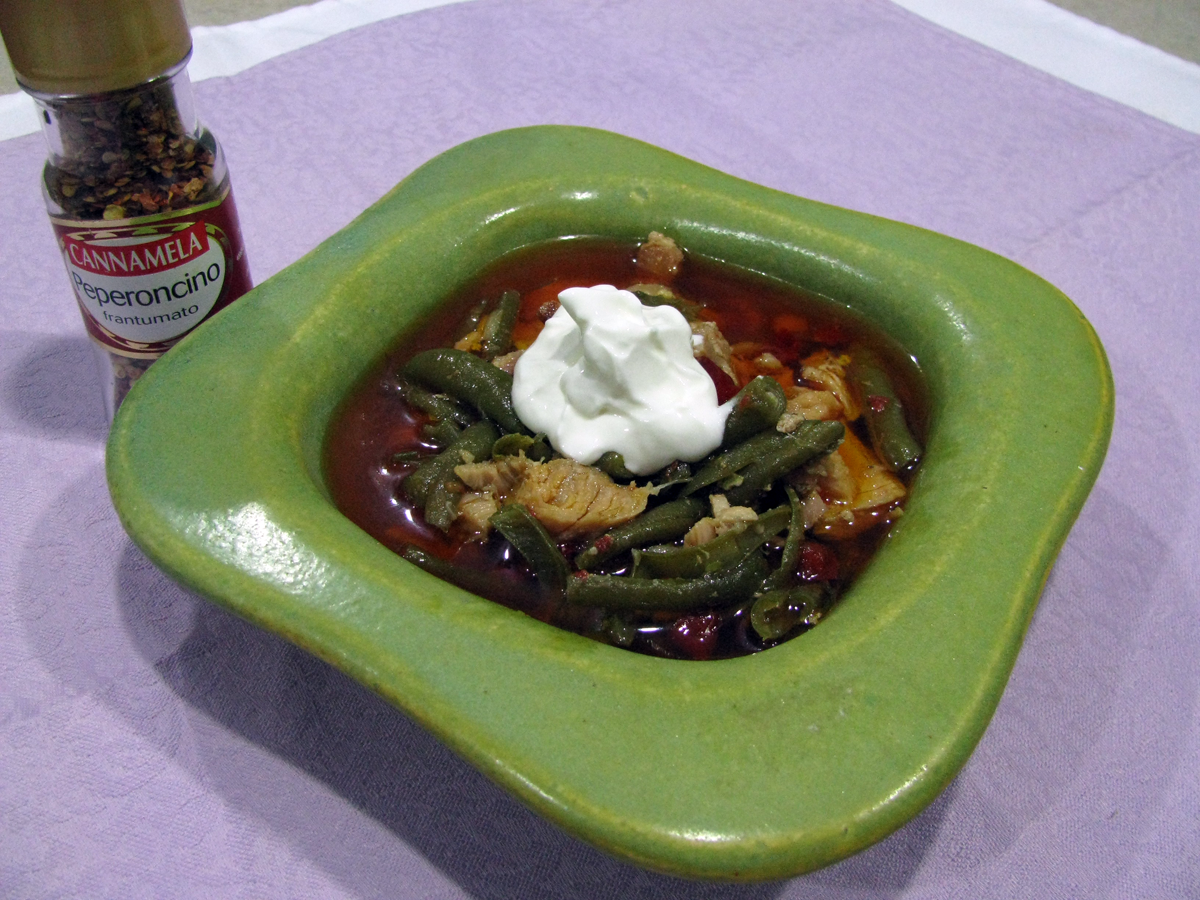
The mum-in-law made this for dinner tonight and it was delish! It's pretty easy to make too, and something you can walk away from while it's simmering. It's a good dish to make if you're busy.

Notes on making: We used canned red bell peppers because that was what we had on hand. Feel free to use fresh if you have it. We also used frozen green beans, as we have some frozen from our garden from last year. Also, you could chop the chicken up before cooking it if desired.
Low Carb Hearty Chicken Soup
10 slices of thick bacon, chopped
1 large onion, chopped
2 c. water
3 c. chicken broth
4 lbs boneless skinless chicken thighs
4 cloves garlic
1 T. salt
1 tsp pepper
15oz can of diced red bell pepper (or equivalent fresh)
2 1/2 c. green beans, frozen or fresh from garden
sour cream for topping (optional)
In a large pot sautée bacon and onion until bacon is crisp and onion is tender.
Pour in water, 2 cups of the chicken broth, add chicken, garlic, salt and pepper. Cook until chicken is done. Remove chicken and cut up into 1" cubes.
Add chicken back into pot, and add the red bell peppers and another cup of chicken broth. Cook approximately 30 minutes.
Add the green beans and cook until the green beans are tender.
Serve hot, top with sour cream if desired. Makes about 10-12 servings.
Notes on making: We used canned red bell peppers because that was what we had on hand. Feel free to use fresh if you have it. We also used frozen green beans, as we have some frozen from our garden from last year. Also, you could chop the chicken up before cooking it if desired.
Tuesday, February 15, 2011
Low-Carb Venison Meatloaf : Updated
UPDATED: New Pictures 2/15/2011
We had this the other night for dinner:
Mix all this in a large bowl until all ingredients are well mixed. Put into a casserole pan. Bake at 350 degrees for about an hour. Everyone here thought it was very tasty!
New Pics!
We made this again tonight (the 15th) and I took pictures so I could update this post. I think we put in more peppers than the recipe calls for, so take note.

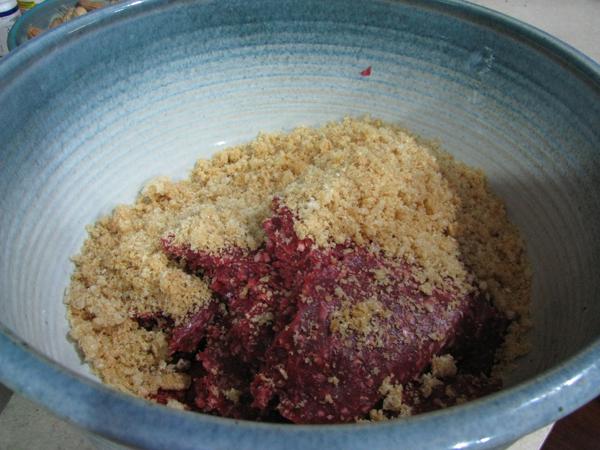
Venison and ground pork rinds

Fresh Yard Eggs, and yes that is a green egg! I think the lady has some Araucana chickens.

Colorful peppers

Peppers are chopped

Mixing it up

In the pan, ready for the oven

And the final piece, enjoy!
We had this the other night for dinner:
Low-Carb Venison Meatloaf
2 lbs. ground venison
2 T. pure lard (not hydrogenated crap)
2 eggs
2 c. pulverized pork rinds (put them in a zippy bag and use a rolling pin on them)
2 tsp salt
1 c. chopped onions
1/2 c. chopped green peppers (or sweet peppers)
15 oz. tomato sauce (or spaghetti sauce, make sure it doesn't have any added crap)
Mix all this in a large bowl until all ingredients are well mixed. Put into a casserole pan. Bake at 350 degrees for about an hour. Everyone here thought it was very tasty!
New Pics!
We made this again tonight (the 15th) and I took pictures so I could update this post. I think we put in more peppers than the recipe calls for, so take note.
Venison and ground pork rinds

Fresh Yard Eggs, and yes that is a green egg! I think the lady has some Araucana chickens.

Colorful peppers
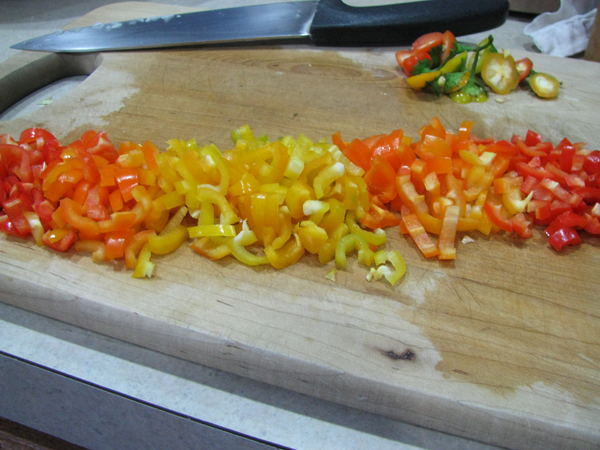
Peppers are chopped
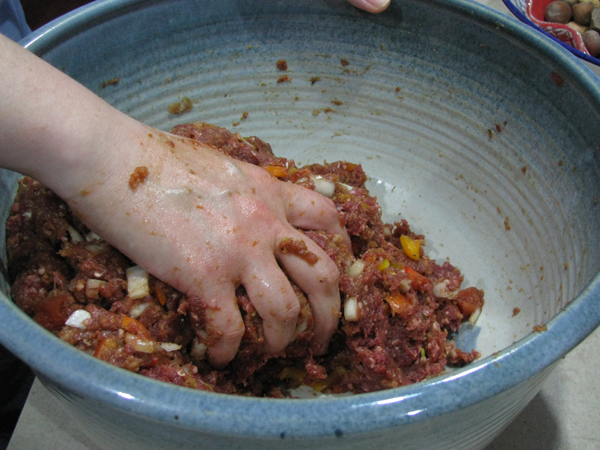
Mixing it up
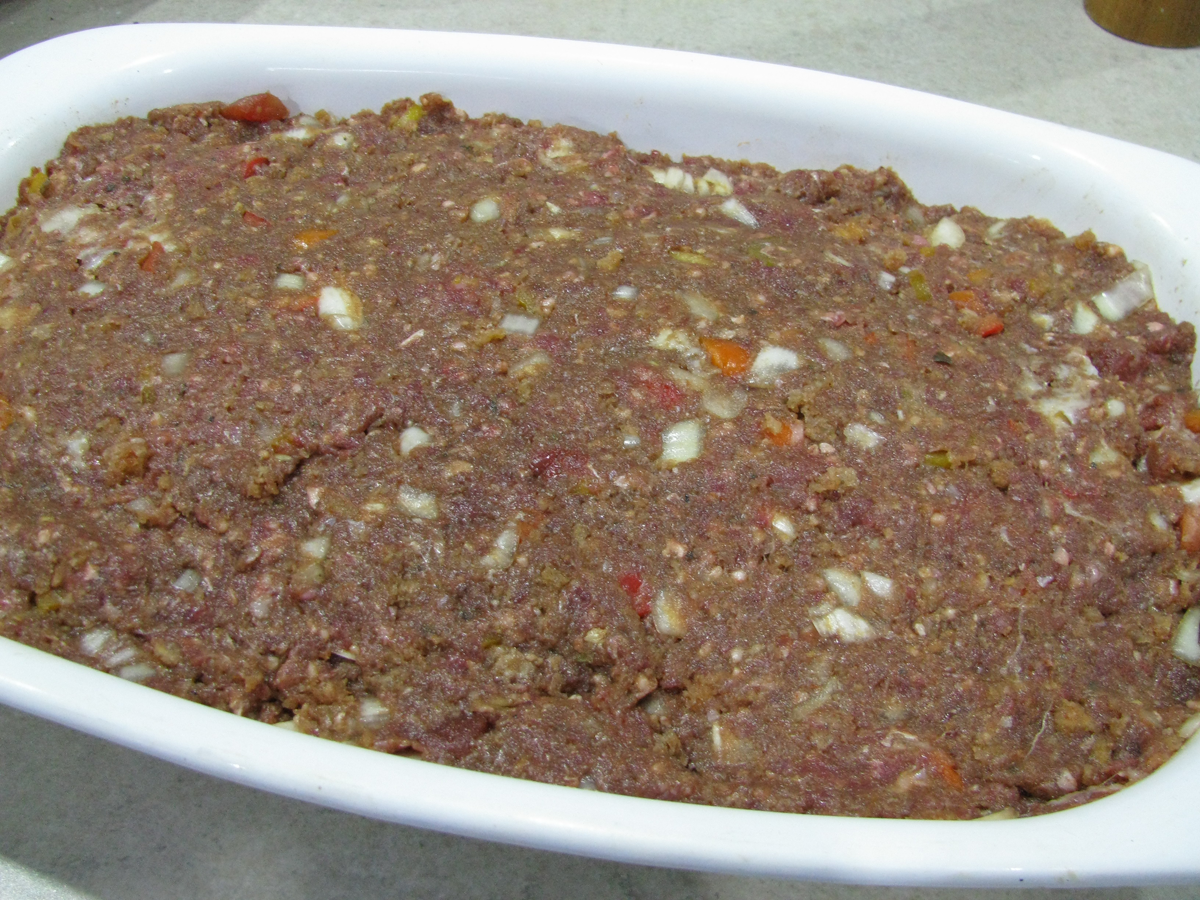
In the pan, ready for the oven
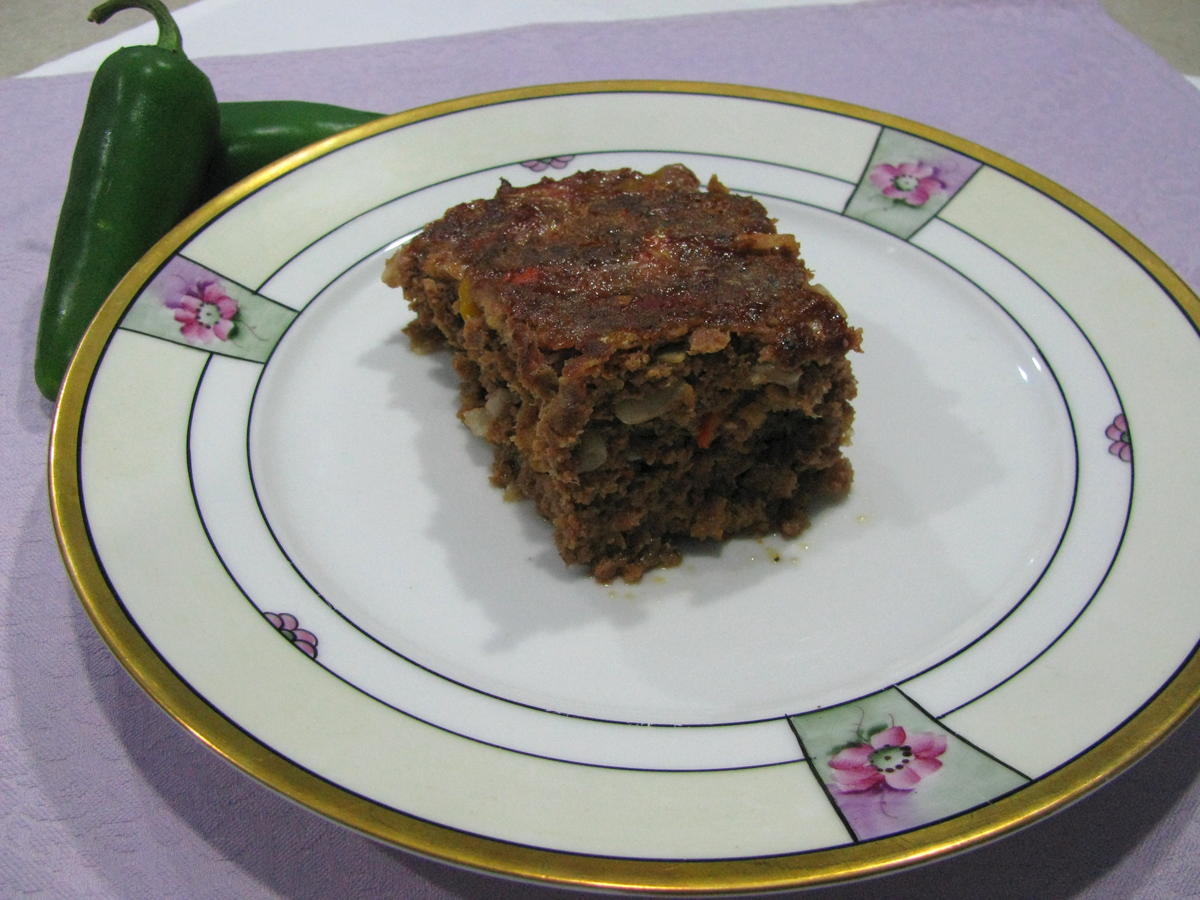
And the final piece, enjoy!
Monday, February 14, 2011
The Misconception of Natural Sweeteners
Lots of things are natural, meaning they occur in nature. Arsenic, cyanide, uranium, deadly nightshade. That doesn't mean you'd want to eat them, or even come into contact with some of them. I don't know how many articles I have read decrying the evils of High Fructose Corn Syrup, and yet saying that regular sugar is fine. Now, I'm not saying that HFCS is the same as sugar, it's not, by a long shot, however, neither of them are good for your health. Other naturally occurring sugars are no better, like honey. Sugar is sugar, and the glucose spikes your blood sugar while the fructose portion damages your liver and raises your triglyceride levels. That includes the fructose in fruit.
We have articles in newspapers like this one, since it's Valentine's day:
The problem is, they can't let go of the notion, that "everybody knows it's common knowledge" notion, that fruit is good for you. Five hundred years ago everyone knew the earth was flat too, and the center of the universe to boot. We all know what happened to Galileo when he dared to suggest otherwise.
Another newspaper article, also acts like natural sweeteners aren't a problem:
The first article I cited did have a great line in it:
We have articles in newspapers like this one, since it's Valentine's day:
"But let's not make fructose the only bad guy here. The real problem is our consumption of all added sugar. Naturally occurring sugars like fructose, found in fruit, and lactose, found in milk, are valuable nutrients."Overall, this article is better than most, but still has some problems. It fails in that it differentiates the fructose in fruit from the fructose in HFCS. There's not one iota of a difference, with perhaps the exception that if you ate a piece of fruit you might get less than if you ate something laden with HFCS. The problem is, our modern fruit has been bred to be bigger and sweeter. The sweeter it is, the more fructose is in it. Also, the fructose found in sucrose (table sugar) is also the same to your cells.
The problem is, they can't let go of the notion, that "everybody knows it's common knowledge" notion, that fruit is good for you. Five hundred years ago everyone knew the earth was flat too, and the center of the universe to boot. We all know what happened to Galileo when he dared to suggest otherwise.
"Does this research mean that eating fruit will increase your risk of heart disease and diabetes? Absolutely not."That statement may be blatantly false, considering the study out of New Zealand that I wrote about last week, that I might add no American media picked up (good thing I didn't hold my breath).
Another newspaper article, also acts like natural sweeteners aren't a problem:
"While the massive amount of high-fructose corn syrup consumed by many people isn't a great choice, a more moderate amount of natural sweeteners can be a wonderful complement to a healthy diet."What exactly is their idea of "moderation"? Eating 100 lbs of sugar a year versus the current 150+? Taubes wrote about this in "Good Calories, Bad Calories" and it seems from some reports by doctors who were in Africa and other colonial places a hundred years ago that a sugar intake of approximately 60 lbs was the cut off point of "too much". After consumption rose above that level, and after a time frame of about 20 years consuming such levels, they saw diabetes and metabolic syndrome begin to develop, along with all the other western diseases that go along with them. And really, it might be that a lower consumption just means it takes longer to develop metabolic problems in some people, or maybe even in most people. I doubt seriously the authors of these news articles imagine that we really might need to restrict our sugar intake to a minuscule amount to avoid developing disease.
The first article I cited did have a great line in it:
"If we really looked like what we eat, most Americans would look like kernels of corn."There's the truth if I ever read it.
Sunday, February 13, 2011
Grocery Run
I've made it a habit whenever we go to the store now to watch what other people are buying who are in line next to me, just out of curiosity. Today there was a lady in front of us, she had no meat or protein that I could see, except for two cartons of eggs. What she did have, was two loaves of white bread, macaroni and cheese, white spaghetti noodles, among a bunch of other carb laden merchandise. She spent about $200 (that's what the mum-in-law said), I didn't see the total. I could buy a lot of meat for that, and be much more satiated than after eating all that junk. She was overweight, but not terribly so, of course, she would probably be considered obese by the BMI standard.
Behind us was a family, mother, father, and three school age kids, a boy and two girls. They appeared to be a normal weight, although they were talking about sports the kids played, so I'm assuming they are not genetically predisposed to insulin resistance and because they're lean, they play sports and burn the carbs off before they do damage. I believe it was Taubes who said in Good Calories, Bad Calories, that athletes are not thin because they're athletes, they're athletes because they're thin. For some that works well, others, it eventually stops working, which is why many people who are thin when they are young are not when they get past 40. They too had no meat or protein that I could see, except for a box of flax seed meal. They had multiple boxes of granola bars (which in my opinion are nothing more than sugar laden junk food most of the time), pop tarts, frozen bread thingies with cheese on them, snack cups of fruit, along with some other frozen pizzas and other frozen carb junk.
What did we buy? Besides some broccoli (we're making Chicken Divan again tonight, it's delish!), we bought a bunch of marked down chicken livers and ground beef, for our dogs. We decided that we have too many dogs, eight at the moment, so that we can't afford to feed them entirely meat all the time, but we decided we could supplement their dog food. Before you freak out and wonder how or why we have so many, we live in the country and seem to have a knack for accumulating unwanted and dumped dogs. The last dog we got, dug into our fence during a storm. We put up fliers and no one claimed him. We figured he was dumped and decided to keep him since he chose us LOL. One of the dogs is actually mine, the other seven are my in-laws'. My dog was also dumped, we found him at a filling station, curled up in a little ball on the pavement. People had been feeding him hot dogs, he was malnourished, and absolutely covered in fleas. He also had a hurt back. He's completely better now, after being on Previcox for some months, we were able to take him off of it, and his back seems completely better. I don't understand how people can just throw a dog away like it's nothing. But whatever, their loss is our gain.
Anyway, we currently feed them the Costco brand, which isn't terrible, since the first ingredient is chicken, but it still doesn't have enough meat in it I think. The third ingredient is rice. I'm sorry, but the ancestors of dogs, living in the paleolithic probably didn't eat much in the way of rice. They may have eaten some grains from the intestines of the animals they ate, but probably not much. On that note, hubby and I were talking about it, and we wondered if that wasn't how people came to invent bread (and subsequently settle down to get their fix of it). It's possible I suppose, that if ancient people roasted intact, the stomach of big game animals that they may have gotten something the consistency of bread if the animal were eating grains.
Behind us was a family, mother, father, and three school age kids, a boy and two girls. They appeared to be a normal weight, although they were talking about sports the kids played, so I'm assuming they are not genetically predisposed to insulin resistance and because they're lean, they play sports and burn the carbs off before they do damage. I believe it was Taubes who said in Good Calories, Bad Calories, that athletes are not thin because they're athletes, they're athletes because they're thin. For some that works well, others, it eventually stops working, which is why many people who are thin when they are young are not when they get past 40. They too had no meat or protein that I could see, except for a box of flax seed meal. They had multiple boxes of granola bars (which in my opinion are nothing more than sugar laden junk food most of the time), pop tarts, frozen bread thingies with cheese on them, snack cups of fruit, along with some other frozen pizzas and other frozen carb junk.
What did we buy? Besides some broccoli (we're making Chicken Divan again tonight, it's delish!), we bought a bunch of marked down chicken livers and ground beef, for our dogs. We decided that we have too many dogs, eight at the moment, so that we can't afford to feed them entirely meat all the time, but we decided we could supplement their dog food. Before you freak out and wonder how or why we have so many, we live in the country and seem to have a knack for accumulating unwanted and dumped dogs. The last dog we got, dug into our fence during a storm. We put up fliers and no one claimed him. We figured he was dumped and decided to keep him since he chose us LOL. One of the dogs is actually mine, the other seven are my in-laws'. My dog was also dumped, we found him at a filling station, curled up in a little ball on the pavement. People had been feeding him hot dogs, he was malnourished, and absolutely covered in fleas. He also had a hurt back. He's completely better now, after being on Previcox for some months, we were able to take him off of it, and his back seems completely better. I don't understand how people can just throw a dog away like it's nothing. But whatever, their loss is our gain.
Anyway, we currently feed them the Costco brand, which isn't terrible, since the first ingredient is chicken, but it still doesn't have enough meat in it I think. The third ingredient is rice. I'm sorry, but the ancestors of dogs, living in the paleolithic probably didn't eat much in the way of rice. They may have eaten some grains from the intestines of the animals they ate, but probably not much. On that note, hubby and I were talking about it, and we wondered if that wasn't how people came to invent bread (and subsequently settle down to get their fix of it). It's possible I suppose, that if ancient people roasted intact, the stomach of big game animals that they may have gotten something the consistency of bread if the animal were eating grains.
Saturday, February 12, 2011
We reap what we sow...
And in this case, a lot of wheat and corn are sown, even by our frozen northern neighbors. Canadians are not immune to the bad dietary advice given here in the States. Indeed, it seems that the poor advice has spread pretty much the world over.
A few days ago, the Leader-Post, a Saskatchewan newspaper, published an online article about how "fresh artisan bread... and warm oatmeal raisin cookie[s]" can be part of a weight loss diet. I feel myself gaining weight just thinking about that. They deride the low carb diet, saying:
Weight is gained back after going off a low-carb diet, because low carb isn't a temporary diet. You gained weight from eating carbohydrates in the first place, so of course when you go back to eating them, you gain the weight back. That's why Atkins has a maintenance phase, and the carbohydrate intake subsequently is based on how many carbs you can eat and still keep the weight off.
The article goes on to say:
I'd like to know what "key weight-loss strategy" they're thinking of. I suppose they think that if we all just nibble on iceberg lettuce, that surely we'll somehow magically get thin. They go on to give bad advice, first by saying that there's nothing decent to eat on-the-go (by decent, they mean full of fiber), and then saying if you do find it, it will be expensive. I hardly qualify a banana as being "healthy." Most people's insulin levels would spike, and they'd be hungry again in an hour. As for on-the-go food, I was thinking what a great thing the low carb diet is, as you can always get a huge bacon and cheese burger with lettuce, tomato, and mayonnaise and then toss the bun. You have a good bit of fat and protein that will keep you satiated for hours.
So why am I writing about this nonsense article, when there are so many other nonsense articles out there? Because two days later the same paper published two articles about how so many people in Saskatchewan are diabetic.
A few days ago, the Leader-Post, a Saskatchewan newspaper, published an online article about how "fresh artisan bread... and warm oatmeal raisin cookie[s]" can be part of a weight loss diet. I feel myself gaining weight just thinking about that. They deride the low carb diet, saying:
"Just eight years ago, the lowcarb wave rolled through North America. Admitting to eating bread or even starchy vegetables was like confessing to a crime. Carbs were cut out and weight was lost -initially. When the dust settled, weight was gained back. Low-carb stores closed for good."First of all, I've never heard of anyone having a problem admitting to eating carbohydrates. It's more like the opposite, where you tell people you don't eat carbs and they look at you like you've got three heads. Secondly, low carb stores? Hmm, never had any of those here. Saskatchewan must be a strange place to live. Maybe the cold has something to do with it, but I digress.
Weight is gained back after going off a low-carb diet, because low carb isn't a temporary diet. You gained weight from eating carbohydrates in the first place, so of course when you go back to eating them, you gain the weight back. That's why Atkins has a maintenance phase, and the carbohydrate intake subsequently is based on how many carbs you can eat and still keep the weight off.
The article goes on to say:
"All vegetables, fruit and grain products are carbohydrates. Since a key weight-loss strategy is to make half the plate vegetables in most meals, eliminating carbs is illogical...
Unfortunately, the wrong carbs are everywhere. Forget to bring food for a busy day and it can mean game over. Many muffins, cookies and even sandwiches available on the go lack fibre. And if vegetables and fruit weren't packed, you might be without them until returning home. If you stumble upon them, will you pay a toonie for a banana at the coffee shop?"
I'd like to know what "key weight-loss strategy" they're thinking of. I suppose they think that if we all just nibble on iceberg lettuce, that surely we'll somehow magically get thin. They go on to give bad advice, first by saying that there's nothing decent to eat on-the-go (by decent, they mean full of fiber), and then saying if you do find it, it will be expensive. I hardly qualify a banana as being "healthy." Most people's insulin levels would spike, and they'd be hungry again in an hour. As for on-the-go food, I was thinking what a great thing the low carb diet is, as you can always get a huge bacon and cheese burger with lettuce, tomato, and mayonnaise and then toss the bun. You have a good bit of fat and protein that will keep you satiated for hours.
So why am I writing about this nonsense article, when there are so many other nonsense articles out there? Because two days later the same paper published two articles about how so many people in Saskatchewan are diabetic.
"Saskatchewan has the highest combined prevalence of diabetes and prediabetes on the Prairies and a quarter of our population will be living with either condition by the end of this decade...Well, no wonder so many people have diabetes when the advice they're given is rubbish. As the proverb goes, you reap what you sow. In this case, bad advice has sown an epidemic of diabetes and obesity. And what happens? The diabetic gets blamed for their medical condition, a condition brought on by bad advice, which leads to other diseases that eventually cause death in a very long, drawn out, painful way. We can't possibly lay the blame where it belongs, which is at the feet of people who are supposed to be educated in medicine and diet, people who should know better, and yet ignore the evidence that what they're telling people, is making people sick and killing them.
It might be a tiresome old message to some ears, but diet and exercise is a good prescription to follow -both for those who have diabetes and those who want to avoid it."
Thursday, February 10, 2011
Insulin Resistance and Response
I've spent my day reading all about insulin resistance and insulin response. It's a very fascinating subject.
What prompted this was that I saw arguments on some forums that insulin has a short half-life, therefore it cannot have an adverse impact on tissue. I think that this is quite frankly, codswallop. Not because it's been proven one way or the other, but because the amount of time (or exposure) is not the only thing that determines damage. Frequency is just as important to take into consideration. Temporary high blood sugar spikes could possibly damage your internal organs. If it happens once, it might not be a problem, but when it happens repeatedly every day, over the course of time, it would come as no surprise if organ damage developed. Insulin does indeed have a short half-life, it is estimated to be between 9 and 16 minutes in humans.
However, this does not mean that insulin does it's job in this amount of time, nor does it mean that insulin is reduced completely in that amount of time. By definition, a half life is the amount of time it takes half of the thing in question to decay. Because it is always half, if you understand basic math, you will realize that it's exponential as to how long it takes for something to be cleared completely1 from a system.
The math is for n, the number of half lives elapsed, the percentage remaining is 100/(2^n). This does not tell you how much is left after n cycles, the quantity being dependent upon the initial amount produced or in the case of insulin, secreted. It takes five half-lives for complete decay to be achieved. This means that after a meal insulin is in your blood at higher than basal levels for at least 45 to 75 minutes based on the 9 to 16 minute half-life. However, in real life, it may be much longer. Insulin remained elevated in subjects after a meal for more than 120 minutes in this study. If you are eating high carb meals with snacks in-between, how often do you think your insulin levels are elevated?
In a healthy person, perhaps this isn't enough time to do damage, even with frequency (although I doubt it, which may be why almost everyone becomes insulin resistant at some point, even if it's when they're old). However, a lot of people become insulin resistant when young. Insulin resistance means that your cells are unable to use the glucose in your blood. Insulin secretion will continue in waves so long as glucose levels in the blood are raised. If glucose levels remain elevated long enough, your pancreas' β-cells may lose their ability to produce enough glucose and this is by definition diabetes.
So is it just carbs? Not completely. If you are insulin resistant, and trying to lose weight, one reason why it's very important to make sure that on a low carb or paleo diet that a good quantity of your diet is from fat, is because protein can cause an insulin response just like carbohydrates. So get the 'low fat' crap out of your head! One study showed that consuming a steak could cause plasma insulin levels to rise nearly 100 pmol/l above fasting levels, whereas cod fillet only caused a rise of 50 pmol/l. This may very well be because steak has about twice the protein as cod fillet. According to caloriecount.about.com, one ounce of steak has between 7.7 and 8.6g of protein (depending upon the type of steak). The same amount of cod fillet has 4.8g of protein. The study's authors say the difference in insulin response could also be attributed to carnosine, a dipeptide which is found in beef but not cod. Regardless, lean meat can cause an insulin response.
Keep in mind that protein is vital for rebuilding muscles, and if you're weightlifting you may need more than someone who's not.
Now, what do all these studies mean? Not a damned thing if you ask me. Honestly, the people funding the study influence the results. The data can really be interpreted to mean anything. And I do mean anything. We now know that cholesterol doesn't cause heart disease, but rather inflammation and homocysteine probably do. And yet there are dozens of studies about the nefarious effects of cholesterol, most of them poorly done, and the data manipulated to say what the researchers wanted to be said.
So, what causes insulin resistance? It seems no one is very sure, and there may be multiple causes. Some say it's chronically elevated insulin due to elevated blood glucose from over consumption of carbohydrates. Some of it is probably genetic. Whatever causes it, eating low carb or paleo is beneficial, as it reduces inflammation and makes insulin resistance unlikely. Indeed, though it is anecdotal, many people have noticed improved glucose tolerance after eating low carb for a long time.
1 Insulin is never completely cleared from our system. We secrete insulin in small amounts every few minutes, even when we haven't eaten.
What prompted this was that I saw arguments on some forums that insulin has a short half-life, therefore it cannot have an adverse impact on tissue. I think that this is quite frankly, codswallop. Not because it's been proven one way or the other, but because the amount of time (or exposure) is not the only thing that determines damage. Frequency is just as important to take into consideration. Temporary high blood sugar spikes could possibly damage your internal organs. If it happens once, it might not be a problem, but when it happens repeatedly every day, over the course of time, it would come as no surprise if organ damage developed. Insulin does indeed have a short half-life, it is estimated to be between 9 and 16 minutes in humans.
However, this does not mean that insulin does it's job in this amount of time, nor does it mean that insulin is reduced completely in that amount of time. By definition, a half life is the amount of time it takes half of the thing in question to decay. Because it is always half, if you understand basic math, you will realize that it's exponential as to how long it takes for something to be cleared completely1 from a system.
The math is for n, the number of half lives elapsed, the percentage remaining is 100/(2^n). This does not tell you how much is left after n cycles, the quantity being dependent upon the initial amount produced or in the case of insulin, secreted. It takes five half-lives for complete decay to be achieved. This means that after a meal insulin is in your blood at higher than basal levels for at least 45 to 75 minutes based on the 9 to 16 minute half-life. However, in real life, it may be much longer. Insulin remained elevated in subjects after a meal for more than 120 minutes in this study. If you are eating high carb meals with snacks in-between, how often do you think your insulin levels are elevated?
In a healthy person, perhaps this isn't enough time to do damage, even with frequency (although I doubt it, which may be why almost everyone becomes insulin resistant at some point, even if it's when they're old). However, a lot of people become insulin resistant when young. Insulin resistance means that your cells are unable to use the glucose in your blood. Insulin secretion will continue in waves so long as glucose levels in the blood are raised. If glucose levels remain elevated long enough, your pancreas' β-cells may lose their ability to produce enough glucose and this is by definition diabetes.
So is it just carbs? Not completely. If you are insulin resistant, and trying to lose weight, one reason why it's very important to make sure that on a low carb or paleo diet that a good quantity of your diet is from fat, is because protein can cause an insulin response just like carbohydrates. So get the 'low fat' crap out of your head! One study showed that consuming a steak could cause plasma insulin levels to rise nearly 100 pmol/l above fasting levels, whereas cod fillet only caused a rise of 50 pmol/l. This may very well be because steak has about twice the protein as cod fillet. According to caloriecount.about.com, one ounce of steak has between 7.7 and 8.6g of protein (depending upon the type of steak). The same amount of cod fillet has 4.8g of protein. The study's authors say the difference in insulin response could also be attributed to carnosine, a dipeptide which is found in beef but not cod. Regardless, lean meat can cause an insulin response.
Keep in mind that protein is vital for rebuilding muscles, and if you're weightlifting you may need more than someone who's not.
Now, what do all these studies mean? Not a damned thing if you ask me. Honestly, the people funding the study influence the results. The data can really be interpreted to mean anything. And I do mean anything. We now know that cholesterol doesn't cause heart disease, but rather inflammation and homocysteine probably do. And yet there are dozens of studies about the nefarious effects of cholesterol, most of them poorly done, and the data manipulated to say what the researchers wanted to be said.
So, what causes insulin resistance? It seems no one is very sure, and there may be multiple causes. Some say it's chronically elevated insulin due to elevated blood glucose from over consumption of carbohydrates. Some of it is probably genetic. Whatever causes it, eating low carb or paleo is beneficial, as it reduces inflammation and makes insulin resistance unlikely. Indeed, though it is anecdotal, many people have noticed improved glucose tolerance after eating low carb for a long time.
1 Insulin is never completely cleared from our system. We secrete insulin in small amounts every few minutes, even when we haven't eaten.
Tuesday, February 8, 2011
There's No Fat in Sugar
 We have an obesity epidemic in this country because our government, dietitians and doctors continue to give people the wrong information. Take for example an article on the Pima Indians from the NIH.
"Thirty years of research show that exercising and eating lower fat, fiber-rich foods can at least delay diabetes. "If you delay it long enough," adds Dr. Knowler, "It's almost as good as preventing it...
[NIH doctors] also discovered that high levels of insulin in the blood, or hyper-insulinemia, is another strong risk factor.
Studying this clue, researchers working with patients found that high levels of insulin were linked to insulin resistance. Normally, the pancreas releases insulin to regulate the amount of sugar or glucose in the blood. People who have non-insulin-dependent or Type II diabetes (hereafter referred to simply as "diabetes") produce insulin, but their bodies don't respond to it effectively. NIH researchers have made it clear that people with insulin resistance are those most likely to get diabetes...
The second strategy is to encourage those who are at high risk to change behaviors that can lead to diabetes, such as eating a high fat diet, being physically inactive, and being overweight.
The NIH has begun a major nation-wide program to prevent diabetes in people who increase exercise and eat lower fat foods." [emphasis mine]
Now let me explain something to you that even a five year old should be able to understand. We have three basic nutrients, fat, carbohydrates and protein. Carbohydrates break down in the blood into sugar. This causes you to secrete insulin, sometimes it makes people insulin resistant, some think quite possibly because of exposure to sugar and/or refined carbohydrates.
Once you are insulin resistant, simply cutting out the sugar and simple carbohydrates doesn't stop you from being insulin resistant. If you continue to eat carbohydrates, depending on genetics, you may become type 2 diabetic. If you don't eat carbohydrates, and restrict them severely, you will not. It's not possible (to my knowledge) to become diabetic if you are not eating carbs, because you don't have an increase in blood sugar if you're not consuming carbohydrates and therefore very little insulin is secreted. Some people can eat more carbs than others and be okay. Some have to cut out all carbohydrates, as in the case Taubes mentions in his book about the du Pont executive who couldn't even eat an apple. Some have said their insulin resistance improves after months of being on a low carb diet, and they can then have some carbs without having problems.
So you tell me why in the hell they are advocating that people who are already insulin resistant eat more carbohydrates? Because that's what they're doing. By lowering fat you raise carbohydrate consumption. Protein intake cannot increase very much, you can't tolerate too much of it (unless you're body building and breaking down muscle).
Why do they blame fat? I think it's because of the mistaken notion that since the Pima were agriculturalists that meant they didn't eat meat and that they only ate carbs. There isn't a single documented case of a native society being completely vegetarian, that I know of anyway. They usually tend to eat whatever they can get their hands on.
"A dietary change common to all these cases [of Native American cultures] has been the increased consumption of sugar and refined carbohydrates ... Since the key diagnostic feature of diabetes is high blood sugar, often accompanied by sugar in the urine, diabetes is frequently spoken of as "sugar diabetes" and "I've got sugar" or "I've got high sugar"... All carbohydrates cause a rise in blood glucose, and the glycemic index, a meaure of the impact of food or a meal on the rise in blood glucose, has a significant but transitory effect on both insulin production and glucose homeostasis." --from the Encyclopedia of medical anthropology by Carol R Ember, p 342
Since the Pima didn't grow sugar or refine grain to within an inch of it's life, I'm going to go with door number 1. And that is, the Pima are overweight or obese and diabetic because they consume carbohydrates typically found in the western diet. They may have consumed carbohydrates before contact with Europeans, but they were not the same kind of carbohydrates. Also, because they live in a rather inhospitable place, they may have not gotten enough calories, and this functions in much the same way as carbohydrate restriction if Ancel Key's studies on starvation are worth anything.
It's sad that all of the Native Americans' ancestors were screwed over by the Europeans. But what's even sadder, is that they are continuing to be screwed over even today, just like every other overweight or obese person in this country who has been told that they're fat because they eat too much. They will continue to get type 2 diabetes, will continue to have legs amputated and will continue to die prematurely as long as the lie that fat is the problem is perpetuated.
Low-Carb Nut Based Cereal Recipe
I have the best recipe ever for cereal, and it's so easy to make. I found it by accident when trying to make cookies. I suggest finding raw whole milk to eat with it. The more fat in the milk, the slower the lactose is absorbed by your body.
In a Kitchen Aid mixer (or similar) beat butter until creamy. Add splenda, molasses and peanut butter. Beat on medium until mixed.
Add in dry ingredients. Beat on medium again until mixed, scrape sides of bowl with a spatula.
On a baking sheet that has sides, put a piece of parchment paper. Make sure it covers the surface. Spread the mixture onto the parchment paper with a knife, it should be about 1/4 inch deep. Bake at 375 degrees for about fifteen minutes, or until brown on top. Let cool and cut into small 1/4 inch squares. Best refrigerated and served cold with raw whole milk on it. Everyone here agrees it's really good.
You can also use different types of nuts, like ground hazelnuts, or all flax seed meal, but I've found you might get a slightly different consistency, it might be more or less crumbly. We've tried it different ways and it's all good. You can also use almond butter instead of peanut butter.
We've also found if you leave it sitting out to cool for a few hours before cutting it, that it stays together better and is less crumbly.
Low Carb Cereal
1 c. butter (softened)
1 c. splenda (not packets, but bagged kind)
3/4 tsp molasses
3/4 c. peanut butter
1 c. chocolate or vanilla whey protein powder
1/2 c. flax seed meal
1 c. almond flour
1 tsp baking soda
1 tsp salt
In a Kitchen Aid mixer (or similar) beat butter until creamy. Add splenda, molasses and peanut butter. Beat on medium until mixed.
Add in dry ingredients. Beat on medium again until mixed, scrape sides of bowl with a spatula.
On a baking sheet that has sides, put a piece of parchment paper. Make sure it covers the surface. Spread the mixture onto the parchment paper with a knife, it should be about 1/4 inch deep. Bake at 375 degrees for about fifteen minutes, or until brown on top. Let cool and cut into small 1/4 inch squares. Best refrigerated and served cold with raw whole milk on it. Everyone here agrees it's really good.
You can also use different types of nuts, like ground hazelnuts, or all flax seed meal, but I've found you might get a slightly different consistency, it might be more or less crumbly. We've tried it different ways and it's all good. You can also use almond butter instead of peanut butter.
We've also found if you leave it sitting out to cool for a few hours before cutting it, that it stays together better and is less crumbly.
Subscribe to:
Posts (Atom)