I haven't written a blog post on here in how long?! I got busy, and I decided that I was bored with critiquing all these studies, because really they're all the same crap. There's something wrong with all of them. They're either underpowered, or funded by special interest, or the researchers are unethical sacks of shit. You get the idea.
But I got with the 21st century and got a smart phone late last year. I made the mistake (only in that it takes up too much of my time) of following some very genius people on twitter like Woo, and it came to my attention that the ridiculous cult of personality that is people like Richard Nikoley and Carbsane and others have come into a veritable classical age. Why are these idiots even still around? Why have they not scurried off into the nether regions of the Interwebs? What's more, why do they care what I eat? Why do they care what you eat? No, I'm serious. You have to ask yourself why these people care so damn much whether you ate bacon for breakfast or potatoes. You can't tell me it's because they're altruistic or something. They're all really rude people with no manners and I find it hard to believe they are doing what they do out of the goodness of their hearts. So, why don't you do what makes you feel good, keeps your blood-work healthy, and keeps the weight off? If eating potatoes and bananas does that for ya, well, more power to you.
This is tangential though to what spurned this blog post. You see, in the West, formal religion has been on the decline for decades. A lot of people may identify as one religion or another, but many don't go to church or even socialize with others who share their beliefs. And that is why we have the rise of the 'gurus', people like Nikoley, and Carbsane, and the thirty-bananas-a-day guy (is he even still alive?). You're all looking for something that has meaning. Something to be a part of. You don't want to do the old school thing where you join a church. So you jump on, and sometimes fall off, bandwagons of cult personalities. This doesn't help you at all. All it helps are the ad revenues of people who really don't give a fig about your health, but were very happy that you brought traffic to their site and maybe even bought whatever they were hawking.
The 'gurus' have spawned something worse though than wasted time, wasted money, and perhaps inflicting ill health on people. They have spawned what I call the Food Inquisition. Excuse me, but when did it become okay to comment about what I eat? When did it become okay to comment on what is in my grocery basket? You see, when you think that the diet you are following is the One True Diet and all others are anathema, then the next logical step is we must squash the unbelievers! Burn the heretics! We can't allow them to eat bacon, don't they know it's going to kill them? We must get the government to intervene, make them tax everything that is bad for people, to protect them from themselves. Just like in the Medieval period, the Inquisition only functioned with the cooperation of the civil power.
Yes, it's that absurd. You see, evolutionarily speaking, we are really no different physiologically than our medieval ancestors, and I do think that some of you have taken a leaf out of their books. You need to stop it. Just stop it. Next time you feel compelled to comment about what someone is eating. Don't. If they want your opinion, they'll ask you. And chances are, they don't want your opinion.

Friday, May 6, 2016

Thursday, August 16, 2012
Eggs will kill ya dead!
Today I happened to catch on the local news a story about how eggs are
going to kill ya! They're going to kill ya dead, just like cigarette
smoking! I just had to go find this study. Luckily the school I teach at
subscribes to the journal it was in.
I have some huge problems with this study. The first is, it's not a random clinical trial. They only surveyed (yeah, nice waste of money) people coming to a vascular prevention clinic. Uh, is it just me, or do you think that people who are unhealthy, sick, and/or have a family history of illness are the most likely to go to a clinic like that?
Looking at Table 1 in the study, mean Triglycerides are high and so is BMI. So a lot of the participants are overweight. I wonder if there are any normal, healthy people in this survey? There's also a few diabetics thrown in for good measure. I didn't see where they controlled for that. But wait, because it gets better.
Looking at Table 2, I almost fell out of my chair. From laughing. The people who ate the least eggs, <50 in "egg years", were the youngest. Their ages were 55.70 +/- 17.03 at first visit, so some of them were as young as 38.67 years. Now as the egg consumption goes up, so do the ages. The people who ate the most eggs were much older. Their ages were 69.77 +/-11.38 at first visit. The youngest in the high consumption group was 58.39. That seems like some underhanded chicanery if you ask me!
Of course the older people are going to have more instances of heart disease and thicker arteries too because of their age. They even state that in the article, that the older people have more plaque. Oh, but wait! The study says they "adjusted" for age. Why instead of poking around with numbers, actually study the same age groups? Or would that be because there wouldn't be any correlation? (Never mind causation.)
One could easily draw the conclusion that eggs have nothing to do with the thickness of the plaque, but with age. I could just as easily draw the conclusion that as you get older you eat more eggs. That's valid right? Or maybe the more eggs you eat, the older you get. Maybe if you never eat eggs you'll never get old? I'm screwed in that case!
It's interesting that they say that there were 2831 patients with data on egg yolk consumption, but only 1231 were used for various reasons. I'm sure those reasons were all good right, like not anything to do with throwing out data we didn't like, right? Right?
Also of interest, is that they found that fasting cholesterol, BMI, Triglycerides, HDL cholesterol and LDL cholesterol were not significant predictors of the thickness of plaque. Just egg yolks!
In my humble opinion, considering that the sample was unbalanced, not random in the least and that more than half of the data they had access to was thrown out, that this amounts to someone with an agenda, with an axe to grind. Because if you really wanted to help people, and you really wanted to find out what was causing heart disease, you wouldn't have such poor research methods. However, if what you really want is to push an agenda, you won't care about data or ethics or anything else. You won't care if you kill people, so long as yours is the voice that is heard, so long as yours is the message that is received. Because diet is a religion to quite a few people out there, on all sides.
Just so you know, I'm my own experiment in this case. I eat at least three eggs almost every day. If I drop dead of heart disease, well, we won't know if it was the eggs that caused it, or my propensity for fountain diet cokes :P
I have some huge problems with this study. The first is, it's not a random clinical trial. They only surveyed (yeah, nice waste of money) people coming to a vascular prevention clinic. Uh, is it just me, or do you think that people who are unhealthy, sick, and/or have a family history of illness are the most likely to go to a clinic like that?
Looking at Table 1 in the study, mean Triglycerides are high and so is BMI. So a lot of the participants are overweight. I wonder if there are any normal, healthy people in this survey? There's also a few diabetics thrown in for good measure. I didn't see where they controlled for that. But wait, because it gets better.
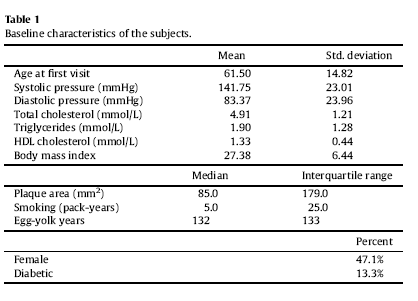 |
| Table 1, click for larger version |
Looking at Table 2, I almost fell out of my chair. From laughing. The people who ate the least eggs, <50 in "egg years", were the youngest. Their ages were 55.70 +/- 17.03 at first visit, so some of them were as young as 38.67 years. Now as the egg consumption goes up, so do the ages. The people who ate the most eggs were much older. Their ages were 69.77 +/-11.38 at first visit. The youngest in the high consumption group was 58.39. That seems like some underhanded chicanery if you ask me!
 | |
| Table 2, click for larger version |
Of course the older people are going to have more instances of heart disease and thicker arteries too because of their age. They even state that in the article, that the older people have more plaque. Oh, but wait! The study says they "adjusted" for age. Why instead of poking around with numbers, actually study the same age groups? Or would that be because there wouldn't be any correlation? (Never mind causation.)
One could easily draw the conclusion that eggs have nothing to do with the thickness of the plaque, but with age. I could just as easily draw the conclusion that as you get older you eat more eggs. That's valid right? Or maybe the more eggs you eat, the older you get. Maybe if you never eat eggs you'll never get old? I'm screwed in that case!
It's interesting that they say that there were 2831 patients with data on egg yolk consumption, but only 1231 were used for various reasons. I'm sure those reasons were all good right, like not anything to do with throwing out data we didn't like, right? Right?
Also of interest, is that they found that fasting cholesterol, BMI, Triglycerides, HDL cholesterol and LDL cholesterol were not significant predictors of the thickness of plaque. Just egg yolks!
In my humble opinion, considering that the sample was unbalanced, not random in the least and that more than half of the data they had access to was thrown out, that this amounts to someone with an agenda, with an axe to grind. Because if you really wanted to help people, and you really wanted to find out what was causing heart disease, you wouldn't have such poor research methods. However, if what you really want is to push an agenda, you won't care about data or ethics or anything else. You won't care if you kill people, so long as yours is the voice that is heard, so long as yours is the message that is received. Because diet is a religion to quite a few people out there, on all sides.
Just so you know, I'm my own experiment in this case. I eat at least three eggs almost every day. If I drop dead of heart disease, well, we won't know if it was the eggs that caused it, or my propensity for fountain diet cokes :P
Wednesday, August 15, 2012
Low carb, Hypothyroidism, and How to Lie with Statistics
I'm just an artist. An artist that read Darrell Huff's "How to Lie with Statistics". It's an old book, published sixty years ago now. Apparently people have been using statistics to lie about things for a while now.
I had heard something about low-carb diets causing hypothyroidism (repeat after me, correlation is not causation). As it stands, it seems to me that there is no way to know definitively whether they do or not, because the subject has never been studied. Oh, but you say, what about all those studies that are cited by so many bloggers. One of the first posts I found when I delved into this notion, was by blogger Anthony Colpo, and I read his post on the matter. Not withstanding the rudeness (which is not just on his side of the argument but rather all about the blogosphere as it were [did y'alls mothers not teach basic manners?]), I did think he might-could-be on to something. Until of course I looked at the studies he cited.
I never understood exactly why an underpowered study was, well, underpowered until I read Huff's book. You see, if you don't have enough of a sample size, what you have is chance. Yes that's right, pure unadulterated chance. The same sort of chance that you have flipping a coin. The explanation that Huff gives is crystal clear, and I urge you to buy his book and read it. If you flip a penny ten times (let's say to represent the outcome of ten patients in a study), you might get that it comes up heads eight out of the ten times. But you might get that it comes out heads two of the ten times. You would have to flip thousands of times (or maybe study 100k participants because humans have more than two variables) to come out with any sort of reasonable data to study.
There could be something to this and there might not be. If there is a higher incidence of thyroid problems among people who eat low-carb (and I don't even know that that is true, but IF it is) how do you know that the problems weren't triggered by the diet they ate before they ate low-carb, the crappy Standard American Diet? Or that since most people who do low-carb want to lose weight, maybe the obesity triggered their thyroid to go out of whack. Or maybe it was a virus they were exposed to. It could be absolutely any of the above, or none at all. A week long study is not enough for your endocrine system to adjust to the changes of going from a Standard diet to a low-carb diet. Six males or three random participants tells you nothing other than chance. It seems like most of the medical studies I read are run by Vegas gambling addicts. Let's throw the dice and see what we come up with! This is not science. This is nonsense.
I had heard something about low-carb diets causing hypothyroidism (repeat after me, correlation is not causation). As it stands, it seems to me that there is no way to know definitively whether they do or not, because the subject has never been studied. Oh, but you say, what about all those studies that are cited by so many bloggers. One of the first posts I found when I delved into this notion, was by blogger Anthony Colpo, and I read his post on the matter. Not withstanding the rudeness (which is not just on his side of the argument but rather all about the blogosphere as it were [did y'alls mothers not teach basic manners?]), I did think he might-could-be on to something. Until of course I looked at the studies he cited.
I never understood exactly why an underpowered study was, well, underpowered until I read Huff's book. You see, if you don't have enough of a sample size, what you have is chance. Yes that's right, pure unadulterated chance. The same sort of chance that you have flipping a coin. The explanation that Huff gives is crystal clear, and I urge you to buy his book and read it. If you flip a penny ten times (let's say to represent the outcome of ten patients in a study), you might get that it comes up heads eight out of the ten times. But you might get that it comes out heads two of the ten times. You would have to flip thousands of times (or maybe study 100k participants because humans have more than two variables) to come out with any sort of reasonable data to study.
"The importance of using a small group is this: With a large group any difference produced by chance is likely to be a small one and unworthy of big type...How results that are not indicative of anything can be produced by pure chance--given a small enough number of cases--is something you can test yourself at small cost. Just start tossing a penny... Only when there is a substantial number of trials [or participants] involved is the law of averages a useful description or prediction."--Darrell Huff, How to Lie with Statistics p.39-40The two studies Colpo cites in his article, Dietary-induced Alterations in Thyroid Hormone Metabolism during Overnutrition and Isocaloric carbohydrate deprivation induces protein catabolism despite a low T3-syndrome in healthy men are woefully underpowered. The first one used three, yes THREE participants to conclude that no carbohydrates induces low T3 over a week. Yes, a week. The second study had a total of six participants over the course of eleven days (the abstract doesn't say if that's 11 days for each diet, or 11 days total, but whether it is one or the other it adds up to bull-hockey). I suppose that's twice as good as the first study. Bull-hockey times two equals twice as much bull-hockey for your grant money.
There could be something to this and there might not be. If there is a higher incidence of thyroid problems among people who eat low-carb (and I don't even know that that is true, but IF it is) how do you know that the problems weren't triggered by the diet they ate before they ate low-carb, the crappy Standard American Diet? Or that since most people who do low-carb want to lose weight, maybe the obesity triggered their thyroid to go out of whack. Or maybe it was a virus they were exposed to. It could be absolutely any of the above, or none at all. A week long study is not enough for your endocrine system to adjust to the changes of going from a Standard diet to a low-carb diet. Six males or three random participants tells you nothing other than chance. It seems like most of the medical studies I read are run by Vegas gambling addicts. Let's throw the dice and see what we come up with! This is not science. This is nonsense.
Friday, January 20, 2012
You might think...
... that after a while, the chorus of inaccurate information would be drowned in the sea of evidence. MSNBC's Health Today posted an article four days ago (I've been busy) on Paula Deen's diabetes. They basically say the same old tired non-sense about how it has nothing to do with what you eat, that if you only maintain your weight and exercise more you won't get diabetes, unless of course you are predisposed to it because of genetics.
What’s important when it comes to diabetes prevention is not what you eat, but rather, how much, said Linda Siminerio, director of the Diabetes Institute at the University of Pittsburgh Medical Center.
“To my knowledge no particular food has been linked to an increase in the risk of diabetes,” Siminerio said. “It’s being overweight and inactive.”
Linda Siminerio ought to be ashamed of herself. How does one become director of a Diabetes Institute without having a grasp on biochemistry? What in the hell does she think makes people gain weight? What food could be cut out to make them lose weight effortlessly? I'll give you three guesses. Carbohydrates(!) make you gain weight (if you are insulin resistant). End of discussion.
Excessive carbohydrate intake (along with damage to your mitochondria, maybe from eating trans-fats or all the fake processed crap or something else unknown or all of the above) exacerbate insulin resistance, which in time leads to diabetes. See! I understand that and I'm a freakin' artist. I'm probably more qualified than she is to talk about what diabetics and those at risk of diabetes ought to eat. Why? Because I have a brain, some common sense, and can look at the data and draw a conclusion. Ms. Siminerio on the other hand is beholden to the "establishment". She can't say anything that hasn't already been dictated or she'd probably lose her cushy position as director of some Institute on Something.
Oh, but you say, "Some people eat carbohydrates and they don't get fat or get diabetes." And I say, that's fantastic for them. The bottom line is, if your metabolism is "broken" you can't eat carbohydrates. I know, it's very sad. I like brioche and donuts as much as the next person. But like recovering alcoholics liking their alcohol, I know that if I eat them, I will gain all the weight back.
Here's the deal. Doctors and these "experts" are just humans. Half of them probably aren't even as smart as the average person. In fact, I've come to the conclusion that none of them have even half the common sense of your average American. That's a sad state of affairs. I've seen day laborers with more sense than Ms. Siminerio and her "expert" friends. 
I'm rambling now, and I have a ton of other things to do than rage about the stupidity of people. How many more people have to DIE before these asshats stop spreading lies and misinformation? >_<
I'll leave you with something heartening, on the way home today, I saw a sign at a local Tex Mex place that said "Low Carb Plate $7.95" :)
Tuesday, January 17, 2012
We Protest SOPA/PIPA
This site will be blacked out on January 18th to protest SOPA/PIPA.
So much for smaller government.
So much for smaller government.
Saturday, January 14, 2012
Oh noes, Sausage causes cancer
The Daily Telegraph reports that eating sausage will give you pancreatic cancer. I'm just screwed then because I eat a lot of sausage and a lot of red meat. Funny, so did our ancestors and they didn't die of cancer very often.
I'll keep this short because it's waaaaaay past my bedtime, but they drew these conclusions by doing a meta-analysis on eleven studies that used food recall questionnaires. What a waste of time and money.
I'll keep this short because it's waaaaaay past my bedtime, but they drew these conclusions by doing a meta-analysis on eleven studies that used food recall questionnaires. What a waste of time and money.
I'll bet not one of those studies asked how much wheat they ate, or considered macro-nutrient intake. Of course not, because it's all a bunch of BS. They want us all to be vegan but eat Monsanto's genetically engineered crap while we're at it.The latest study, published in the British Journal of Cancer, is from researchers at the respected Karolinska Institute in Stockholm, Sweden. [Respected? By whom?]
They examined data from 11 studies, including 6,643 cases of pancreatic cancer.
Thursday, January 12, 2012
Low Carb Brownie Recipe
I made the chocolate covered peanuts recipe from the other day again today. It's a real winner, everyone in the house likes it, which means I keep running out. Anyway, after I made it, as I was licking the pan before washing it, I had an epiphany. I thought the chocolate part would make a good base for brownies. And boy was I right! Everyone loved these brownies:
Melt butter on very low heat. Add cocoa and stir until smooth. Remove from heat.
In mixing bowl, beat eggs until light. Add sugar and stir well.
Then add the above together (after the cocoa has cooled off a little).
Add vanilla and stir.
Add dry ingredients and mix thoroughly.
Bake on 350 degrees in a well greased 8x8x2 pan for thirty to thirty-five minutes.
Brownies (Low Carb, cake type)
1 stick butter (8 T.)
2 T. cocoa
2 eggs
3/4 c. splenda
1/4 c. erythritol (buy it here)
1 tsp vanilla
3/4 c. almond flour (buy it here or grind your own)
1/2 tsp baking powder
1/2 tsp salt
Melt butter on very low heat. Add cocoa and stir until smooth. Remove from heat.
In mixing bowl, beat eggs until light. Add sugar and stir well.
Then add the above together (after the cocoa has cooled off a little).
Add vanilla and stir.
Add dry ingredients and mix thoroughly.
Bake on 350 degrees in a well greased 8x8x2 pan for thirty to thirty-five minutes.
Saturday, January 7, 2012
Healthier Scammers
While on Facebook today, I saw an ad for a website called Healthier Post claiming to promote health and weight loss. I told you the other day that I could find something to make me face-palm every day of the week! They're out to sell you a supplement of course, and I am sure that there are probably hundreds of others just like them, but I'm picking on them because I saw their ad.
I perused their website, and honestly I wouldn't have bothered writing about them, except for the fact that they are touting patently false information, and some of it would be almost comical, if it weren't for the fact that this information will make you sick and could kill you. Now, some of the information on their site was reasonable. They advocate avoiding sugar and processed flour. I think we all agree those things are not good for you. But how about this?

I perused their website, and honestly I wouldn't have bothered writing about them, except for the fact that they are touting patently false information, and some of it would be almost comical, if it weren't for the fact that this information will make you sick and could kill you. Now, some of the information on their site was reasonable. They advocate avoiding sugar and processed flour. I think we all agree those things are not good for you. But how about this?
This is a screen capture from a page on their website, text hi-light is mine
The idea that your body cannot process fats and oils is one of the most absurd things I've ever read. And I was an Art History major for a while, trust me when I say that I've read a lot of absurd things. I'm not going to get into the biochemistry behind fatty acid metabolism, mostly because I barely understand it myself. (If you want to learn more about biochemistry as it relates to health and weight loss I suggest checking out Hyperlipid's blog, as he knows more about this stuff in his pinky finger, than I do in my whole brain.) What I will say is this, it's very basic science to understand that your body doesn't know fat you eat from fat you store. It's all fuel to your body. If what they said were true, and your body could not "process" fats and oils, humans would not have made it out of the paleolithic. If there is nothing to eat, what do you think your body runs on? It runs on fat released from your adipose (fat) tissue and ketone bodies manufactured by your liver. Your brain can use ketone bodies for fuel instead of glucose once ketone levels are sufficiently high. Research has shown that brain cancer patients could benefit from zero carb diets because brain cancer likes glucose but cannot use ketones. Go figure.
But it gets better! On another page they tell you to avoid the following foods in order to lose weight. It sounds almost like the standard government advice, but the text below has more ridiculous assertions that have no basis in biochemistry.

The idea that your body cannot process fats and oils is one of the most absurd things I've ever read. And I was an Art History major for a while, trust me when I say that I've read a lot of absurd things. I'm not going to get into the biochemistry behind fatty acid metabolism, mostly because I barely understand it myself. (If you want to learn more about biochemistry as it relates to health and weight loss I suggest checking out Hyperlipid's blog, as he knows more about this stuff in his pinky finger, than I do in my whole brain.) What I will say is this, it's very basic science to understand that your body doesn't know fat you eat from fat you store. It's all fuel to your body. If what they said were true, and your body could not "process" fats and oils, humans would not have made it out of the paleolithic. If there is nothing to eat, what do you think your body runs on? It runs on fat released from your adipose (fat) tissue and ketone bodies manufactured by your liver. Your brain can use ketone bodies for fuel instead of glucose once ketone levels are sufficiently high. Research has shown that brain cancer patients could benefit from zero carb diets because brain cancer likes glucose but cannot use ketones. Go figure.
But it gets better! On another page they tell you to avoid the following foods in order to lose weight. It sounds almost like the standard government advice, but the text below has more ridiculous assertions that have no basis in biochemistry.
Another screen shot from their website, emphasis mine
Three things here, first of all your body doesn't view "natural" sugar (whatever they mean by that) any differently than any other sugar. Sugar is sugar. Glucose and fructose are all handled in exactly the same way by your body and it doesn't matter what the source is. Next they say that fats and oils are toxic. Apparently they've never heard of essential fatty acids. You know, those things that are required for you to continue living. I don't know about you but I like living, and I like to eat fat too. Now lastly, they say that you should cut these foods completely out of your diet. You know, you'd almost think they were advocating veganism, but they're not. A few paragraphs down they say, "...you should eat proteins like steak, fish, chicken, and eggs to keep you strong and give you the energy to exercise." Are they just stupid? I'm not entirely sure, but a great portion of steak, fish and all of egg yolks are fat. Maybe they're just uneducated, out to sell you a product, and have copy and pasted various (and thus contradictory) text from around the web.
The moral of this story is, if a website promotes "fast" weight loss, advocates colon "cleansing," wants to sell you something to lose weight, and does not understand that just because something is "natural" doesn't make it good or safe, do like Monty Python and RUN AWAY!
Friday, January 6, 2012
Recipe: Chocolate Peanut Butter Bark
I have come up with the perfect treat if you're eating low-carb. It tastes just like chocolate covered peanuts but in the form of something like toffee bark, in that it is poured into a pan.
I'm calling it:
Chocolate Peanut Butter Bark
Melt the butter on low heat in a sauce pan. Add cocoa and stir until smooth. Add the the peanut butter and stir again until smooth. Turn the heat off.
Add sweeteners and vanilla, and again, stir, but it won't be smooth. At this point, you'll want to add enough cream to make it smooth again. You may need to turn the heat back on at this point. If the mixture winds up a little thin, it's okay because it will harden in the fridge.

Add peanuts and stir until they are thoroughly covered. For the last batch I made I tried peanuts from a local place that still had the skin on them, and they came out just fine.
Pour the mixture into a quarter sheet pan that is covered with parchment paper. Spread the mixture over the pan.

Refrigerate for a few hours until hardened. Once hardened you can break into chunks and put them in a container and freeze them. It's very good frozen! Actually it's just damned good :)


I'm calling it:
Chocolate Peanut Butter Bark
1 stick + 2 T. of butter (total of 10 T.)
6 T. cocoa
4 T. peanut butter
1 1/2 c. splenda
1/2 c. erythritol (buy it here)
2 packets stevia
1/2 tsp vanilla extract
heavy cream as needed (appx. 3-4 T.)
2-3 c. peanuts (depending on how much cream you add)
Melt the butter on low heat in a sauce pan. Add cocoa and stir until smooth. Add the the peanut butter and stir again until smooth. Turn the heat off.
Add sweeteners and vanilla, and again, stir, but it won't be smooth. At this point, you'll want to add enough cream to make it smooth again. You may need to turn the heat back on at this point. If the mixture winds up a little thin, it's okay because it will harden in the fridge.
Don't stop stirring while the heat is on
Add peanuts and stir until they are thoroughly covered. For the last batch I made I tried peanuts from a local place that still had the skin on them, and they came out just fine.
Pour the mixture into a quarter sheet pan that is covered with parchment paper. Spread the mixture over the pan.
Parchment paper is the best thing since sliced meat :P
Refrigerate for a few hours until hardened. Once hardened you can break into chunks and put them in a container and freeze them. It's very good frozen! Actually it's just damned good :)
The final product, great for everyday snacks or a party
The entire recipe has the following nutritional content (according to the Nutrition Data website):
5645 calories (all that butter yum!)
505 g fat
139 g saturated fat
213 g carbs
64 g fiber
184 g protein
That's 149 grams of net carbs in the entire recipe. You can eat maybe three pieces before you've really had quite enough. There's probably about 5 grams of carbs per chunk, depending on the size of the chunk. And a whole lot of yummy fat to mediate those carbs.
The entire recipe has the following nutritional content (according to the Nutrition Data website):
5645 calories (all that butter yum!)
505 g fat
139 g saturated fat
213 g carbs
64 g fiber
184 g protein
That's 149 grams of net carbs in the entire recipe. You can eat maybe three pieces before you've really had quite enough. There's probably about 5 grams of carbs per chunk, depending on the size of the chunk. And a whole lot of yummy fat to mediate those carbs.
Wednesday, January 4, 2012
Face-Palm Thursdays: Because two million years of evolution is obviously wrong
I should start a new trend where I publish things that make me face-palm on Thursdays. Actually, in this subject I could probably find enough things to make me face-palm every day of the week, possibly multiple times a day. US News has the skinny on what will make you skinny. Not really.
Face Palm: Best Diets for the New Year 2012
Top of the list? A diet, called the DASH diet, developed by the National Heart, Lung, and Blood Institute (NHLBI). You guessed it, eat your recommended number of carbs plus all those "healthy" whole grains, and just don't eat salt and saturated fat and you'll lose weight, especially if you cut back on calories! How does that work anyway? And they say that "rigorous studies" showed that this diet can lower blood pressure. Funnily enough, they don't quote exactly which "rigorous studies" they're referring to.
I'm not going to list all of the craptacular diets they put at the top of the list, (and believe me, I know all about craptacular diets having been obese for most of my life and trying repeatedly to lose the weight and being unable to), but they put Atkins towards the bottom. While their "rigorous studies" obviously prove that cutting back salt and eating whole grains defeats heart disease (really! I'm super cereal! pun totally intended) they dis Atkins because all the studies were too short and the data was not statistically significant. You can read that again, but I assure you, you didn't misread it.
Now, the Vegan Diet did better than Atkins and the Paleo diet despite the fact that it "may not provide enough of some nutrients." No kidding. But it ranks higher than ones that are better for you? Well, I believe that's called cognitive dissonance.
And what did they put at the bottom of the list? The Paleo Diet. Because 2 million years of evolution is obviously wrong. To whatever quack job wrote the article on US News, go live with the Inuit for a year like Stefansson did and get back to me on the lack of dairy and grains. Here's what they say about the nutritional breakdown of the Paleo Diet:
Repeat after me, THERE ARE NO ESSENTIAL CARBOHYDRATES.
Face Palm: Best Diets for the New Year 2012
Top of the list? A diet, called the DASH diet, developed by the National Heart, Lung, and Blood Institute (NHLBI). You guessed it, eat your recommended number of carbs plus all those "healthy" whole grains, and just don't eat salt and saturated fat and you'll lose weight, especially if you cut back on calories! How does that work anyway? And they say that "rigorous studies" showed that this diet can lower blood pressure. Funnily enough, they don't quote exactly which "rigorous studies" they're referring to.
I'm not going to list all of the craptacular diets they put at the top of the list, (and believe me, I know all about craptacular diets having been obese for most of my life and trying repeatedly to lose the weight and being unable to), but they put Atkins towards the bottom. While their "rigorous studies" obviously prove that cutting back salt and eating whole grains defeats heart disease (really! I'm super cereal! pun totally intended) they dis Atkins because all the studies were too short and the data was not statistically significant. You can read that again, but I assure you, you didn't misread it.
Now, the Vegan Diet did better than Atkins and the Paleo diet despite the fact that it "may not provide enough of some nutrients." No kidding. But it ranks higher than ones that are better for you? Well, I believe that's called cognitive dissonance.
And what did they put at the bottom of the list? The Paleo Diet. Because 2 million years of evolution is obviously wrong. To whatever quack job wrote the article on US News, go live with the Inuit for a year like Stefansson did and get back to me on the lack of dairy and grains. Here's what they say about the nutritional breakdown of the Paleo Diet:
Fat. At about 39 percent of daily calories from fat, a sample Paleo menu exceeds the government’s 35 percent cap by a bit.
Protein. The government recommends 10 to 35 percent of daily calories come from protein; the Paleo diet clocks in around 38 percent.
Carbohydrates. At 23 percent of daily calories from carbs, it’s far below the government’s 45 to 65 percent recommendation.
Repeat after me, THERE ARE NO ESSENTIAL CARBOHYDRATES.
Saturday, December 24, 2011
Homemade Mayonnaise Recipe
I have found that making mayonnaise from scratch is very easy! It may seem counter intuitive, but doing it by hand is actually easier than trying to get an emulsion in a mixer or blender.
There are a few things that I have learned that will be helpful to you if you decide to try to make your own. The first is, use fresh farm/yard eggs. I don't know what they've done to our commercial egg supply, but the yolks are not the same. I know, you find that incredibly hard to believe. {/snark} Fresh yard eggs will make an emulsion and keep it without you even having to do anything, I mean unless you just dump all the oil in. If you pour the oil slowly and stir fast, the emulsion makes itself (or in Soviet Russia emulsion makes you!)
Secondly, you will want to use "light tasting olive oil" like this here (or whatever brand you'd rather have). Other types of olive oil can have a very strong flavor, which might be okay in some instances, like if you're making dressing out of it. Don't use lard. Trust me on this.
Finally, I've found that a mixture of sherry wine vinegar and lemon juice really makes the best mayonnaise.
So the recipe? There are literally dozens of them, maybe hundreds, but I've found the best one to make by hand is based on the one from Mastering the Art of French Cooking* by Julia Child, et al.
I've altered it though, because it says either sherry wine vinegar or lemon juice, but I insist that using both is better. I also reduce the amount of boiling water needed, maybe because I add more vinegar/lemon juice than she says to. I also suggest you buy the book, because it is one of the best cookbooks ever :)
Homemade Mayonnaise by hand
All you need is a bowl and a whisk to make this. Make sure your bowl is warm (but dry!) so to take the chill off your eggs. Beat the egg yolks until they are thick and sticky, about two minutes.
Add the vinegar, lemon juice, salt and mustard. Beat for 30 seconds.
Then add the oil, a teaspoon at a time at first (don't stop stirring until you have an emulsion!), then once you have an emulsion (after about a quarter of the bottle) you can add a Tablespoon at a time. Once you do have an emulsion, make sure you whip it good after adding oil, before adding any more. When the mixture gets thick, add more sherry wine vinegar or lemon juice to thin it out, alternating between the two. I generally add about 3 T. of each during the course of adding the oil, a Tablespoon here and there. Once you have added all the oil, you'll want to add the boiling water to keep the mayonnaise from turning.
And buy the book! There are a lot more details about making mayonnaise in it, and all about how to fix turned mayonnaise and how to save a mixture that has lost the emulsion. I can't recommend it enough, it's really one of my favorite cook books of all time.
*The edition we have is an old one, so I don't know if they've changed anything in the newer versions
There are a few things that I have learned that will be helpful to you if you decide to try to make your own. The first is, use fresh farm/yard eggs. I don't know what they've done to our commercial egg supply, but the yolks are not the same. I know, you find that incredibly hard to believe. {/snark} Fresh yard eggs will make an emulsion and keep it without you even having to do anything, I mean unless you just dump all the oil in. If you pour the oil slowly and stir fast, the emulsion makes itself (or in Soviet Russia emulsion makes you!)
Secondly, you will want to use "light tasting olive oil" like this here (or whatever brand you'd rather have). Other types of olive oil can have a very strong flavor, which might be okay in some instances, like if you're making dressing out of it. Don't use lard. Trust me on this.
Finally, I've found that a mixture of sherry wine vinegar and lemon juice really makes the best mayonnaise.
So the recipe? There are literally dozens of them, maybe hundreds, but I've found the best one to make by hand is based on the one from Mastering the Art of French Cooking* by Julia Child, et al.
I've altered it though, because it says either sherry wine vinegar or lemon juice, but I insist that using both is better. I also reduce the amount of boiling water needed, maybe because I add more vinegar/lemon juice than she says to. I also suggest you buy the book, because it is one of the best cookbooks ever :)
Homemade Mayonnaise by hand
- 4 egg yolks
- 1 T. sherry wine vinegar
- 1 T. lemon juice
- 1 tsp salt
- 1/2 tsp prepared or unprepared mustard
- ~17 oz bottle of light tasting olive oil
- Sherry wine vinegar and lemon juice as needed (about 3T. of each)
- 3 T. boiling water
All you need is a bowl and a whisk to make this. Make sure your bowl is warm (but dry!) so to take the chill off your eggs. Beat the egg yolks until they are thick and sticky, about two minutes.
Add the vinegar, lemon juice, salt and mustard. Beat for 30 seconds.
Then add the oil, a teaspoon at a time at first (don't stop stirring until you have an emulsion!), then once you have an emulsion (after about a quarter of the bottle) you can add a Tablespoon at a time. Once you do have an emulsion, make sure you whip it good after adding oil, before adding any more. When the mixture gets thick, add more sherry wine vinegar or lemon juice to thin it out, alternating between the two. I generally add about 3 T. of each during the course of adding the oil, a Tablespoon here and there. Once you have added all the oil, you'll want to add the boiling water to keep the mayonnaise from turning.
And buy the book! There are a lot more details about making mayonnaise in it, and all about how to fix turned mayonnaise and how to save a mixture that has lost the emulsion. I can't recommend it enough, it's really one of my favorite cook books of all time.
*The edition we have is an old one, so I don't know if they've changed anything in the newer versions
Thursday, November 24, 2011
Squirrel Stew (also known as Brunswick Stew)
You're going to want to start this recipe really early in the morning because it will take approximately nine hours to make, most of that simmering on the stove. The squirrel can be frozen. I had harvested the squirrels I used to make this a couple months prior and they were stored in freezer bags in the freezer. See youtube on how to field dress a squirrel (not kidding, that's how I learned!)
In a very large pot, first put squirrel meat in the broth adding enough water to cover the meat. Add salt, black pepper and cayenne pepper. Bring to a boil and then reduce heat so it is lightly boiling. Cook meat for about three to four hours, adding water as needed, until the meat falls off the bones.
Using a slotted spoon, remove meat from stock. Add vegetables to stock, all of them should be well diced. You can use any vegetable really, but NOT rice. Rice is never used in Brunswick stew.
Next, remove meat from bones (this can take a while) and then add meat back into pot. Add more salt to taste. Let simmer/lighthly boil, stirring fairly often (it will stick to the bottom of the pot) until vegetables are reduced to mush. Add water as needed. You can make this the day before you need it and reheat it on the stove.
This recipe is really, really good and based on one from a late 19th century cookbook. My husband does not like fried squirrel, but he did love this stew. The long cook time takes a lot of the gaminess out of meat. You might use this recipe for other game meats as well.
- Five squirrels, skinned, field dressed and quartered
- 2 qts chicken stock
- water
- 4 T. salt
- 4 tsp black pepper
- 2 tsp cayenne pepper
- 2 medium sized onions
- 3 medium sized potatoes
- 1 can corn
- 2 c. frozen or fresh lima beans
- 2 c. frozen or fresh okra
- 3-4 carrots
- 3-4 celery stalks
- 5 c. cherry/porter tomatoes
In a very large pot, first put squirrel meat in the broth adding enough water to cover the meat. Add salt, black pepper and cayenne pepper. Bring to a boil and then reduce heat so it is lightly boiling. Cook meat for about three to four hours, adding water as needed, until the meat falls off the bones.
Using a slotted spoon, remove meat from stock. Add vegetables to stock, all of them should be well diced. You can use any vegetable really, but NOT rice. Rice is never used in Brunswick stew.
Next, remove meat from bones (this can take a while) and then add meat back into pot. Add more salt to taste. Let simmer/lighthly boil, stirring fairly often (it will stick to the bottom of the pot) until vegetables are reduced to mush. Add water as needed. You can make this the day before you need it and reheat it on the stove.
This recipe is really, really good and based on one from a late 19th century cookbook. My husband does not like fried squirrel, but he did love this stew. The long cook time takes a lot of the gaminess out of meat. You might use this recipe for other game meats as well.
They're trying to kill us!
Or at least that's what the mum-in-law said when I told her about this stupid email I got with a link to a page with tips on how to control your blood sugar. Lies! That's what I call it. They basically say to remove meat from your diet and add whole grains and fruit as a means to control your blood sugar. Yeah, you know what the definition of insanity is? Doing the same thing over and over and over again and expecting different results. I don't suppose one should expect anything different from a site that is run by a bunch of corporate jackals and overseen by quacks *cough* Dr. Oz *cough*.
Good thing they have a medical disclaimer that states "[this] information is not to be taken as medical or other health advice..." Good advice, that.
By the way, we had a delicious thanksgiving dinner, with deep fried (in lard) turkey, squirrel stew (really! from a late 19th century recipe), jalapenos stuffed with cream cheese and wrapped in bacon, mashed cauliflower, and I don't know what else, plus a bunch of nut flour based deserts.
Good thing they have a medical disclaimer that states "[this] information is not to be taken as medical or other health advice..." Good advice, that.
By the way, we had a delicious thanksgiving dinner, with deep fried (in lard) turkey, squirrel stew (really! from a late 19th century recipe), jalapenos stuffed with cream cheese and wrapped in bacon, mashed cauliflower, and I don't know what else, plus a bunch of nut flour based deserts.
Wednesday, August 17, 2011
Texas Diabetes Council is Murdering Diabetics
The Texas Diabetes Council is trying to murder diabetics. I downloaded their food guide on a lark, and it basically mirrors the crappy food pyramid that the government advocates. They tell diabetics to eat six or MORE servings of bread per day. Hello? Bread is the same as sugar. But oh, sugar is okay for diabetics according to their food guide, but fat isn't.
Excuse me, but what the hell is wrong with these people? Why? I feel some days like I'm living in Orwell's 1984. Freedom is slavery, war is peace, sugar is good for diabetics.
They advocate a no to low fat diet. Since one can only eat so much protein, that means they advocate a high carbohydrate/sugar diet for diabetics. I'm sorry, Texas Diabetes Council, 1960 called. It wants it's diabetic diet back.
If you'd like to call them and ask why they're killing diabetics, their phone number is 1.888.963.7111 Ext 7490, or you can write them at PO Box 149347 MC 1965, Austin TX 78714-9347.
Or you can go in person:
THEY'RE KILLING PEOPLE WITH THEIR BAD, INACCURATE AND FRAUDULENT ADVICE, FUNDED BY OUR TAX DOLLARS. These "authorities" publish a message that is contrary to all of the scientific evidence, a message that makes people sicker so they have to rely on drugs, which ultimately makes them so sick they tax our healthcare system, which we ALL pay for. This nonsense, it makes me absolutely livid. How many more people have to DIE because of their bad advice?
Excuse me, but what the hell is wrong with these people? Why? I feel some days like I'm living in Orwell's 1984. Freedom is slavery, war is peace, sugar is good for diabetics.
They advocate a no to low fat diet. Since one can only eat so much protein, that means they advocate a high carbohydrate/sugar diet for diabetics. I'm sorry, Texas Diabetes Council, 1960 called. It wants it's diabetic diet back.
If you'd like to call them and ask why they're killing diabetics, their phone number is 1.888.963.7111 Ext 7490, or you can write them at PO Box 149347 MC 1965, Austin TX 78714-9347.
Or you can go in person:
Next Quarterly Texas Diabetes Council Meeting: October 27, 2011, 1:00 p.m., Texas Department of State Health Services, 1100 West 49th Street, Austin, TX 78756
THEY'RE KILLING PEOPLE WITH THEIR BAD, INACCURATE AND FRAUDULENT ADVICE, FUNDED BY OUR TAX DOLLARS. These "authorities" publish a message that is contrary to all of the scientific evidence, a message that makes people sicker so they have to rely on drugs, which ultimately makes them so sick they tax our healthcare system, which we ALL pay for. This nonsense, it makes me absolutely livid. How many more people have to DIE because of their bad advice?
Sunday, June 26, 2011
Which Industry Funds Your Study? Sun Exposure and Vitamin D
I decided after reading up about Vitamin D the other day, and hearing that it may prevent sunburns as well, that I would look for more articles on that. Well, I found an article that made me want to laugh when I read the abstract. In fact, if it weren't for the erroneous statement they made, I probably wouldn't have bothered reading it. I found more erroneous propositions in it of course. And these people call themselves researchers? This is the problem with medical research in this country today. Seemingly educated people make stupid assumptions and it gets translated into "common knowledge." So what has irked me so? This from this article, about how terrible the sun is for you:
And these people are "educated"? First of all, average lifespan during the paleolithic is arguable. Secondly, the "average" is dragged down by infant mortality. During the paleolithic if one lived past the age of five and did not succumb to infection disease, one probably had just as much chance to live to eighty as they do now. So the whole "expected lifespan" is irrelevant to their argument. Completely irrelevant. I learned this in introductory archaeology.
Secondly, when evolution chooses for something, it has to be before child bearing age. In other words, it has to happen before you pass it onto your offspring. So, things that are bad for us later in life, are not evolutionarily chosen for. This is basic biology. Who are these people? And who is paying them to write this crap?
Again, I'm not a mouse. I've heard of this type of argument before, it's called an appeal to the vain. Someone should make a snark font, I could use it now. I'm sorry, but no one's skin looks very good at 70, sun or no, unless they've got a plastic surgeon on call. And what does this have to do with cancer?
So now we're at the museum. One of my favorite pieces that I have an appreciation for is Meindert Hobbema's Avenue at Middelharnis. It gives the perception that one is standing, looking down a road in 17th century Holland. Are we in Art History class or doing medical research? I call shenanigans.
In other words, they stuck people under artificial UV light sources. Not the sun. I would think that makes the study pretty irrelevant when it comes to actual sun exposure. How is artificial light the same? I know that it could be composed of the same UV rays, but is it the same? Might there not be some difference, that without doing an actual study where you, oh I don't know, put people in the sun, you'd never know there was a difference? But what do I know, I'm just an artist.
This article has a real problem with what they call the "tanning bed" industry. However, I'm thinking that since they put a large plug in for sunscreen, I believe I know where their funding came from.
Is that anything like the low-fat campaign? I'm to the point that if authority figures tell me I should do something, I believe I should do the opposite.
"When nature gave man the appealing capacity for vit D photosynthesis, the expected lifespan was far less than 40 years."
And these people are "educated"? First of all, average lifespan during the paleolithic is arguable. Secondly, the "average" is dragged down by infant mortality. During the paleolithic if one lived past the age of five and did not succumb to infection disease, one probably had just as much chance to live to eighty as they do now. So the whole "expected lifespan" is irrelevant to their argument. Completely irrelevant. I learned this in introductory archaeology.
Secondly, when evolution chooses for something, it has to be before child bearing age. In other words, it has to happen before you pass it onto your offspring. So, things that are bad for us later in life, are not evolutionarily chosen for. This is basic biology. Who are these people? And who is paying them to write this crap?
"The causal role of UV irradiation in both non-melanoma skin cancer (NMSC) and melanoma has been suspected by experienced clinicians and epidemiologists for well more than a century and was demonstrated repeatedly in studies of hairless mice and other animal models beginning in the 1920s."Yes because we're genetically altered hairless mice. And they suspect UV irradiation causes skin cancer, so therefore it must be true. Wait. What? This doesn't convince me of anything except that whoever wrote this article has the critical thinking skills of a dung beetle. What's even more amusing is they cite an article from 1928. Yes, I'm not making that up. In 1928, they had just figured out that Pellagra wasn't an infectious disease. Incidentally, that's the same year that Alexander Fleming discovered penicillin. My, how far we've come. I need a sarcasm font, but I digress.
"Photoaging changes, even aside from the strongly associated skin cancer risk, is a source of distress for a majority of fair-skinned adults beyond the age of 40–50 years and has spawned a multi-billion dollar skin rejuvenation market. The cause-and-effect relationship between UV exposure and photoaging, like the relationship with skin cancer, has been well documented in mouse models."
Again, I'm not a mouse. I've heard of this type of argument before, it's called an appeal to the vain. Someone should make a snark font, I could use it now. I'm sorry, but no one's skin looks very good at 70, sun or no, unless they've got a plastic surgeon on call. And what does this have to do with cancer?
"...the attractiveness of a tan became embedded in the public psyche and remains there to this day, nearly a century later, despite the revised medical and scientific perception of a tan as a DNA damage response and widespread appreciation that UV exposure often leads to skin cancer."
So now we're at the museum. One of my favorite pieces that I have an appreciation for is Meindert Hobbema's Avenue at Middelharnis. It gives the perception that one is standing, looking down a road in 17th century Holland. Are we in Art History class or doing medical research? I call shenanigans.
"In the 1980s, studies employing normal human volunteers and multiple narrow band UV light sources determined the relative efficacy of different wavelengths of light in producing sunburn and suntan as well as epidermal DNA damage."
In other words, they stuck people under artificial UV light sources. Not the sun. I would think that makes the study pretty irrelevant when it comes to actual sun exposure. How is artificial light the same? I know that it could be composed of the same UV rays, but is it the same? Might there not be some difference, that without doing an actual study where you, oh I don't know, put people in the sun, you'd never know there was a difference? But what do I know, I'm just an artist.
This article has a real problem with what they call the "tanning bed" industry. However, I'm thinking that since they put a large plug in for sunscreen, I believe I know where their funding came from.
"If 2–8 min of unprotected summer sun exposure is required to optimize cutaneous vit D synthesis..."Except it's not. If 2-8 minutes of sun were enough then no one would be deficient in Vitamin D. What the rest of that sentence goes onto say, is that 10-20 minutes is plenty if wearing sunscreen. Yeah, you can't make this stuff up.
"The confusing and misleading media coverage of the “vit D controversy” over the past few years has unfortunately indeed undermined the campaign to reduce the current excessive sun exposure in our society."
Is that anything like the low-fat campaign? I'm to the point that if authority figures tell me I should do something, I believe I should do the opposite.
Friday, June 24, 2011
Vitamin D deficiency and Type 2 Diabetes
In the early part of the 20th century, a disease called Pellagra was thought to be caused by a virus or bacteria. It was common in the lower classes, but also did show up on occasion in more wealthy people. It was thought to be a "dirty" disease, and there was a stigma attached to contracting it. One of the people who contracted Pellagra was my husband's great-great grandmother. She died at a hospital in Dallas in 1922 from the disease. However, her death, and thousands of others were completely preventable. It turned out that Pellagra was a vitamin B3 deficiency.
Now we blame obesity and type 2 diabetes solely on what people are eating, but what if the catalyst for obesity and T2D is really something else entirely? What if it's a vitamin D deficiency? I found the following article at Science Direct:
In other words, if you're not getting a lot of sun, you should probably be supplementing Vitamin D3. I find it interesting that the pushing of the use of sunscreen coincides with the rise of obesity and diabetes in this country. Of course that's when our sugar intake increased too. Maybe it was the perfect storm?
Sunscreen wasn't in widespread use until the 1980s. Prior to that, beach goers might put zinc oxide on their noses, but that was about it. Then with the erroneous idea that the sun causes malignant cancer, enter the sunscreen industry. Like many things, drugs, food, etc. most research about sunscreen is funded by the sunscreen industry. They're out to sell you a product. If you die in twenty years because of it, well, they've made their money.
I would argue that they've forgotten that correlation is not causation. Say it with me, correlation is not causation. Associations are also not cause. Did it occur to them that (besides eating way too much sugar and way too many processed vegetable oils) that a deficiency in Vitamin D3 may be a catalyst for obesity? Obesity and insulin resistance go hand in hand. One may cause the other, or both may be caused by something else entirely. Or it's a chain reaction. Something causes insulin resistance which in turn causes obesity. I'm voting on that last one.
Another interesting article I found that has to do with how vitamin D deficiency may lead to breast, cervical and ovarian cancer. If you're not getting enough sun, I think it's a good idea to supplement Vitamin D3. It's cheap and the pills are small and easy to swallow.
Now we blame obesity and type 2 diabetes solely on what people are eating, but what if the catalyst for obesity and T2D is really something else entirely? What if it's a vitamin D deficiency? I found the following article at Science Direct:
The role of vitamin D deficiency in the pathogenesis of type 2 diabetes mellitus
Vitamin D can be obtained either through dietary intake or produced endogenously. It is found in foods such as oily fish (salmon, sardines, mackerel), egg yolks and fortified milk and juice; however dietary intake only accounts for about 30% of the vitamin D obtained. The primary route via which people obtain vitamin D is through exposure to ultraviolet B (UVB) sunlight at wavelengths between 290–315 nm, occurring predominantly in the summer months (June–July) in the Northern hemisphere (latitude >= 42° N).
In other words, if you're not getting a lot of sun, you should probably be supplementing Vitamin D3. I find it interesting that the pushing of the use of sunscreen coincides with the rise of obesity and diabetes in this country. Of course that's when our sugar intake increased too. Maybe it was the perfect storm?
Sunscreen wasn't in widespread use until the 1980s. Prior to that, beach goers might put zinc oxide on their noses, but that was about it. Then with the erroneous idea that the sun causes malignant cancer, enter the sunscreen industry. Like many things, drugs, food, etc. most research about sunscreen is funded by the sunscreen industry. They're out to sell you a product. If you die in twenty years because of it, well, they've made their money.
Glucose sensors located on β-cells sense increases in blood glucose levels despite increases in insulin secretion; the persistent hyperglycemia triggers a series of events which ultimately leads to an increase in β-cell expression, β-cell mass and enhanced secretory capacity of the pancreas. This compensatory increase in insulin secretion explains why some highly insulin resistant individuals never develop T2DM. In a study which examined pancreatic tissue from obese, non-diabetic individuals, relative β-cell volume of the pancreas was 50% greater in obese individuals than in their lean, non-diabetic counterparts (2.6 ± 0.39% vs. 1.71 ± 0.28%, P = 0.05), suggesting that these obese individuals did not progress to T2DM because they were able to increase their insulin production capacity by increasing β-cell mass. Individuals with T2DM do not experience this increase in β-cell mass, in fact there is a significant decrease in β-cell mass.So long as your body can continue to manufacture insulin to store fat, you will probably not develop Type 2 Diabetes. It is only when this system fails that T2D occurs. Some morbidly obese people do not develop diabetes and it is because they can continue to get fat. A deficiency in Vitamin D may make it difficult for your β-cells to fucntion properly. Another explanation for why some obese people may not develop diabetes is because they're not vitamin D deficient, or if they are, for some reason they require less vitamin D than others.
The identification of the 1α(OH)ase in β-cells suggests that 1,25(OH)2D3 may play a role in overall β-cell function. In vitro and in vivo studies have ascertained that 1,25(OH)2D3 is essential for insulin secretion and glucose homeostasis. VDR mutant mice show a significant decrease in insulin mRNA levels when compared to controls, suggesting that 1,25(OH)2D3 may be required for insulin synthesis.This isn't just something they've tried in a test tube. In vivo studies show that Vitamin D3 is essential for keeping blood sugar levels normal.
Lastly, obese individuals are often vitamin D deficient due to a decrease in the bio-availability of vitamin D metabolites which may explain why obesity is a risk factor for developing T2DM, although this association is only speculative...
Vitamin D deficiency increases peripheral tissue insulin resistance in addition to decreasing insulin secretion from pancreatic β-cells.
I would argue that they've forgotten that correlation is not causation. Say it with me, correlation is not causation. Associations are also not cause. Did it occur to them that (besides eating way too much sugar and way too many processed vegetable oils) that a deficiency in Vitamin D3 may be a catalyst for obesity? Obesity and insulin resistance go hand in hand. One may cause the other, or both may be caused by something else entirely. Or it's a chain reaction. Something causes insulin resistance which in turn causes obesity. I'm voting on that last one.
Another interesting article I found that has to do with how vitamin D deficiency may lead to breast, cervical and ovarian cancer. If you're not getting enough sun, I think it's a good idea to supplement Vitamin D3. It's cheap and the pills are small and easy to swallow.
Tuesday, May 24, 2011
Newest Designs at Cafe Press
I have some new designs at my cafepress store! Grains are for the birds and oats are for horses! This is just a sampling, so please look around.


Wednesday, May 18, 2011
Vegan Bacon
At Hunter-Gatherer.
Who would eat such crap? That's what I'm asking. Look, I've said it before and I'll say it again, if you want to wreck your health being vegan, well fine. Go for it, but why would you eat something that is manufactured by some corporation and that doesn't even resemble food?
Veganism is one of THE stupidest things that exist, and the people who follow it like a religion are even stupider. I understand if you do it for "ethical" reasons (which I think is misguided but whatever), but it certainly ought not be for "health" reasons since it's one of the most unhealthful diets you can eat, right after the Standard American Diet. I blame the lack of saturated fat. Saturated fat is really important for developing and maintaining cognitive function. So is cholesterol, but I digress.
The thing that really burns my biscuits though, is that vegans act like theirs is the natural diet man is supposed to be eating. This couldn't be further from the truth. Do you think that paleolithic man had greens, bananas and other stuff that only grows for part of the year in most places, shipped to them from a tropical location? They ate meat and lots of it. Some archaeologists think that paleolithic people were partially responsible for the mass extinction of mega-fauna at the end of the paleolithic.
If one wanted to be "ethical" about the way we treat this planet, they would eat local. They'd eat what was in their back yard. Of course, that would require having a back yard. I despise living in a city. I've done it, and I really don't like it. The only place I despise living more is in the suburbs. The neighbors are always a bunch of wackos.
If you eat vegan bacon, I'd suggest finding some real food to eat instead. The ingredient list on this vegan bacon reads like any other crap-in-a-box you might find in the frozen food section. Hint: soybean oil is very bad for you
Who would eat such crap? That's what I'm asking. Look, I've said it before and I'll say it again, if you want to wreck your health being vegan, well fine. Go for it, but why would you eat something that is manufactured by some corporation and that doesn't even resemble food?
Veganism is one of THE stupidest things that exist, and the people who follow it like a religion are even stupider. I understand if you do it for "ethical" reasons (which I think is misguided but whatever), but it certainly ought not be for "health" reasons since it's one of the most unhealthful diets you can eat, right after the Standard American Diet. I blame the lack of saturated fat. Saturated fat is really important for developing and maintaining cognitive function. So is cholesterol, but I digress.
The thing that really burns my biscuits though, is that vegans act like theirs is the natural diet man is supposed to be eating. This couldn't be further from the truth. Do you think that paleolithic man had greens, bananas and other stuff that only grows for part of the year in most places, shipped to them from a tropical location? They ate meat and lots of it. Some archaeologists think that paleolithic people were partially responsible for the mass extinction of mega-fauna at the end of the paleolithic.
If one wanted to be "ethical" about the way we treat this planet, they would eat local. They'd eat what was in their back yard. Of course, that would require having a back yard. I despise living in a city. I've done it, and I really don't like it. The only place I despise living more is in the suburbs. The neighbors are always a bunch of wackos.
If you eat vegan bacon, I'd suggest finding some real food to eat instead. The ingredient list on this vegan bacon reads like any other crap-in-a-box you might find in the frozen food section. Hint: soybean oil is very bad for you
Saturday, May 14, 2011
What have they done? Genetically modifying food, low-fat, and declining mental health
I made some homemade mayonnaise today. This is the first time that I used yard eggs in it. The last few times I made it, I used store bought eggs. The yard eggs are expensive, what can I say? I have always noticed that the store bought eggs' shells seem to be very brittle and easily broken. The yard eggs have shells that you have to actually tap hard to break. If I get used to cooking with yard eggs and then go back to the store bought ones, I will make a mess hitting that first egg on the edge of the bowl, because the store bought eggs' shells shatter. What have they done to our food supply?
What prompted this post was, while I was making the mayonnaise, I noticed that it emulsified easily. The store bought eggs don't do that. It's actually kinda crazy. I remember reading that they had been breeding and feeding chickens (or more than likely genetically altering the chickens) to produce lower cholesterol eggs.
Cholesterol is vital for cell membrane stability. If you don't understand the importance of that statement there, I suggest you pick up a basic biology text book. To top it all off, if you don't eat enough cholesterol, your body will make it for you, because you NEED it.
Add into the mix the fact that Monsanto has a gigantic monopoly on what is grown in this country, to the point that they can sue farmers because their genetically modified seeds are spread by the wind or birds, and they win(!?!?!WTF?!??!?!), one has to ask themselves, where are we going here? There will come a point (if we are not already beyond it) where there will be no turning back, and we will have permanently screwed up our food supply.
Beyond that, we come to an even more important thing. The astonishing rise of mental illness in this country. Saturated fat is important. I think that's an understatement of immense proportions. And what have they done? Told people to avoid eating fat, but especially saturated fat. Saturated fat is important for brain health. It's why we are intelligent. Our ancestors eating more saturated fat is probably what set us on the evolutionary path that we are on, and is what allowed our brains to grow bigger and more powerful. The drugs they prescribe people for ADHD, bipolar, depression and other mental illnesses like schizophrenia, do not work in the long term. The long term outcomes are actually worse for people who stay on their medication.
After one starts reading all this, they can't help but wonder if this low-fat crap is perpetuated by greed in what would rival even the most outrageous of conspiracies. By eating low-fat and high carb crap, people wreck their physical and mental health, needing drugs for cardiovascular disease, diabetes, high blood pressure, depression (which many of the anti-depressants trigger bipolar), ADHD (which ritalin leads to violent and aggressive behavior and wrecks the development of the brain).
What have they done? The powers-that-be are profiting off of this, they have destroyed countless lives by doing so, and worse, I think they KNOW what they're doing.
What prompted this post was, while I was making the mayonnaise, I noticed that it emulsified easily. The store bought eggs don't do that. It's actually kinda crazy. I remember reading that they had been breeding and feeding chickens (or more than likely genetically altering the chickens) to produce lower cholesterol eggs.
"Why the shift [in cholesterol]? The decrease in cholesterol might reflect an improvement in hens' diet, the agency says in a statement. Here's the full USDA Statement."Because I'll turn into a pumpkin at midnight if mother nature would know what to feed a chicken!
Cholesterol is vital for cell membrane stability. If you don't understand the importance of that statement there, I suggest you pick up a basic biology text book. To top it all off, if you don't eat enough cholesterol, your body will make it for you, because you NEED it.
Add into the mix the fact that Monsanto has a gigantic monopoly on what is grown in this country, to the point that they can sue farmers because their genetically modified seeds are spread by the wind or birds, and they win(!?!?!WTF?!??!?!), one has to ask themselves, where are we going here? There will come a point (if we are not already beyond it) where there will be no turning back, and we will have permanently screwed up our food supply.
Beyond that, we come to an even more important thing. The astonishing rise of mental illness in this country. Saturated fat is important. I think that's an understatement of immense proportions. And what have they done? Told people to avoid eating fat, but especially saturated fat. Saturated fat is important for brain health. It's why we are intelligent. Our ancestors eating more saturated fat is probably what set us on the evolutionary path that we are on, and is what allowed our brains to grow bigger and more powerful. The drugs they prescribe people for ADHD, bipolar, depression and other mental illnesses like schizophrenia, do not work in the long term. The long term outcomes are actually worse for people who stay on their medication.
After one starts reading all this, they can't help but wonder if this low-fat crap is perpetuated by greed in what would rival even the most outrageous of conspiracies. By eating low-fat and high carb crap, people wreck their physical and mental health, needing drugs for cardiovascular disease, diabetes, high blood pressure, depression (which many of the anti-depressants trigger bipolar), ADHD (which ritalin leads to violent and aggressive behavior and wrecks the development of the brain).
What have they done? The powers-that-be are profiting off of this, they have destroyed countless lives by doing so, and worse, I think they KNOW what they're doing.
Wednesday, April 20, 2011
Pharma-topia
A report has come out on the most popular drugs that are taken. Nearly all of them could be avoided if people would just toss this whole "low-fat" crap, dump the excess carbohydrates (especially sugar and HFCS) and start eating more saturated animal fat.
At number two, with 94 million prescriptions is generic Zocor, or simvastatin, a cholesterol lowering medication. And if you've read Uffe you'll know that this is unnecessary drivel. We have a population a little over 300 million... so that's almost one prescription for every three people in the country!
Metformin (for diabetes) is on down the list at 48.3 million prescriptions. Type 2 diabetes is a completely avoidable disease in most cases, and yet we have how many people with diabetes?
What else is on the rise here? Anti-psychotics. I think that the ad they run on television for Abilify is designed to MAKE you depressed. Seriously. Anyway, I suggest you read Anatomy of an Epidemic by Robert Whitaker. Big pharma has pushed anti-depressants and other anti-psychotics as 'wonder drugs' and they are not. They're possibly worse than the statins. Most people would see their mood improve if they'd just eat more saturated fat, for example butter or coconut butter/manna.
If your doctor tries to prescribe something you should ask questions and research it before agreeing to take it. It is your health that is at stake after all.
The only pill you should be taking is the red one.
At number two, with 94 million prescriptions is generic Zocor, or simvastatin, a cholesterol lowering medication. And if you've read Uffe you'll know that this is unnecessary drivel. We have a population a little over 300 million... so that's almost one prescription for every three people in the country!
Metformin (for diabetes) is on down the list at 48.3 million prescriptions. Type 2 diabetes is a completely avoidable disease in most cases, and yet we have how many people with diabetes?
What else is on the rise here? Anti-psychotics. I think that the ad they run on television for Abilify is designed to MAKE you depressed. Seriously. Anyway, I suggest you read Anatomy of an Epidemic by Robert Whitaker. Big pharma has pushed anti-depressants and other anti-psychotics as 'wonder drugs' and they are not. They're possibly worse than the statins. Most people would see their mood improve if they'd just eat more saturated fat, for example butter or coconut butter/manna.
If your doctor tries to prescribe something you should ask questions and research it before agreeing to take it. It is your health that is at stake after all.
The only pill you should be taking is the red one.
Subscribe to:
Posts (Atom)