Showing posts with label disease. Show all posts

Thursday, August 16, 2012

Eggs will kill ya dead!

Today I happened to catch on the local news a story about how eggs are going to kill ya! They're going to kill ya dead, just like cigarette smoking! I just had to go find this study. Luckily the school I teach at subscribes to the journal it was in.

I have some huge problems with this study. The first is, it's not a random clinical trial. They only surveyed (yeah, nice waste of money) people coming to a vascular prevention clinic. Uh, is it just me, or do you think that people who are unhealthy, sick, and/or have a family history of illness are the most likely to go to a clinic like that?

Looking at Table 1 in the study, mean Triglycerides are high and so is BMI. So a lot of the participants are overweight. I wonder if there are any normal, healthy people in this survey? There's also a few diabetics thrown in for good measure. I didn't see where they controlled for that. But wait, because it gets better.
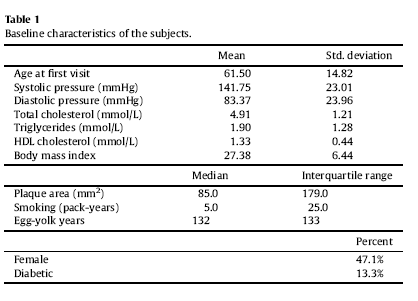
Table 1, click for larger version

Looking at Table 2, I almost fell out of my chair. From laughing. The people who ate the least eggs, <50 in "egg years", were the youngest. Their ages were 55.70 +/- 17.03 at first visit, so some of them were as young as 38.67 years. Now as the egg consumption goes up, so do the ages.  The people who ate the most eggs were much older. Their ages were 69.77 +/-11.38 at first visit. The youngest in the high consumption group was 58.39. That seems like some underhanded chicanery if you ask me!

Table 2, click for larger version

Of course the older people are going to have more instances of heart disease and thicker arteries too because of their age. They even state that in the article, that the older people have more plaque. Oh, but wait! The study says they "adjusted" for age. Why instead of poking around with numbers, actually study the same age groups? Or would that be because there wouldn't be any correlation? (Never mind causation.)

One could easily draw the conclusion that eggs have nothing to do with the thickness of the plaque, but with age. I could just as easily draw the conclusion that as you get older you eat more eggs. That's valid right? Or maybe the more eggs you eat, the older you get. Maybe if you never eat eggs you'll never get old? I'm screwed in that case!

It's interesting that they say that there were 2831 patients with data on egg yolk consumption, but only 1231 were used for various reasons. I'm sure those reasons were all good right, like not anything to do with throwing out data we didn't like, right? Right?

Also of interest, is that they found that fasting cholesterol, BMI, Triglycerides, HDL cholesterol and LDL cholesterol were not significant predictors of the thickness of plaque. Just egg yolks! 


In my humble opinion, considering that the sample was unbalanced, not random in the least and that more than half of the data they had access to was thrown out, that this amounts to someone with an agenda, with an axe to grind. Because if you really wanted to help people, and you really wanted to find out what was causing heart disease, you wouldn't have such poor research methods. However, if what you really want is to push an agenda, you won't care about data or ethics or anything else. You won't care if you kill people, so long as yours is the voice that is heard, so long as yours is the message that is received. Because diet is a religion to quite a few people out there, on all sides.

Just so you know, I'm my own experiment in this case. I eat at least three eggs almost every day. If I drop dead of heart disease, well, we won't know if it was the eggs that caused it, or my propensity for fountain diet cokes :P

Friday, June 24, 2011

Vitamin D deficiency and Type 2 Diabetes

In the early part of the 20th century, a disease called Pellagra was thought to be caused by a virus or bacteria. It was common in the lower classes, but also did show up on occasion in more wealthy people. It was thought to be a "dirty" disease, and there was a stigma attached to contracting it. One of the people who contracted Pellagra was my husband's great-great grandmother. She died at a hospital in Dallas in 1922 from the disease. However, her death, and thousands of others were completely preventable. It turned out that Pellagra was a vitamin B3 deficiency.

Now we blame obesity and type 2 diabetes solely on what people are eating, but what if the catalyst for obesity and T2D is really something else entirely? What if it's a vitamin D deficiency? I found the following article at Science Direct:

The role of vitamin D deficiency in the pathogenesis of type 2 diabetes mellitus

Vitamin D can be obtained either through dietary intake or produced endogenously. It is found in foods such as oily fish (salmon, sardines, mackerel), egg yolks and fortified milk and juice; however dietary intake only accounts for about 30% of the vitamin D obtained. The primary route via which people obtain vitamin D is through exposure to ultraviolet B (UVB) sunlight at wavelengths between 290–315 nm, occurring predominantly in the summer months (June–July) in the Northern hemisphere (latitude >= 42° N).

In other words, if you're not getting a lot of sun, you should probably be supplementing Vitamin D3. I find it interesting that the pushing of the use of sunscreen coincides with the rise of obesity and diabetes in this country. Of course that's when our sugar intake increased too. Maybe it was the perfect storm?

Sunscreen wasn't in widespread use until the 1980s. Prior to that, beach goers might put zinc oxide on their noses, but that was about it. Then with the erroneous idea that the sun causes malignant cancer, enter the sunscreen industry. Like many things, drugs, food, etc. most research about sunscreen is funded by the sunscreen industry. They're out to sell you a product. If you die in twenty years because of it, well, they've made their money.

Glucose sensors located on β-cells sense increases in blood glucose levels despite increases in insulin secretion; the persistent hyperglycemia triggers a series of events which ultimately leads to an increase in β-cell expression, β-cell mass and enhanced secretory capacity of the pancreas. This compensatory increase in insulin secretion explains why some highly insulin resistant individuals never develop T2DM. In a study which examined pancreatic tissue from obese, non-diabetic individuals, relative β-cell volume of the pancreas was 50% greater in obese individuals than in their lean, non-diabetic counterparts (2.6 ± 0.39% vs. 1.71 ± 0.28%, P = 0.05), suggesting that these obese individuals did not progress to T2DM because they were able to increase their insulin production capacity by increasing β-cell mass. Individuals with T2DM do not experience this increase in β-cell mass, in fact there is a significant decrease in β-cell mass.
So long as your body can continue to manufacture insulin to store fat, you will probably not develop Type 2 Diabetes. It is only when this system fails that T2D occurs. Some morbidly obese people do not develop diabetes and it is because they can continue to get fat. A deficiency in Vitamin D may make it difficult for your β-cells to fucntion properly. Another explanation for why some obese people may not develop diabetes is because they're not vitamin D deficient, or if they are, for some reason they require less vitamin D than others.

The identification of the 1α(OH)ase in β-cells suggests that 1,25(OH)2D3 may play a role in overall β-cell function. In vitro and in vivo studies have ascertained that 1,25(OH)2D3 is essential for insulin secretion and glucose homeostasis. VDR mutant mice show a significant decrease in insulin mRNA levels when compared to controls, suggesting that 1,25(OH)2D3 may be required for insulin synthesis.
This isn't just something they've tried in a test tube. In vivo studies show that Vitamin D3 is essential for keeping blood sugar levels normal.

Lastly, obese individuals are often vitamin D deficient due to a decrease in the bio-availability of vitamin D metabolites which may explain why obesity is a risk factor for developing T2DM, although this association is only speculative...

Vitamin D deficiency increases peripheral tissue insulin resistance in addition to decreasing insulin secretion from pancreatic β-cells.

I would argue that they've forgotten that correlation is not causation. Say it with me, correlation is not causation. Associations are also not cause. Did it occur to them that (besides eating way too much sugar and way too many processed vegetable oils) that a deficiency in Vitamin D3 may be a catalyst for obesity? Obesity and insulin resistance go hand in hand. One may cause the other, or both may be caused by something else entirely. Or it's a chain reaction. Something causes insulin resistance which in turn causes obesity. I'm voting on that last one.

Another interesting article I found that has to do with how vitamin D deficiency may lead to breast, cervical and ovarian cancer. If you're not getting enough sun, I think it's a good idea to supplement Vitamin D3. It's cheap and the pills are small and easy to swallow.